
Beneath the western slope of Wawel Hill lies a cave that almost everyone who has visited Kraków knows. The Dragon's Den (Smocza Jama) is a karst cave, that is, one carved by water in the Jurassic limestone of which the hill is made. According to legend a dragon lived in it; that story has a separate text, and here what matters is the rock itself: how it is built, who cleared it of rubble and where the route leads today. It is visited one way only: you enter from the hill grounds and leave by the Vistula, where the dragon sculpture stands.
The cave in numbers and in discrepancies
Wikipedia gives the whole cave as 276 metres long and the tourist route as 82 metres. The official website of Wawel Royal Castle, which manages the entrance, speaks of a cave 270 metres long and a route of 81 metres. It is similar with the steps: Wikipedia counts 136, the castle 135. The differences are small and probably result from different measurements, but it is a good reason to treat these figures as approximate. One thing is certain: only a small part of the system is open to visitors.
The route leads through three chambers. The largest is about 25 metres long and up to 10 metres high. According to the castle website its highest part is covered by a brick dome from 1830, which closes an opening in the ceiling. The cave entrance lies at about 205.5 m above sea level, and the difference in levels along the route is about 15 metres. In many places the walls and vault have been reinforced with brick and pillars, because the cave lies under the former defensive walls.
The cave formed in the rock of which the whole of Wawel Hill is built. The castle website states that karstification began about 12 million years ago; this is an estimate, not the date of a single event.
From tavern to tourist route
Caves within the hill had long been known, and Jan Długosz already mentioned them. The first written mention of this particular cave dates from the first half of the 16th century. In 1565 Sigismund II Augustus ordered the openings to be walled up, because for safety reasons he did not want vagrants and beggars staying in them. Soon afterwards the cave was in use again. According to Wikipedia a tavern operated in it, described in a poem by Jan Andrzej Morsztyn. The castle website links it with the 17th and 18th centuries: part of a chamber was said to serve as a storeroom and banqueting hall of a tavern standing on the bank of the Vistula, in front of the lower entrance.
At the end of the 18th century the lower entrance from the river side was walled up during fortification works. There were two openings in the ceiling, and through one of them in 1829 the historian Ambroży Grabowski got inside. The interior was full of rubble, and where the defensive walls ran above the cave, pillars were built to support them. In 1842 the Senate of the Free City of Kraków ordered the cave to be cleared of rubble and opened to the public. Here the sources diverge: Wikipedia speaks of a decision from 1842, and the castle website of the cave being opened in 1843-1846, thanks to the efforts of Grabowski.
The present form of the route was given to the cave in 1918 by Professor Adolf Szyszko-Bohusz. He used a previously dug shaft, in which he built a spiral staircase, and installed electric lighting. The visit begins near the Thieves' Tower (baszta Złodziejska), in a small brick turret that is a former well from the Austrian period. The cave was opened on 3 August 1918, and the income from tickets was meant to cover part of the cost of its renovation. The same architect directed the renovation of Wawel Castle, and on the wall by the road up the hill you can still see the stone Wawel Bricks (Cegiełki Wawelskie), commemorating the fundraising for that renovation.
Research and unknown passages
The first scientific research was carried out in 1874 by Professor Alojzy Alth. From 1966 comprehensive works were under way, among other things to secure the cave against collapse. In 1974 miners, under the supervision of scientists from the AGH University of Science and Technology, adapted it for visitors and drove a four-metre tunnel to passages that had earlier been detected by geophysical methods. Further parts were discovered by speleological surveys in 1983, 1995 and 1996.
Beyond the tunnel lies a system of small chambers and passages with a siphon in the initial part, closed to tourists. A rare crustacean, the Tatra cave shrimp (studniczek tatrzański), lives in the small pools there. The results of water studies were published in 2005: the waters are mineralised, differ in composition from typical cave waters and are heavily polluted. The origin of the water is not entirely clear. Wikipedia points to at least two sources, possibly the Vistula and groundwater from beneath the city centre.
Chromy's sculpture by the exit
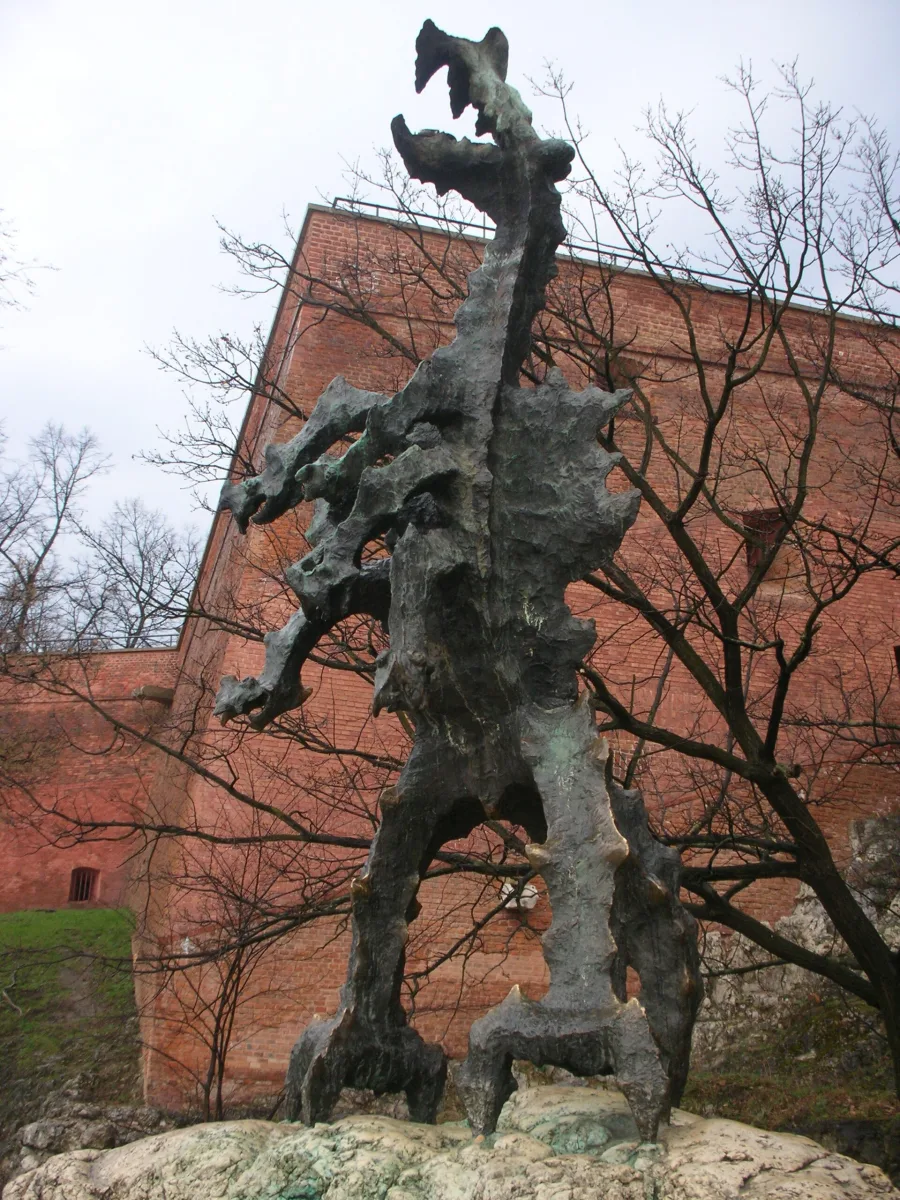
At the mouth of the cave stands a bronze dragon by Bronisław Chromy, a Kraków sculptor who also made the crucifix in the Ark of the Lord church in Nowa Huta. According to the original concept the dragon was to be partly submerged in the Vistula, but it was decided that rubbish carried by the current would settle on the sculpture. For that reason in 1972 it was placed on a block above the river, next to the cave exit. Here too there is a small discrepancy: the entry on the sculpture gives the year 1972, and the photo caption in the entry on Chromy 1970, which may mean the time of creation, not of installation.
In spring 1973 a gas installation designed by Feliks Prochownik was fitted inside the sculpture, and since then the dragon has breathed fire every three minutes. It is best seen after dark, against the dark bronze. Viewing the sculpture does not require entering the cave, because it stands on a publicly accessible bank, near the Vistula Boulevards.
How to fit it into a visit to Wawel
Entry to the cave is part of a visit to the hill, so it is easiest to combine it with the rest of the route. The cave is not accessible to wheelchair users, because you go down steep spiral stairs, and you can visit in one direction only. From the exit by the Vistula you return uphill to the hill. The Royal Gardens, the viewing terrace on the Small Tower and the archcathedral make a good set.
This cave should not be confused with the Dragon's Den in the Kościeliska Valley. That is a short Tatra cave in the Kraków Gorge (Wąwóz Kraków), with chains and ladders, and it has nothing in common with the cave beneath Wawel except the name. The hours, season and rules of entry to the cave are set by the castle, so they should be checked on its website before a visit.
Be the first! Add a comment.
You need to log in to add a comment.
Log in