
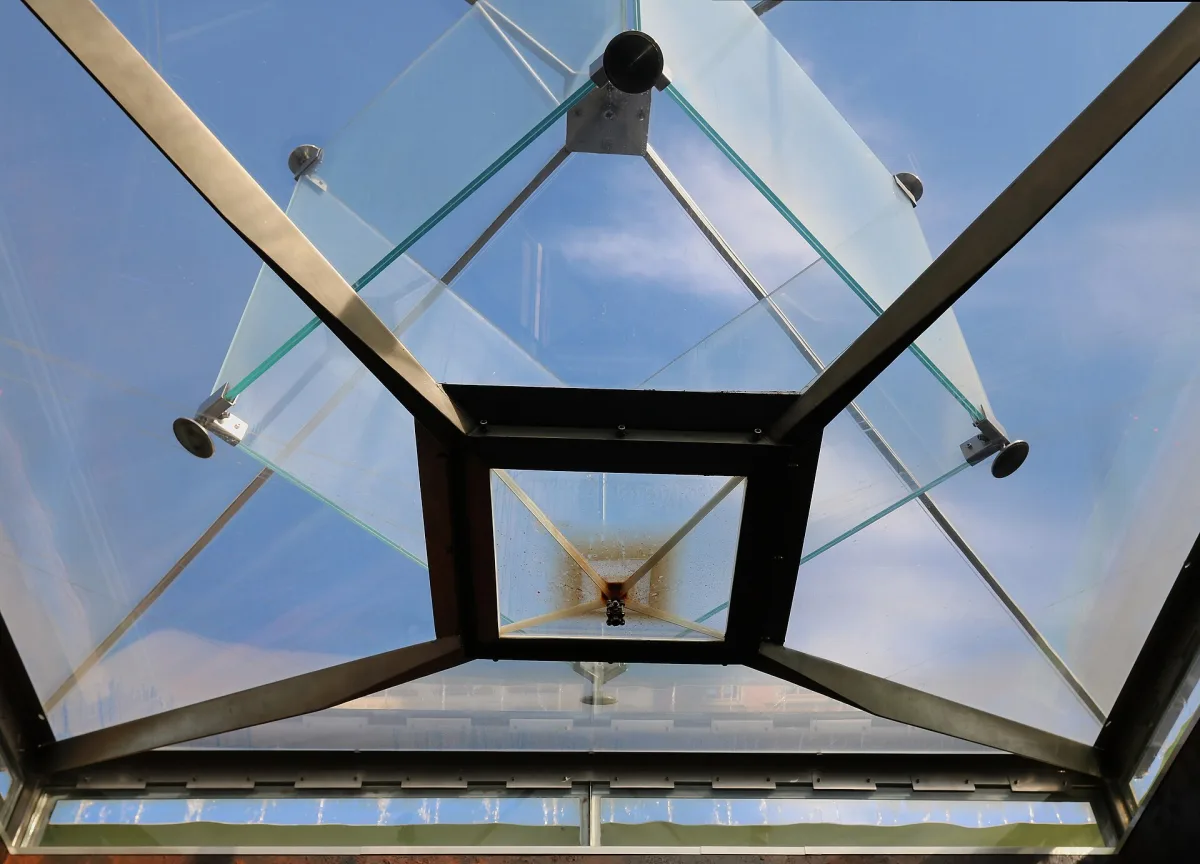
The square's surface as a lid
Since the square was laid out its level has risen in some places by more than 5 metres. What medieval residents of Kraków had underfoot therefore lies beneath the surface today. Beneath the eastern part of the Main Market Square operates a branch of the Museum of Kraków, Rynek Underground, entered from the Cloth Hall (Sukiennice). According to Wikipedia it covers more than 6,000 square metres, of which nearly 4,000 is an archaeological reserve.
The first work underground began in mid-2005, and the museum was officially opened on 24 September 2010. Wikipedia states that the opening was originally planned for 5 June 2010, but the completion of works was pushed back to 31 August. The design of the exhibition was prepared by the team of Prof. Andrzej Kadłuczka of Studio Archecon, and the concept of the exhibition by Dr Cezary Buśko. Part of the work was co-financed by the European Union from the European Regional Development Fund.
Streets, a settlement and a cemetery from before the charter
The oldest surviving roads that can be seen from the route are dated to the 11th century. According to Wikipedia, the permanent exhibition includes, among other things: former water supply systems, a crossing of roads, a pre-charter settlement, relics of a burnt settlement, the medieval paving of the Cloth Hall and a cemetery from the 11th century. This is best read as a description of what is shown to visitors, not a complete list of everything archaeologists found beneath the Market Square.
Among the traces shown is the pre-charter settlement, that is traces of habitation from before the charter of 1257. The process by which the level of the square rose over several centuries is shown by so-called archaeological witness sections, that is preserved earth profiles in which successive layers can be seen as in a cross-section.
Objects from daily life
From the exhibition Wikipedia lists 14th-century coins, ceramics, ornaments, medieval tools, 600-year-old hygiene items, clay figurines, leather shoes, dice, beads and medallions from the East, and Tatar arrowheads. Such a set documents that the Kraków Market Square had been the site of trade with distant lands for centuries.
A separate item is a block of trade lead weighing 693 kilograms, called a loaf in descriptions. Wikipedia calls it unique on a world scale; this is the encyclopaedia's assessment, not the result of a comparison with other collections, and should be read as such.
Stalls and holograms
The route leads around the Cloth Hall (Sukiennice) along glass ramps and walkways suspended above the preserved medieval roads. Market stalls have been recreated here, including Bolesław's Stalls and the Rich Stalls, as well as a reconstruction of a medieval merchant's stall and 12th-century workshops of a goldsmith and a blacksmith. Wikipedia states that the Rich Stalls, on the ulica Senna side, cover about 1,200 square metres.
The permanent exhibition is titled “Following the European Identity of Kraków”. It relies on multimedia techniques: according to Wikipedia, about six hundred models can be viewed in three dimensions on one of 37 touch screens, and there are holograms recreating the former buildings of the Market Square and a screen made of water vapour. During the visit the sounds of a market or of burning buildings can be heard.
Other undergrounds beneath the Market Square
Rynek Underground is only one of the spaces beneath the square. Beneath St Adalbert's Church archaeological research uncovered relics of an earlier, masonry church from the early 11th century, and an exhibition related to the history of the Market Square has been set up in its undercroft. Wikipedia also mentions cellars beneath the surface of the square, an underground link between the Town Hall Tower and the Cloth Hall, and a medieval hall beneath the main hall of the Cloth Hall, 100 metres long and 5 high.
What we do not settle here
This text is based on Wikipedia entries on Rynek Underground, on the Main Market Square and on St Adalbert's Church, and on the museum's website. We do not describe the course of the excavations themselves, because we have not checked this in archaeologists' publications. For this reason the title speaks of what is shown beneath the square, not of the whole history of the discoveries.
Be the first! Add a comment.
You need to log in to add a comment.
Log in