
Many Lesser Poland castles are ruins or hotels today, but a dozen or so have real museums in their chambers. This text does not repeat the history of the strongholds, because we describe that in the lists of the castles of the Jura and of the castles on the Dunajec and Poprad. The question is different: what will you actually see inside. We begin with the castles that offer the most and end with those whose interiors are modest or absent.
Wiśnicz: the chapel, the stables and sculptures in the oldest wing
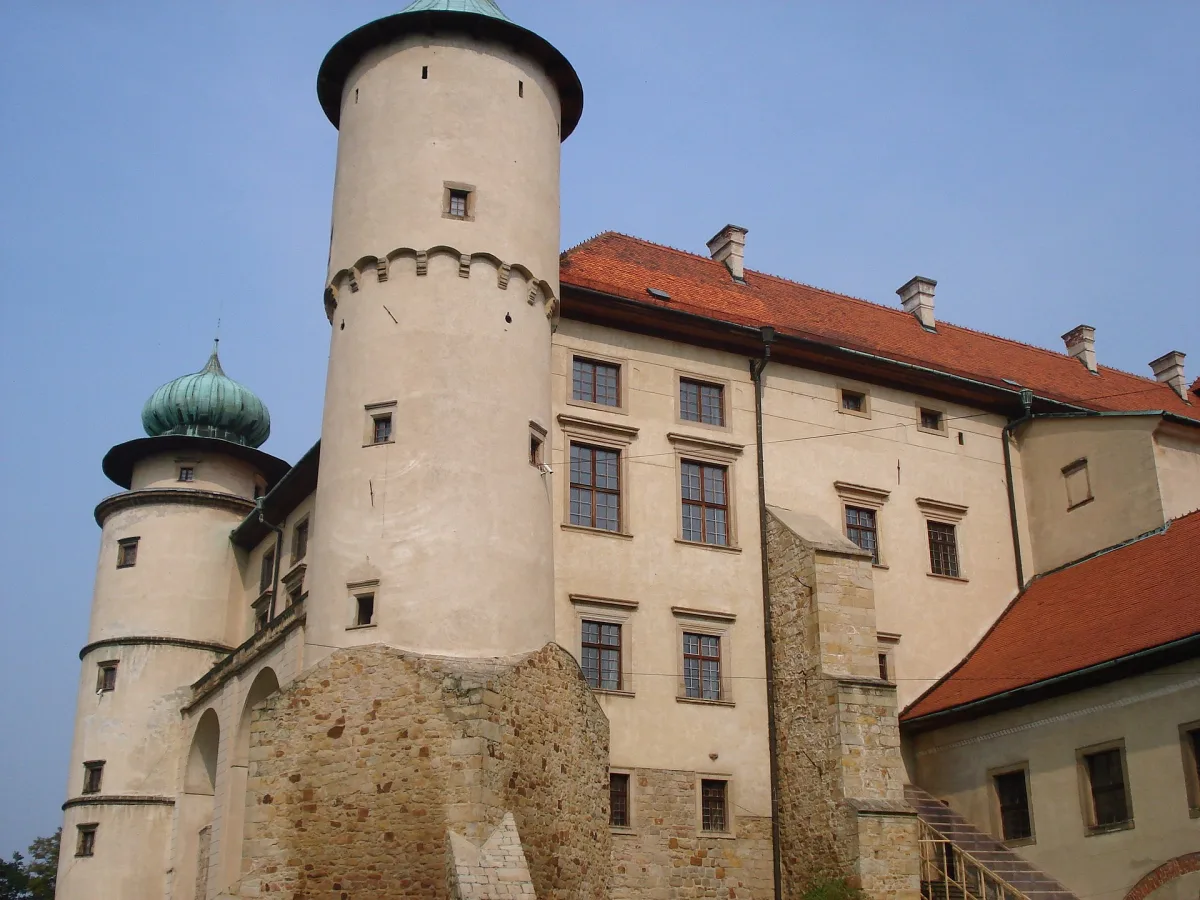
Nowy Wiśnicz Castle is an early Baroque residence of the Lubomirski family, and its website lists several separate exhibitions. It is visited with a guide, in groups.
The first route leads through the castle chapel and the Lubomirski family crypt, in which, according to the castle's entry, six sarcophagi stand. The chapel is joined by the exhibition “Pompa funebris”, devoted to the Sarmatian funeral: a 17th- and 18th-century ceremony with a catafalque under a canopy known as castrum doloris, coat-of-arms shields and a coffin portrait painted on tin.
The second route descends to the underground stables, where the exhibition “Medieval Instruments of Torture” has been arranged. It is a collection of an Italian historical association from Verona, more than fifty exhibits with illustrations and descriptions. According to the exhibition's description, the original instruments have essentially not survived, and the objects shown are reconstructions.
The third exhibition is in the Kmita Tower, the oldest part of the castle. “Póki się istni” (“While We Exist”) consists of four rooms devoted to the sculptor Czesław Dźwigaj: busts, about three hundred medals, drawings, paintings and volumes of poems. Five ceramic sculptures more than two metres high stand out, named after dynasties and eras, from the Piasts to the Reborn Poland, together with a series of nine early chroniclers in the form of ceramic tondi, from Gallus Anonymus to Maciej Stryjkowski.
The fourth is the “Collector's Cabinet”, which came into being from the gift of a private collector. It shows mainly porcelain, especially Meissen, along with figurines, 19th-century household glass, meerschaum pipes, walking sticks and women's fashion accessories. A separate building, the former Almshouse of 1641, houses the Wiśnicz Land Museum, opened in 2002. It collects documents, photographs and works by artists associated with the region, among them Klimowski, Rojek and Stasiniewicz. The castle's entry in our database suggests that the museum operates within the castle walls, but according to the castle's website it stands on the road from the castle to the market square.
Niepołomice: Polish art and a naturalist with a camera
Niepołomice Royal Castle is divided into a hotel part and a museum part. The Niepołomice Museum occupies the first floor and was established in 2001 around the archive of Włodzimierz Puchalski, a nature photographer, film-maker and traveller. Hence the castle holds an exhibition of his study and hunting rooms.
The largest exhibition, according to the museum's description, is the exhibition of 19th-century Polish art from the collections of the National Museum in Kraków: more than 130 paintings and 25 sculptures in eight rooms. The works are arranged by the genres of painting that the French Royal Academy distinguished in the 17th century, so the order runs through landscapes, genre scenes, portraits and religious and historical scenes. Among the authors are Siemiradzki, Stanisławski, Grottger, Wyczółkowski, Michałowski, Malczewski and Stanisław Witkiewicz. A considerable part of the paintings had never been shown before, hence the title “Known and Unknown”.
The permanent exhibition “Niepołomice. The Town, Time and People” tells the story of the town from the First Partition to the outbreak of the Second World War, mainly through postcards, chronicles, family photographs and documents. The museum also lists the exhibition “Treasures of the Niepołomice Parish”.
Dobczyce: a museum built by volunteers
Dobczyce Castle is a partly rebuilt ruin above the dam of the lake, and its museum is run not by the state but by PTTK (Polish Tourist and Sightseeing Society). According to the museum's website, the institution was founded in 1963 through the efforts of members of the Dobczyce branch of the society, and its patron is Władysław Kowalski, the first curator.
The interiors are divided into themed rooms. In the Historical Room lie copies of royal privileges granted to the town, and there stand a replica of a cannon known as a bombard and a model of the castle. The National Memory Room is devoted to the First and Second World Wars in the area of today's Myślenice County and shows uniforms, equipment and weapons. In the former prison dungeon a torture chamber has been arranged, with instruments, including some dug up during archaeological work, and a board with penalties for particular crimes.
The Fireplace Room houses an archaeological exhibition from the Neolithic to modern times, with stove tiles from the castle decorated with the Szreniawa coat of arms. Further on are the chapel with a painting of St Casimir Jagiellon and a well hewn in the rock, which was converted into a castle ice-house. Below the hill there is an open-air museum, with, among other things, an inn from 1830 and a funeral house with a horse-drawn hearse.
Wieliczka: the salt-works castle and a collection of salt cellars
Żupny Castle stands in Wieliczka and was the seat of the administration of the Kraków Salt Works (Żupy Krakowskie), that is, the salt mines in Wieliczka and Bochnia and the salt-boiling houses. According to the museum, in the 14th century as much as a third of royal income came from salt. The most famous item is the collection of salt cellars. The collection has been built up since 1973, numbers more than a thousand objects and is ranked by the museum among the most valuable in the world. The oldest specimens are Gothic jewels hollowed out of agates and mounted in gilded silver, and the younger ones are made of porcelain, glass, wood, bone, quartz or mother-of-pearl. The most valuable were bought at the international art fair in Maastricht.
The castle is itself an exhibit. The museum describes it as the centre of the mine's daily life: from the tower miners were summoned to work, and in the salt-works kitchen meals were served, which it calls the first workers' canteen in Poland. In 1683 an apartment was arranged here for Queen Marie Casimire, returning with her husband from the relief of Vienna. The central part of the castle was destroyed by aerial bombs in 1945 and was rebuilt after the war together with the Gothic Hall. The entry in our database gives Bochnia as the locality, but the castle is in Wieliczka, a few hundred metres from the Wieliczka Salt Mine.
Oświęcim, Dębno, Szymbark: smaller exhibitions
Oświęcim Castle has been the seat of the Castle Museum (Muzeum Zamek) since 2010. According to Wikipedia it presents four exhibitions: an archaeological one, from excavations on the castle hill and at the Wołek fortress; a religious one, with objects of Catholic and Jewish worship; an ethnographic one, with interiors of early 20th-century Catholic and Jewish homes; and a biographical one about Aleksander Orłowski, a composer and conductor, the author of the town's hejnał (bugle call). Among the religious monuments the article lists the 15th-century tombstone of Mikołaj Myszkowski. The arrangement of the exhibitions may have changed since the article was written, so check the museum's website before you travel.
Dębno Castle, a late Gothic brick building from 1470-1480, has housed an interiors museum since 1978, a branch of the museum in Tarnów. The permanent exhibition includes medieval weaponry, ceramics, furniture, religious paintings and household items, and at weekends visits are with a guide. The castle is sometimes closed for modernisation, so check the museum's website before you travel.
Szymbark Kasztel is a Renaissance fortified manor house from 1585-1590, a branch of the museum in Gorlice. It has a rectangular plan measuring 20 by 13 metres and four corner towers. The museum announces a temporary closure to visitors, so always check the notice. We have not established what exhibitions occupy its chambers today, and therefore we do not describe them.
Sucha Beskidzka: a residence and the history of a library
Sucha Beskidzka Castle is called the Little Wawel because of its arcaded courtyard. It houses the Municipal Museum, a cultural centre, a hotel and a restaurant. In 1975 the State Art Collections at Wawel opened a branch here, and the Museum of the Sucha Region operates in the Gardener's Cottage at the edge of the park. Among surviving features of the interiors are a stone fireplace from the former Marshal's Hall and a chapel in the clock tower with a faded polychrome. We have not been able to confirm exactly what the exhibition rooms show today.
The best-documented part of the castle's history is its library. Aleksander Branicki and his son Władysław bought whole collections, and according to the inventory of 1932 the book collection numbered 55 thousand volumes, including an illuminated Bible from the 13th century and 22 incunabula. During the Second World War a considerable part was destroyed, and the surviving books were scattered among Wrocław, Kraków, Warsaw and Gdańsk.
Castles with no interiors or limited ones
Several sites with “castle” in the name do not offer exhibitions. Nowy Sącz Royal Castle was almost completely destroyed in 1945, when soldiers of the Home Army blew up an ammunition depot set up there by the Germans. What remains are fragments of walls and the reconstructed Blacksmith's Tower in the park. A regional museum was opened there in 1938. The ruins of Tarnów Castle on St Martin's Hill are remains of walls and cellars, without interiors. In Zator a neo-Gothic palace on the site of the former castle is occupied by a research institution, and the interiors are opened by arrangement with the administrator, while the park is open until dusk.
Lipowiec Castle, which has its own museum and a well hewn in the rock, is described in the list of the castles of the Jura.
Be the first! Add a comment.
You need to log in to add a comment.
Log in