
Shooting at the cock: a school of town defence
The Fowler Brotherhood (Bractwo Kurkowe), also called the Shooting Society, the Confraternity of Shooters or the Shooting School, grew out of a simple need. When walls were being built around Kraków, the duty of maintaining and defending them fell on the townspeople, who in their daily lives were occupied with trade and crafts, not the art of war. They had to be trained regularly, so the town set up a paramilitary organisation to which members of the guilds belonged. The Polish name comes from the aim of the exercises: shooting at a wooden cock (kur).
When this began is not known. The website of the Kraków brotherhood stresses that no known document recorded the moment of its founding, and that its activity probably began at the earliest at the end of the 13th or the beginning of the 14th century, when the town already had the beginnings of fortifications. Wikipedia assumes that the organisation was founded in the 14th century, but the first source mentions come only from the 15th century, and the earliest is in Jan Długosz, who already writes of the cock as a target. All that is certain, then, is that the brotherhood existed in the 15th century, and there is no exact founding date.
The weapons changed: first bows, then crossbows, and from the end of the 16th century firearms. Crossbowmen are shown in a miniature in the Behem Codex of 1505. The aim has remained the same to this day.
The ordinance, the statute and the silver cock
A particular flowering came in the time of Sigismund Augustus. In 1562 the town council gave the brotherhood an ordinance which regulated the shooting contests. According to Wikipedia, shooting was to take place several dozen times a year, and the most important contest was held a week after the octave of Corpus Christi, when the members shot at the cock for the title of Cock King (król kurkowy). The prize included exemption from municipal taxes. Two years later the brotherhood received a statute.
In 1565 the Town Council gave the brotherhood a silver cock, which became its symbol. Legend links this gift with King Sigismund Augustus, but the brotherhood's website notes that this is only a legend and that the donor was the town council. Entries in the council's books from 1541 mention an earlier honorary emblem, so the silver cock had predecessors. It has the form of a heraldic eagle with a crown on its head, is 42 centimetres high, and on the base are engraved the year 1565 and the names of eight Kraków councillors and patricians, the then elders of the brotherhood. According to the brotherhood's website, it is the largest and most magnificent emblem of this kind in the world. This is the brotherhood's own assessment, not an independent comparison.
The original went into the collections of the Historical Museum of the City of Kraków, today the Museum of Kraków. At ceremonies a faithful copy is used, made in 1964-1965 by the sculptor and chaser Wiesław Łabędzki. At the enthronement the outgoing king wears this copy on a chain around his neck.
In earlier times the Cock King had real benefits. According to Wikipedia, in 1593 Sigismund III Vasa exempted the Kraków Cock Kings from customs duties on goods brought into the Commonwealth, and in 1635 Władysław IV Vasa exempted them from all taxes for the duration of their reign. The first king known by name was the passementerie maker Tomasz, mentioned in 1578, without a surname.
Interruptions, a fire and the return in the 19th century
The first Celestat, that is the place for shooting exercises, lay on the eastern edge of the town, beyond St Nicholas' Gate (Brama Mikołajska). In the 16th century it was moved to the space between the walls next to this gate. The name comes from the German word Zielstätte. The building was destroyed by a fire on 14 August 1794, started, according to Wikipedia, by Prussian soldiers after the fall of the Kościuszko Uprising. The last Cock King of the First Republic was Stanisław Piątkowski, elected in 1793. After the Partitions the brotherhood existed only formally, and the last entry in the minute book dates from 1807.
The organisation was not forgotten. After the creation of the Free City of Kraków, on 19 July 1831 the brotherhood was officially revived, at first as the charitable Society of Shooting Amateurs, and the Łobzów palace became its temporary seat. In 1832 a statute was approved under the name Kraków Shooting Society, and on 1 May 1834 the first Cock King in decades was elected. The old mementoes, including the silver cock, were preserved and handed to the Society by its elder Wojciech Bartynowski, who had earlier taken them out to Hungary.
The Celestat on Lubicz Street
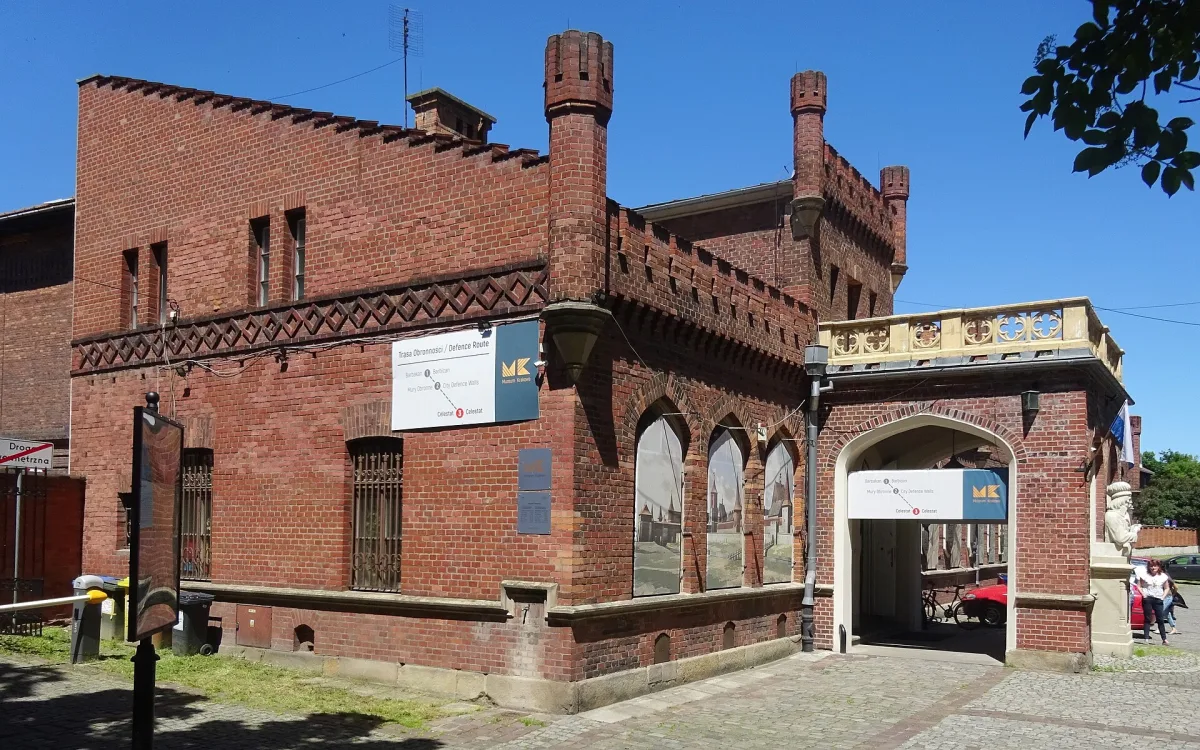
In 1837 the Society bought a garden in the Wesoła suburb and within a few months built a neo-Gothic villa there to a design by Tomasz Majewski and Franciszek Maria Lanci. Wikipedia writes that it was the first building in Kraków in the English Gothic Revival style. Today this villa at Lubicz 16 is called the Celestat, and the garden surrounding it is the Shooters' Park (Park Strzelecki). The brothers opened it to all the inhabitants of Kraków, a restaurant operated in the garden, and concerts were organised in summer. Portraits of successive Cock Kings began to be hung in the building, a tradition that continues to this day. The brotherhood hosted Emperor Franz Joseph I there in 1851 and 1880.
In the 20th century the Celestat and the brotherhood shared a difficult fate. During the First World War the premises were occupied by the army, and after the war the building was rented for several years to the YMCA. The outbreak of the Second World War interrupted its activity, and according to Wikipedia the Society was formally dissolved in 1940 by a decree of the Governor-General Hans Frank. After the war the brothers resumed their activity, but on 28 June 1951 the Voivodeship National Council ordered the Society's liquidation. The mementoes were handed to the Historical Museum of the City of Kraków.
The revival came on 10 June 1957, when the Society was entered in the register of associations. Wikipedia links this with the thaw and the celebrations of the 700th anniversary of Kraków's foundation charter. The properties were recovered only in 1991. After renovation the Celestat is leased by the Museum of Kraków, which on 21 June 1997 opened a permanent exhibition on the history of the brotherhood there.
The Cock King and the June procession
The king is whoever brings down the last fragment of the wooden cock. In earlier centuries the bird stood at the top of a pole, later on a wooden target. A keen eye and a little luck decide, as Kraków Travel puts it. The winners of second and third place become marshals, and power is symbolised by insignia, including ornamental marshals' staffs and silver chains.
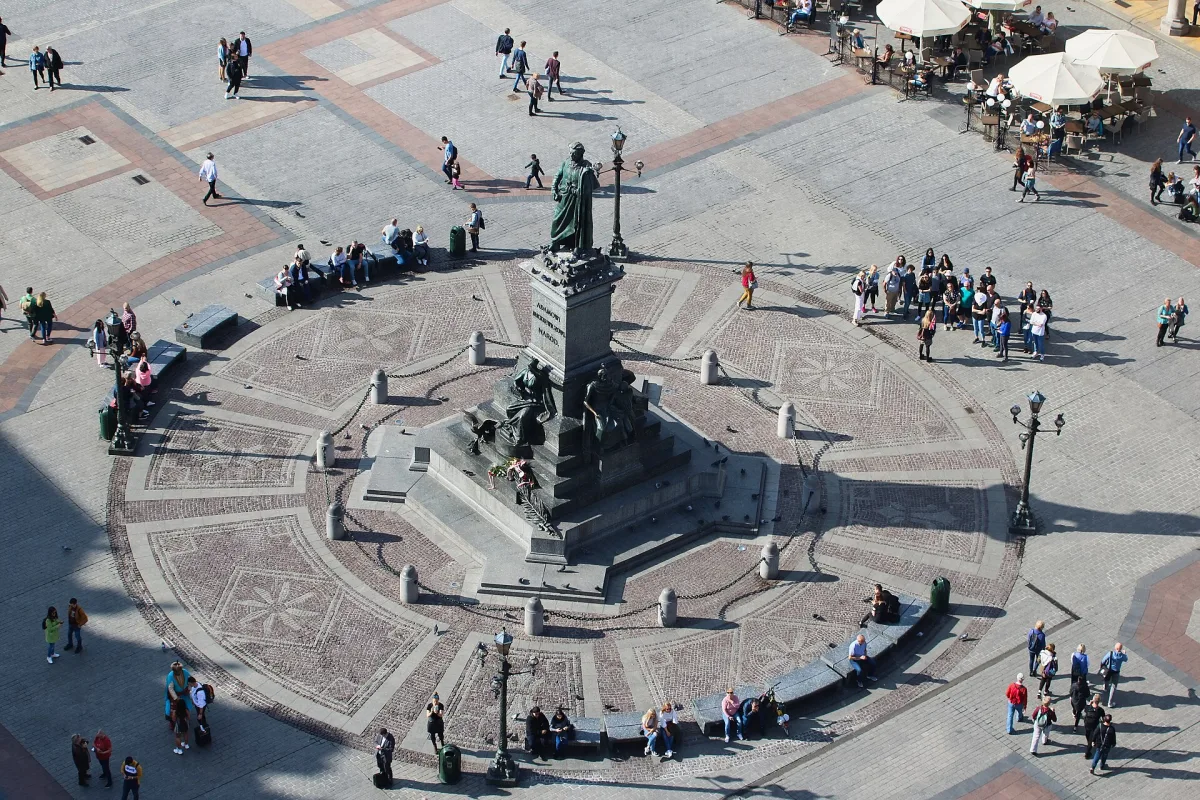
The formal enthronement takes place in June, with no fixed date. The procession sets out from the Celestat to the Main Market Square, and the brothers walk in Sarmatian żupan coats and kontusz robes modelled on noble dress of the 17th and 18th centuries. Wikipedia adds that the march also leads to St Mary's Basilica. The actual handing over of the insignia takes place on a platform in front of the Town Hall Tower on the Main Market Square. The easiest way to see the brotherhood in action is therefore in June, and in the other months the exhibition at the Celestat.
Honorary brothers
Only men belong to the brotherhood, mainly residents of Kraków. The rank of honorary brother was conferred on distinguished figures. In 1910, the year of the unveiling of the Grunwald Monument funded by Ignacy Paderewski, the brothers passed a resolution appointing the artist an honorary member. The brotherhood's website also lists John Paul II among its honorary brothers, as well as several presidents.
Be the first! Add a comment.
You need to log in to add a comment.
Log in