
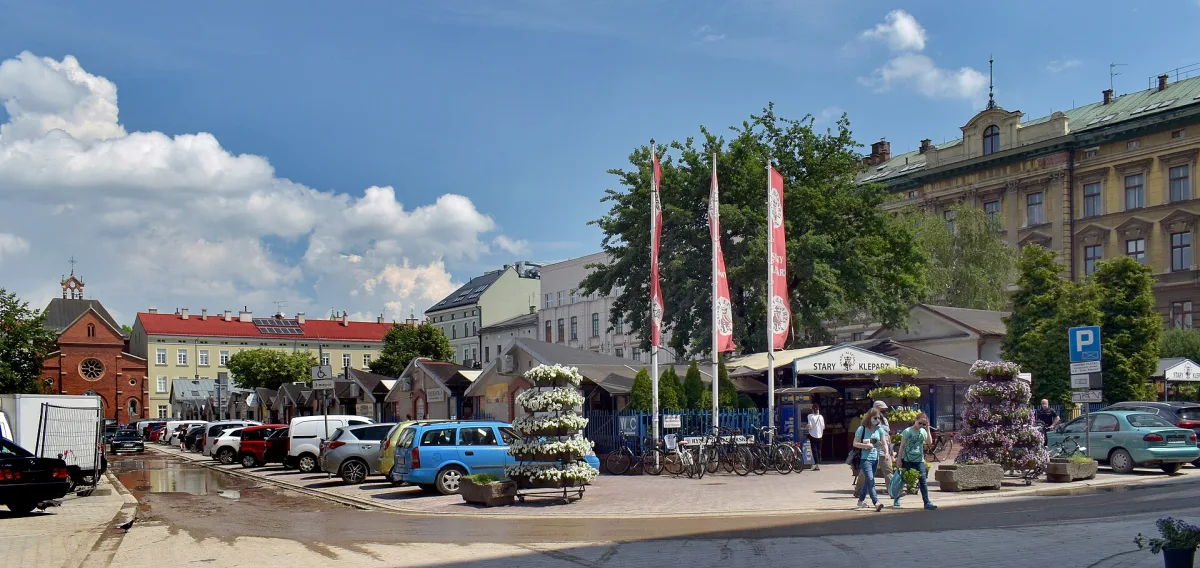
Stary Kleparz: a market older than the union with Kraków
Stary Kleparz is the western part of the former market square of Kleparz, a separate town north of the Old Town. According to Wikipedia, Casimir the Great granted it a charter under Magdeburg law in 1366, and the square was probably laid out at that time. It was much larger than it is today and came close to the Main Market Square in size, also taking in the area of today's plac Matejki. It had a Kleparz town hall, demolished in 1803. The square was divided into parts: the eastern one held a horse market, the western one a grain market.
The weekly Kleparz markets dealt mainly in grain and farm produce, and also in cattle, which spared Kraków's main square the inconveniences that came with it. The character of the town was determined by the number of inns and coaching houses: according to a register of 1632, Kleparz had stables for 2,380 horses. The origin of the name has not been settled. Wikipedia says it may be linked to clinching (“uklepywanie”) deals at the market, while others connect it with the staves (“klepki”) from which coopers made barrels.
Kleparz burned down several times: the source lists fires in 1476, 1528 and 1755. It was incorporated into Kraków in 1792 and finally lost its town rights in 1794. After the incorporation the square was partly built over, and in 1880 its western part was officially named Rynek Kleparski and kept its character as a market square.
Mały Rynek: the butchers' market by the Main Market Square
Trade was not limited to the suburbs. According to the Historic Kraków Culinary Trail, Mały Rynek served as an auxiliary market for the Main Market Square from the Middle Ages. In time it specialised in the sale of meat and fish, and in the 18th century it gained the name of the Butchers' Market (Rynek Rzeźniczy). Around the municipal butchers' stalls centred the life of one of Kraków's oldest guilds, the butchers.
Plac Nowy: from Libuszhof to the Okrąglak
Until the 19th century the area of today's Plac Nowy in Kazimierz was occupied by the so-called Libuszhof, a cluster of lanes and buildings. The present shape of the square was set out in regulation plans of 1808 and 1844. It used to be called plac Kupa, and since the end of the 20th century it has popularly been known as the Jewish Square.
In the middle of the square stands the Okrąglak, a market pavilion built in 1900 on a twelve-sided plan: an inner hall surrounded by a ring of stalls. In 1927 it was leased to the Jewish Community, which set up a ritual poultry slaughterhouse there. After the war the Okrąglak again served as a market hall, although for a number of years most of the small shops were used only as storerooms by traders selling at the stalls outside. In 2008 the building was entered in the heritage register. The square also works as a market selling vegetables and antiques, and the surrounding area hosts festivals and events.
The Market Hall: the larder of the city centre from the 1930s
In the second half of the 1920s the City Council decided to move food trade from municipal stalls and butchers' stands into buildings that met sanitary requirements. In 1928 architects of the Municipal Building Office travelled to Czechoslovakia and Germany to see halls there. Three were planned: one by Rynek Kleparski, one in Podgórze and the largest in Grzegórzki, at the junction of ulica Grzegórzecka and aleja Daszyńskiego, where trade had already taken place. It was meant to be the “larder” of the city centre, Kazimierz, Półwsie Zwierzynieckie and Zwierzyniec.
Only this one was built. Juliusz Dumnicki's first plans were drawn up in 1936, construction began in 1937, and it was completed by the Germans: the hall opened on 17 August 1940. It had 36 stalls. In the 1990s the interior was divided by a ceiling to create an additional storey, and in 2024 the complex of buildings was entered in the heritage register.
Squares outside the centre
The city's list of market squares also includes Nowy Kleparz, plac Na Stawach and plac Imbramowski. Plac Na Stawach in Półwsie Zwierzynieckie took its name from the fish ponds of the Norbertine nuns of Zwierzyniec, filled in during the 19th century; the name was given in 1912. According to Wikipedia, the square lies on the route of the Lajkonik procession, which visits the traders there and collects a “tribute” from them.
Wikipedia describes plac Imbramowski in Prądnik Biały as the largest market in Kraków. It began as an unorganised place by an old village road, where farmers came with their carts. After the market on ulica Kamienna was closed in the 1950s, trade moved to the corner of ulica Opolska and ulica Grażyny, and from the 1950s to the 1970s an unofficial car market was also held there.
Be the first! Add a comment.
You need to log in to add a comment.
Log in