
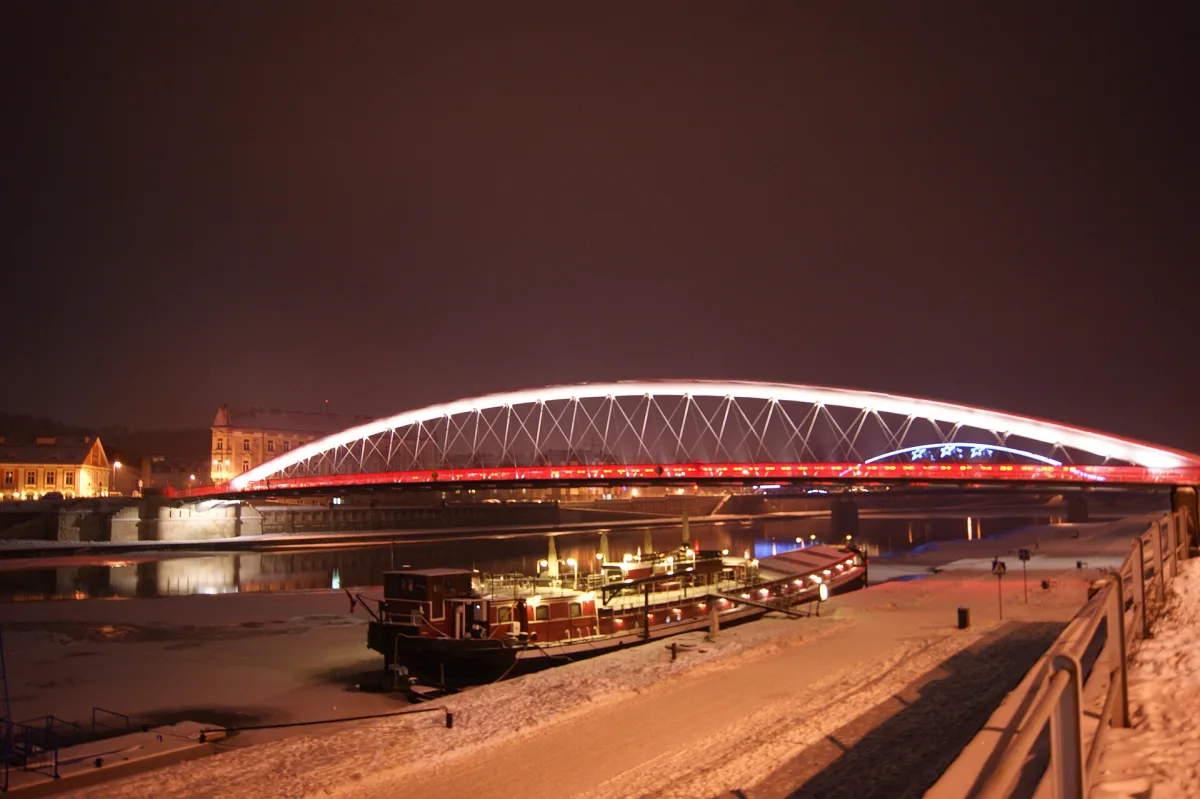
A walk from Kazimierz to Podgórze today begins on a steel footbridge and ends in Zabłocie, a former factory district where museums now stand. The route is short, and it tells of a river that for centuries divided two towns, of industry, and of how a post-industrial area found a new use.
A footbridge on the site of an old bridge
Father Bernatek Footbridge connects the area around Wolnica Square in Kazimierz with Podgórze Market Square across the Vistula. It stands on the site of the former Podgórze Bridge. According to Wikipedia, the first bridge was built here in 1335, after the founding charter of Kazimierz, and in modern times the crossing was served by wooden and floating structures. A bridge with a wooden structure on stone piers was built in 1844-1850 to a design by Tomasz Kutschera. In 1901 the first electric tram line in Kraków was extended to it. It was dismantled in 1925.
The brick abutments on both banks survived from that bridge, and today's structure rests on them. The abutments are one of the sites on the Kraków Technology Trail, created in 2006.
The footbridge was built in 2009-2010 and opened on 30 September 2010. The design was made by the studio of Prof. Andrzej Getter. The structure consists of a steel arch 145 metres long, from which two decks are suspended, one for pedestrians and one for cyclists, each about 130 metres long. The whole weighs more than 700 tonnes. On the decks hang balancing sculptures from the series “Between Heaven and Earth” by Jerzy Kędziora. For its design the footbridge received first place in 2011 in the Maksymilian Wolff bridge competition, in the category of pedestrian footbridges.
The name was given to the footbridge by the Kraków City Council. Its patron is Fr Laetus Bernatek, a monk who at the turn of the 19th and 20th centuries brought about the construction of the buildings of the Brothers Hospitallers' hospital in Kraków. Wikipedia notes that the name was chosen against the wishes of some residents and district councillors, who had proposed the name Podgórze Footbridge or Karol Footbridge. Some people in Kraków also criticised the investment itself, pointing to two nearby bridges with adequate pavements.
Podgórze on the other side of the river
Podgórze was a separate town until 1915. It received its town charter on 26 February 1784 and was incorporated into Kraków in 1915. Its centre is the triangular Podgórze Market Square from 1785, beside which stands the neo-Gothic St Joseph's Church from 1905-1909. The history of the former town is shown by the Podgórze Museum, a branch of the Museum of Kraków.
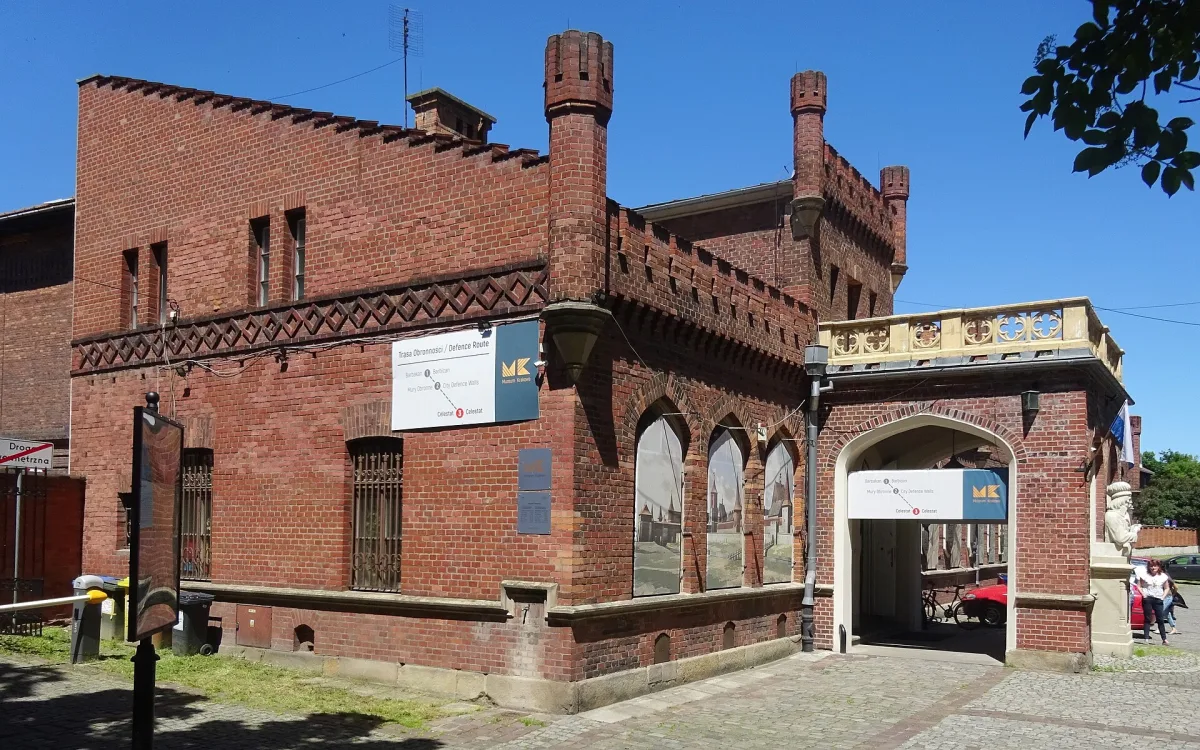
From the Kazimierz side, it is pleasant to combine crossing the footbridge with a walk along the river. The Vistula Boulevards, built in the first decade of the 20th century, are today a place for walks and cycling, and the Vistula Cycle Route runs along them. If you start from the Kazimierz side, the Museum of Engineering and Technology lies on the way, in a former tram depot on św. Wawrzyńca Street.
Zabłocie: from salt port to museum district
The name Zabłocie means an area lying behind the mud, and it appears in sources in 1334. In the Middle Ages there was a port here on the Vistula, through which salt from Wieliczka passed. The district developed fastest at the turn of the 19th and 20th centuries, when the railway was routed through it, railway works were built, and then factories: a soap factory, vodka and match factories and many others. After 1989 many state enterprises were closed and the area fell into decline. Its regeneration has been under way since the late 1990s, and Wikipedia notes that the footbridge contributed to a revival of tourist traffic in Zabłocie.
On the site of the former railway station, Stacja Wisła Park was created, with a wildflower meadow, a stage and an urban farm. The former Podgórze power station, joined to a new building, houses Cricoteka, the documentation centre of the art of Tadeusz Kantor. Its premises on Nadwiślańska Street received the SARP Award of the Year in 2014.
At Lipowa 4 two museums stand on the grounds of a single former factory. The MOCAK Museum of Contemporary Art, opened in 2011, occupies a new building and six converted former production buildings. Next to it is Oskar Schindler's Enamel Factory, a branch of the Museum of Kraków.
The factory on Lipowa Street as a museum of occupied Kraków
The plant was founded as the Factory of Enamelled Vessels and Tin Products “Rekord”. Here the sources differ on the date: the Wikipedia entry on the factory itself and the museum's data give 1937, while Wikipedia in the entry on Zabłocie lists the factory among the plants of 1930. In November 1939 Oskar Schindler took over as trustee and renamed the plant Deutsche Emailwarenfabrik. In 1944 about 1,100 people worked there, among them a growing number of Jews. According to Wikipedia, thanks to the list drawn up by Schindler and his accountant of people transferred to the factory in Brünnlitz, more than 1,100 people were saved.
Today the administration building houses the permanent exhibition “Kraków - Time of Occupation 1939-1945”, opened in June 2010. It is not a museum of one person, but an account of the fate of the city and its inhabitants during the German occupation, and Schindler's story is part of it. The exhibition touches on the persecution of the Jewish population, so it is worth planning the time and frame of mind for the visit in advance. The ghetto in Podgórze, Ghetto Heroes Square and the camp in Płaszów require a separate, factual description, which is why in this walk they are only mentioned.
Be the first! Add a comment.
You need to log in to add a comment.
Log in