
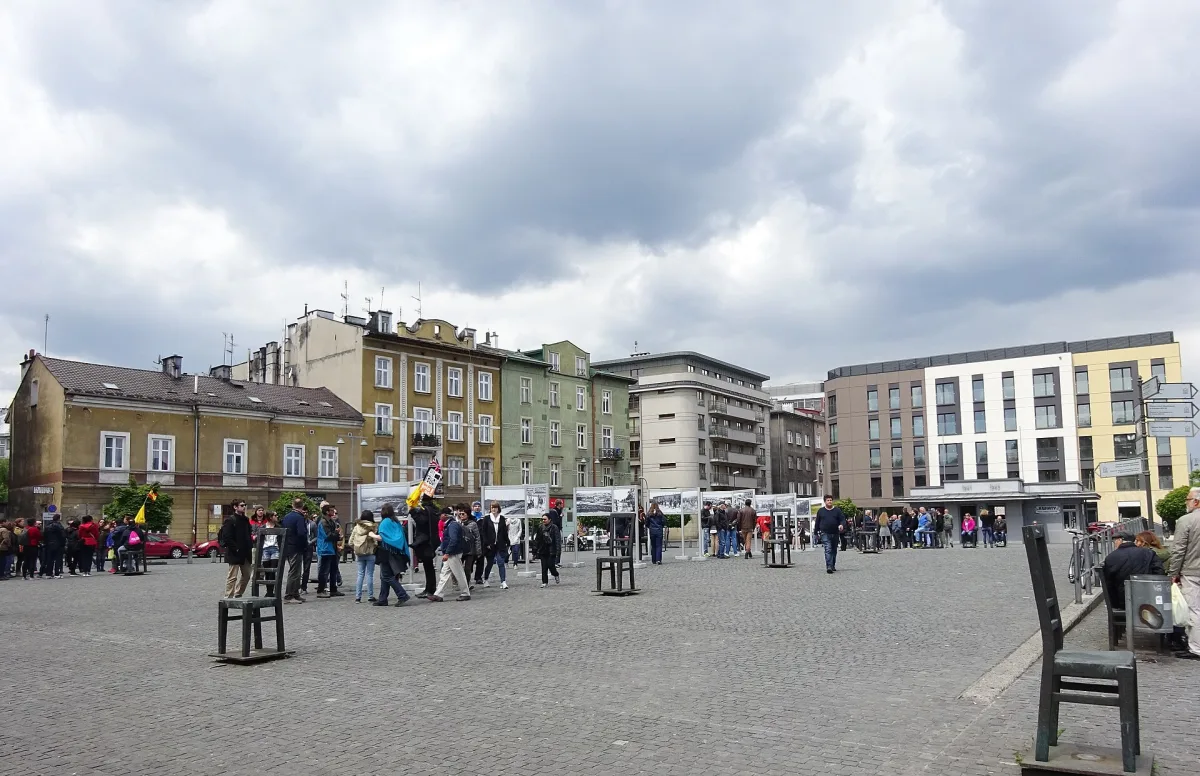
The pharmacy on Plac Zgody
The Eagle Pharmacy (Apteka Pod Orłem) stood on Plac Zgody in Podgórze, today Plac Bohaterów Getta 18. When the Germans created a closed district for the Jewish population in Podgórze in March 1941, the pharmacy fell within its boundaries. It was run by Tadeusz Pankiewicz, a pharmacist who had worked in the family pharmacy since 1930 and had managed it since 1934.
According to Pankiewicz's biography on Wikipedia, based on his memoirs and the literature, the German authorities agreed to let the pharmacy operate in the ghetto on certain conditions, including employing only staff regarded as "Aryan". The Museum of Kraków, on the other hand, states that during the ghetto the pharmacy was a place of meeting and refuge for its inhabitants.
Pankiewicz and his co-workers
Irena Droździkowska, Aurelia Danek-Czortowa and Helena Krywaniuk worked in the pharmacy with Pankiewicz in 1941-1943. The Museum of Kraków writes that the whole staff of the pharmacy witnessed the destruction of the centuries-old history of Kraków's Jews. The merit of Pankiewicz and his co-workers, according to the museum, is that they did not remain indifferent to suffering, helped those in need and after the war bore witness to the events in the ghetto.
According to Pankiewicz's biography on Wikipedia, he was awarded the medal of Righteous Among the Nations in 1983.
Memoirs: The Pharmacy in the Kraków Ghetto
Pankiewicz described his experiences of the occupation years in the book "Apteka w getcie krakowskim" (The Pharmacy in the Kraków Ghetto), first published just after the war. According to the Museum of Kraków, it is the basis of the script of the current exhibition. The authors of the exhibition also drew on accounts from the archives of the Jewish Historical Institute, on the collections of Yad Vashem and on other memoirs, diaries and recordings from the period.
In his book Pankiewicz described everyday life in the ghetto, the deportation actions and the liquidation of the ghetto in March 1943. It is the account of a person who for two years lived in the centre of the closed district. In the history of the ghetto itself, the pharmacy therefore appears both as a place and as a source of knowledge about the people who lived there.
The pharmacy as a museum
Today the former pharmacy is a branch of the Museum of Kraków and part of the museum's Memory Trail 1939-1956 (Trasa Pamięci). The exhibition "Tadeusz Pankiewicz's Pharmacy in the Kraków Ghetto" occupies all the rooms and consists of six parts. Each refers to the former function of the room: the dispensing room presents the history of the place and its people, the prescription room tells of ways of surviving in the ghetto, the duty room shows the figure of Pankiewicz as a witness and chronicler of the Holocaust, the storeroom recalls the role of the pharmacy as a place of meeting and refuge, and the laboratory speaks of the post-war memory and forgetting of Kraków's Jews.
After the pharmacy was closed in the 1960s, its furnishings were destroyed. According to the museum, the furniture, equipment and vessels were reconstructed on the basis of documentation and witness accounts, and alongside them original objects from the period are shown, together with a few items found from the Pankiewicz family's former pharmacy. Information on visiting is provided by the Museum of Kraków.
In front of the pharmacy stands a monument made of empty chairs, and the history of the whole district is described in the entry on the Kraków ghetto.
Be the first! Add a comment.
You need to log in to add a comment.
Log in