
In occupied Kraków the Germans carried out mass executions on the outskirts of the city, beside railway tracks, beneath a cemetery wall and on the grounds of a camp. After the war monuments were erected at several of these sites. This text describes eight of them: when each was unveiled, what event it commemorates and what the sources say about the victims. The numbers and names come from Wikipedia entries on the individual monuments, which are based, among others, on a 1988 guide to commemorated places of struggle and martyrdom and on studies by the Foundation Centre for Documentation of the Struggle for Independence. Where there is only one source, this is stated plainly.
The first executions and repressions in 1939-1943
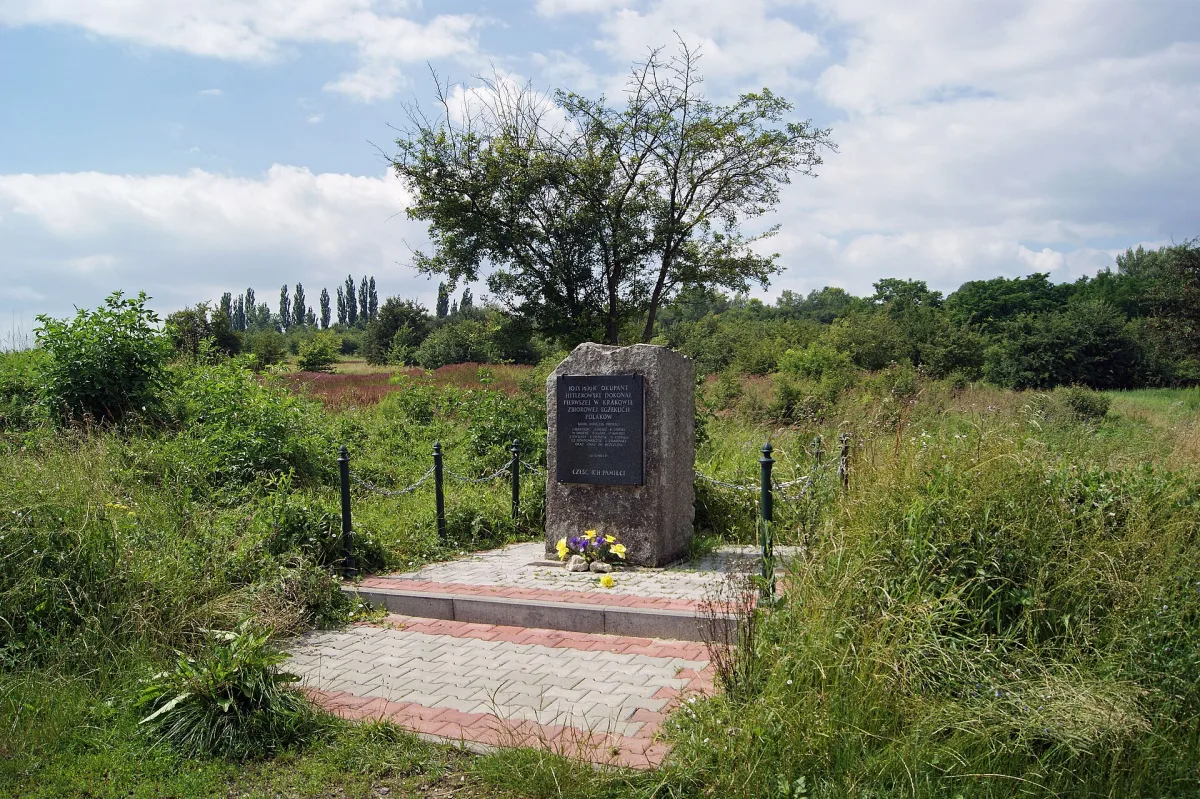
The Martyrdom Monument on ulica Abrahama in Podgórze stands beneath the wall of the Jewish cemetery. The Wehrmacht occupied Kraków on 6 September 1939. Four days later, on 10 September, 13 residents of Kraków were shot at this spot. According to Wikipedia, eleven are known by name and two remain unknown. The granite block with a black plaque was unveiled in 1984, and its inscription describes the event as the first mass shooting of Poles in Kraków.
The obelisk on ulica Wodna, next to Kraków Płaszów station, commemorates the execution of 26 June 1942. According to the entry on the Martyrdom Monument to the Hanged, the Germans hanged seven Poles in reprisal for the derailing of a military train at the station there. The entry does not give the names of those executed. A photograph of the execution is included in Tadeusz Wroński's book “Kronika okupowanego Krakowa”.
The granite stone on ulica Grottgera in the former Łobzów is the monument to Those Shot on 20 October 1943. Twenty people were shot, hostages, as the source puts it, as part of German reprisals. The identities of only two of them have been established: Tadeusz Fornal and Tomasz Marszałek. The monument was unveiled on 4 August 1946, less than three years after the execution.
Executions in the northern districts, November 1943 and January 1944
In Krzesławice, on ulica Wańkowicza, stands the Monument to Those Shot. Wikipedia describes two events from November 1943. On 10 November German railway guards travelling on a train on the Kocmyrzów - Kraków line fired from the carriage windows and fatally shot a woman resident. On 13 November SS men brought ten adults by lorry and shot them at this spot. This information comes from a single entry, whose bibliography is a press article about Krzesławice. In the nearby fort stands a separate monument to those murdered in Krzesławice in 1939-1941.
On the Na Wzgórzach estate, on ulica Kocmyrzowska, is the Martyrdom Monument in Grębałów. According to Wikipedia, on 29 January 1944 the Germans shot 80 Poles here. It was an execution of hostages in reprisal for a partisan attack on two trains running between Kraków and Miechów and the killing of two railway guards. The names of the victims are not known, and the bodies were buried in an unknown place. The remains left at the site were collected and buried by the keeper of the Grębałów fort, Antoni Grzesiak, who fenced the place, raised a mound and set up a cross. The monument was unveiled on 29 January 1963 on the initiative of the ZBoWiD branch at the Lenin Steelworks. The sandstone sculpture shows a female figure in a gesture of despair; it was designed by Jadwiga Horodyska, M. Grodzicki and Z. Trzebiatowski. The figure of 80 comes from one source.
Scouts from Podgórze
By St Joseph's Church in Podgórze stands an obelisk from 1998, the subject of the entry Monument to the Memory of the Scouts of the “Alicja” Platoon. The platoon was the Podgórze unit of the Assault Groups, operating from the spring of 1943. According to Wikipedia, in July 1943 it numbered about fifty boys and twelve girls aged roughly 17-20, the youngest being 15. The first arrests took place in August and September 1943, and by April 1944 most of the members had been arrested. Some were shot in public executions, some were tortured to death in the prison on ulica Montelupich or at the Gestapo headquarters at ulica Pomorska 2, and others were deported to concentration camps. The entry names only two survivors: Janina Potoczek and Stanisław Pławecki.
Montelupich: the police prison
Many victims of executions in Kraków and its surroundings had earlier been taken to the prison at ulica Montelupich 7, built by the Austrians as a garrison prison. According to Wikipedia, in 1940-1944 it housed a German police prison under the Gestapo, in which about 50,000 people were held. Among them were professors of the Jagiellonian University arrested in Sonderaktion Krakau. After interrogation most prisoners were deported to the Auschwitz-Birkenau and Plaszow camps. Executions were carried out on the prison grounds, and some of the prisoners were shot in the vicinity of the city, among other places in Podłęże and in Fort Krzesławice. The same entry states that on 2 February 1944 in Podłęże 100 Poles taken from Montelupich were shot in reprisal for the failed attempt on Hans Frank. The figures on the prison come from one source. After the war the building served successive authorities as a prison, and today it is a remand centre.
Płaszów and Stalag 369
The Monument to the Victims of Fascism from 1964, designed by Witold Cęckiewicz, stands on the rampart of the former Austro-Hungarian redoubt FS-22 on the edge of the site of the former KL Plaszow camp. According to Wikipedia, mass executions were carried out at the camp's outer fence, on this redoubt. The sculpture in Pińczów limestone was made by Ryszard Szczypiński: five figures in a row beneath a stone block. The inscription on the rear speaks of a tribute to the martyrs murdered in 1943-1945. Beside it stand three separate plaques: one for Jewish women from Hungary held in the camp before deportation to Auschwitz (2000), one for Jews from Poland and Hungary murdered in Plaszow, funded by the Kraków Jewish community, and one dated 13 November 2012 for soldiers of the Home Army serving in the “navy-blue” police, shot in the camp.
The Stalag 369 Monument on ulica Żywiecka in Dębniki does not commemorate executions but a German prisoner-of-war camp for French, Belgian and Dutch soldiers. It stands on the site of the former camp gate. The granite boulder with a plaque in Polish, French and Dutch was unveiled on 3 August 1966; the initiator was Jan Harasymowicz and the design was made by Wiktor Zin.
Be the first! Add a comment.
You need to log in to add a comment.
Log in