
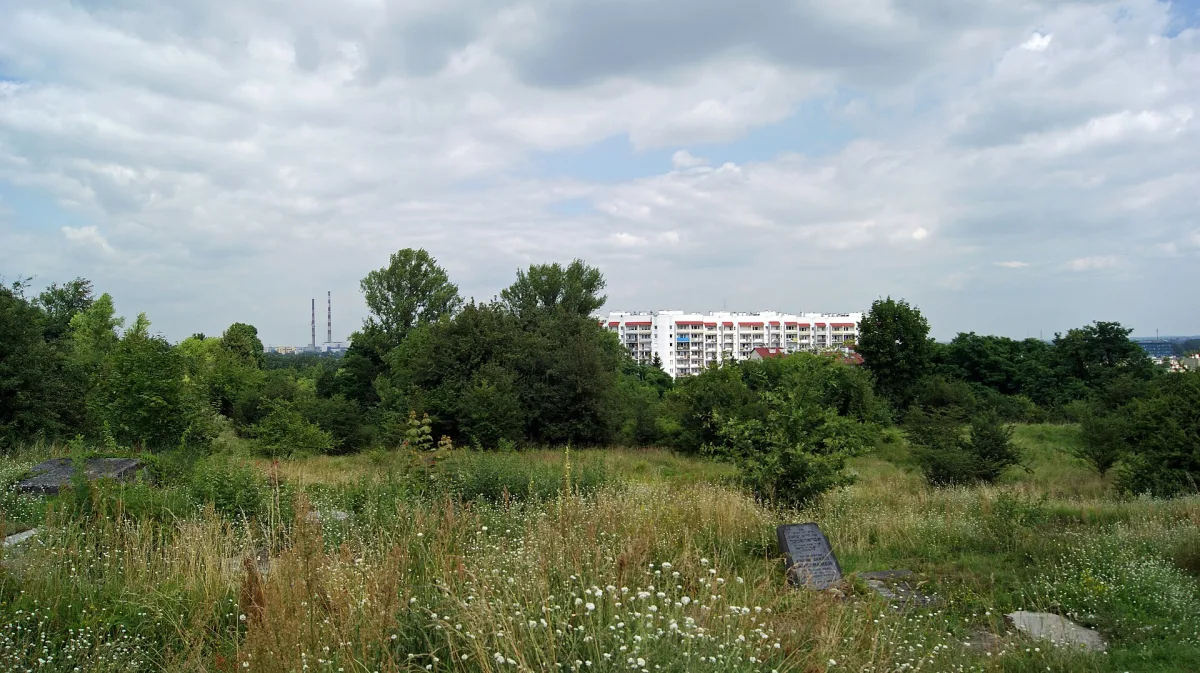
KL Plaszow was a German Nazi camp in Kraków, established in the autumn of 1942 in Podgórze and Wola Duchacka. It began as a forced labour camp, from January 1944 it was a concentration camp, and the last prisoners left it in January 1945. Today its grounds are a place of remembrance under the care of the KL Plaszow Museum. This text describes the history of the camp, while the post-war fate of the perpetrators and the work of the museum are covered in a separate article.
The founding of the camp on the site of the cemeteries
According to the Institute of National Remembrance (IPN), the labour camp, in German Zwangsarbeitslager Plaszow, was established in October 1942 on the order of Julian Scherner, the SS and Police Leader in Kraków. The KL Plaszow Museum gives the same timeframe: founding in the autumn of 1942. The Jewish Historical Institute, in one of its articles, writes of the camp being founded in December 1942, so popular literature may give different start dates. This discrepancy concerns the first weeks of construction, not the year itself.
The camp was built on two Jewish cemeteries. The KL Plaszow Museum states that before the war the site held the cemetery of the Podgórze community, founded in 1887, and the cemetery of the Kraków community, in use from 1932, together with funeral and administrative buildings. There were also two redoubts and powder magazines of the Austrian Kraków Fortress from the 19th century, and a sanatorium of the Society for the Protection of Health for children at risk of tuberculosis. Prisoners dismantled and levelled the cemeteries on which the camp was established. Today the entry on the Podgórze Jewish Cemetery describes what remains of the former necropolis.
The camp was originally intended for Jews from the Kraków ghetto, which was being liquidated. Its history is described in a separate entry on the Kraków ghetto.
Expansion and division of the camp
According to the museum, in mid-1944 the camp covered about 80 hectares. It was divided into three sectors: a prisoner sector with residential barracks for women and men, a hospital and a service area; an administrative sector for the SS staff; and an industrial sector with workshops in which prisoners worked. Work was also carried out in two camp quarries. Until September 1943 prisoners also worked in factories outside the camp, and some of them lived in sub-camps next to those factories. The museum lists among them a sub-camp at Oskar Schindler's Enamel Factory; the present-day Oskar Schindler's Enamel Factory is described separately as a branch of the Museum of Kraków.
In July 1943, according to the IPN on 7 July, a corrective labour camp for Poles was separated off within the camp. It received people accused of belonging to the resistance movement, of ordinary and administrative offences, and victims of pacification actions in villages near Kraków. The museum states that the number of these prisoners ranged from several hundred to about three thousand. The camp was also a transit point: transports from other camps in the Kraków, Lublin and Radom districts were brought to it, as well as Jews from Hungary, who were sent on to KL Auschwitz.
On 10 January 1944 the labour camp was converted into a concentration camp, in German Konzentrationslager Plaszow bei Krakau. This date is given by the IPN and the KL Plaszow Museum.
Numbers of prisoners and victims: what the sources say
The figures for Plaszow are estimates, because the camp archive was destroyed, as the museum explicitly notes. The discrepancies between the sources are as follows:
- The KL Plaszow Museum states on its memorial site page that in 1942-1945 about 35,000 prisoners passed through the camp, mainly Jews from Kraków and other towns of southern Poland, from Hungary and Slovakia, as well as Poles and Roma. In its answers to visitors' questions it gives a range of 30,000-35,000.
- The museum estimates that 5,000-6,000 people were murdered in the camp.
- Wikipedia states that probably about 40,000 prisoners passed through the camp.
- The Jewish Historical Institute writes, in an article about the trial of Amon Göth, that towards the end of the camp's existence about 25,000 prisoners were held there, including about 6,000 Poles. The same text states that about 150,000 people passed through the camp, a figure many times higher than the museum's estimate.
- The indictment of Göth, which we discuss in a separate article, speaks of the murder of about 8,000 people in the camp.
- The IPN historical guide by Ryszard Kotarba (2nd edition, 2016) states that according to post-war findings several thousand people died in the camp itself; Mieczysław Pemper, the former secretary of the commandant, estimated the victims at more than 5,000, and the remains of as many as 8,000-10,000 people may lie on the camp grounds, of whom about half died in the camp itself.
These are figures of different categories: prisoners of the camp, people transported through the camp on their way to other camps, and people killed on its grounds. People who were not its prisoners were also killed on the camp grounds: the museum lists Poles brought by the Gestapo for executions and people held in Kraków prisons, above all on Montelupich Street. The museum identifies three sites of mass executions on the camp grounds, at the northern boundary of the old Jewish cemetery and on two former redoubts.
Commandants and administration buildings
According to the IPN, Amon Göth was commandant of the camp from 11 February 1943 to 13 September 1944. He was followed as commandant by Arnold Büscher, and in January 1945, when the camp was being evacuated, the commandant was Kurt Schupke. Göth lived in a villa at Heltmana 22, described in the entry KL Plaszow - Commandant's Villa.
The camp administration was housed in the Grey House at Jerozolimska 3. The KL Plaszow Museum states that before the war it was the administrative building of the Jewish cemeteries. While the camp was operating it housed the camp administration, and the cellar contained a prison and a punishment cell. After the war the building was used for housing; it is owned by the Jewish Religious Community in Kraków, and under an agreement with the city authorities it became part of the museum.
Liquidation of the camp
From the summer of 1944, as the liquidation of the camp began, transports were sent from it to other concentration camps. The museum lists KL Auschwitz, Mauthausen, Gross-Rosen with its sub-camp in Brünnlitz, Ravensbrück, Flossenbürg and Buchenwald. The last group of prisoners, about 600 people according to the museum and more than 600 according to the IPN, was sent to KL Auschwitz on 14 January 1945.
The grounds of the former camp are today entered in the heritage register and regarded by the museum as a war cemetery. Their description and the rules for visiting are covered in the entry on the grounds of the former KL Plaszow camp, and the rules of visiting are provided by the KL Plaszow Museum.
Be the first! Add a comment.
You need to log in to add a comment.
Log in