
The decision to create a camp for Poles
The Auschwitz-Birkenau State Museum states in its chronology that at the end of 1939 the Higher SS and Police Leader in Wrocław decided to prepare a plan for a concentration camp for Poles. The reason was mass arrests and the overcrowding of prisons in Upper Silesia and the Dąbrowa Basin. The German police had been arresting Poles since September 1939, and the prisons and camps within the Reich could not hold all those detained.
In April 1940, after inspections at several sites, Heinrich Himmler issued an order to create a camp in the former artillery barracks in Oświęcim, which the occupier called Auschwitz. According to the museum, the camp was based on 22 pre-war brick barrack buildings. Originally a quarantine camp was envisaged, but this concept was never carried out. The camp was organised on the model of the pre-war concentration camps in Germany.
The expulsion of residents of the area began as early as 19 June 1940. The museum estimates that the occupier resettled at least 5,000 Poles from Oświęcim and nearby villages, and deported the entire Jewish population of the town, about 7,000 people, to nearby ghettos. Eight villages were destroyed and more than a hundred buildings demolished. The pre-war history of the town is described separately, in the text on Oświęcim as a town.
The first prisoners
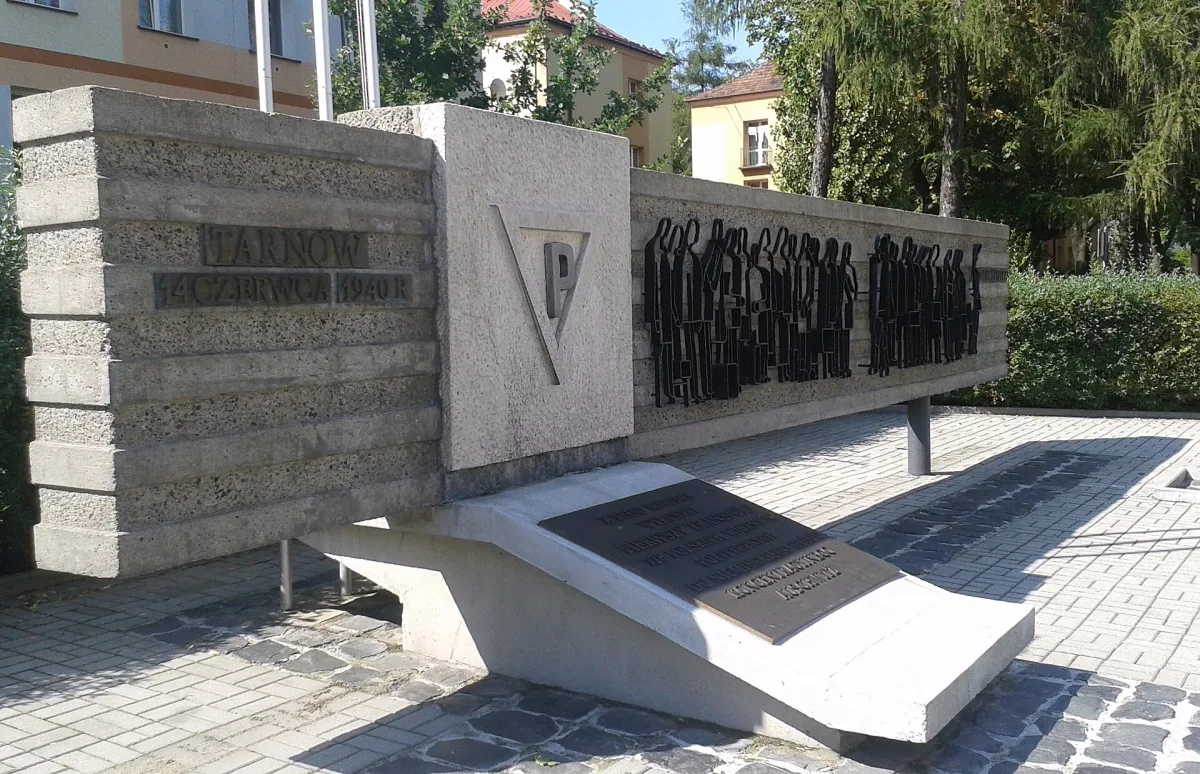
On 14 June 1940 the first transport of political prisoners arrived at the camp: 728 Poles, among them a small group of Polish Jews. The museum regards this day as the beginning of the camp's operation. The transport set out from Tarnów and was unloaded at the ramp by the main camp. It is remembered by the monument in Tarnów.
In 1940 almost 8,000 people were registered in the camp, almost exclusively Poles. Among them were a few Jews and Germans, the latter usually as prisoner functionaries. In 1941 more than 26,000 people were registered: according to the museum about 15,000 Poles, 10,000 Soviet prisoners of war and more than a thousand Jews. The first transport of prisoners from the Protectorate of Bohemia and Moravia, on 6 June 1941, began the deportations to the camp of people of nationalities other than Polish.
In October 1941 a camp for Soviet prisoners of war was set up in the main camp. The museum's chronology also shows that on 3 September 1941 Zyklon B was used in the camp for the first time, against about 600 Soviet prisoners of war and 250 Polish prisoners, and that in the autumn of that year the first gas chamber in Auschwitz I began operating.
The main camp within the Auschwitz complex
The museum divides the history of the camp into two periods. From its creation in 1940 until the first months of 1942, Auschwitz operated solely as a concentration camp in which prisoners died slowly, of hunger, disease and exhausting labour. From 1942 until October 1944 it was at the same time a concentration camp and a centre for the mass murder of Jews. This second strand is discussed in the text on Birkenau.
The camp grew. In the summer of 1944 the complex occupied about 40 square kilometres in its central part and included more than 40 subcamps, scattered within a radius of several hundred kilometres. The museum states that about 135,000 people were held there at that time, including about 105,000 registered prisoners and about 30,000 unregistered, which accounted for 25 per cent of all people in the concentration camp system.
On 22 November 1943, because of the difficulty of administering such a large complex, it was formally divided into three camps: Auschwitz I (the main camp), Auschwitz II-Birkenau and Auschwitz III-Monowitz. Auschwitz I housed the SS garrison administration, the commandant's office, the main offices of the political department and of the prisoner labour department, the main stores, workshops and SS enterprises. Work in these units was the main occupation of the prisoners of this camp. The commandant of Auschwitz I had seniority over the commandants of the other two camps.
In August 1944 about 16,000 prisoners were held in the main camp: about 10,000 Jews, 4,000 Poles and 3,000 people of other nationalities. In October 1944 a camp for several thousand women employed in the production of fuses at the Union-Werke plant was opened in new blocks of the camp's extension.
Scale and estimates of the number of victims
The museum gives the figures for the whole Auschwitz complex following Franciszek Piper's research of 1992. According to these estimates, about 1.3 million people were deported to the camp and about 1.1 million died. About 400,000 prisoners were registered: about 195,000 non-Jews and about 205,000 Jews. Elsewhere in the museum's chronology the figure of about 405,000 registered is given. The remaining people, mostly Jews, were killed after arrival, without being entered in the records. A detailed breakdown by group is in the text on Birkenau. Beside the table of those deported, the museum notes that according to Georges Wellers the number deported was 1,433,405 people.
The museum at Auschwitz I
When the Red Army entered the camp on 27 January 1945, it found about 7,000 prisoners in the main camp, Birkenau and Monowitz. Earlier, on 17-21 January, the SS had marched about 58,000 prisoners deeper into the Reich. In April 1946 the Ministry of Culture and Art sent to Oświęcim a group of former prisoners led by Tadeusz Wąsowicz to secure the site and organise a museum. The Auschwitz-Birkenau State Museum was established by an act of the Sejm of 2 July 1947. It covers the two surviving parts of the camp: Auschwitz I and Auschwitz II-Birkenau. In 1979, on Poland's initiative, the site was inscribed on the UNESCO World Heritage List, and since 2007 the inscription has borne the title "Auschwitz-Birkenau. German Nazi Concentration and Extermination Camp (1940-1945)".
At Auschwitz I there is a main exhibition, opened in 1955. It is housed in blocks 4, 5, 8, 9 and 11 and is based on documents, photographs, models and objects that survive from prisoners and deportees. In further buildings there are national exhibitions, the first opened in 1960 (Czechoslovak and Hungarian). The main camp is also linked to the Auschwitz-Birkenau complex as a whole. Rules for visiting are given by the museum.
Be the first! Add a comment.
You need to log in to add a comment.
Log in