
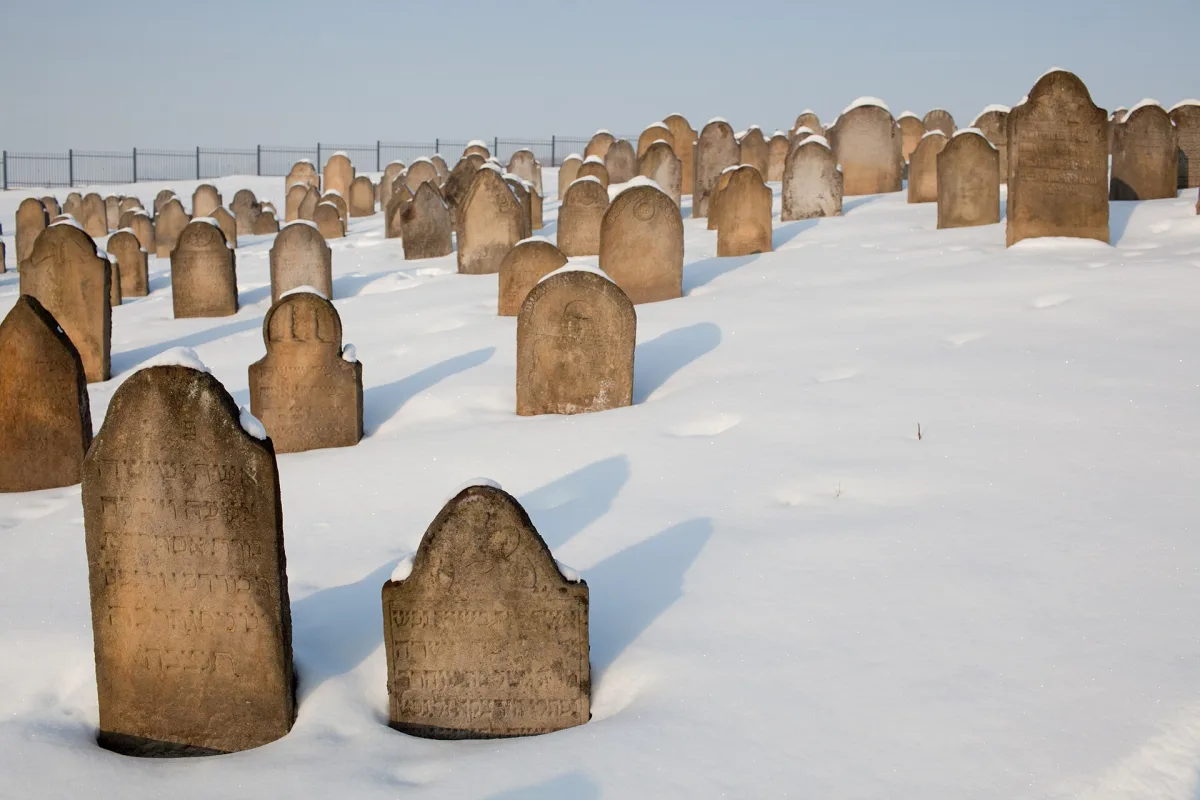
The Jewish cemeteries of southern Lesser Poland, from the Pogórze foothills to the Tatras and the Sącz Beskids, are usually small and mostly destroyed during the German occupation. The description is based on Wikipedia entries, which in turn rely on the 1990 guide by Przemysław Burchard. The numbers of gravestones therefore reflect the state described in that literature. The cemeteries of Kraków and Tarnów are covered in separate texts in this section.
Pogórze and the Tarnów area: Ryglice, Tuchów, Ołpiny, Rzepiennik Strzyżewski, Biecz
The cemetery in Ryglice was established in the first half of the 19th century on the road to Galia Dolna and covers 0.75 ha. About a hundred matzevot have survived, which according to Wikipedia show a high standard of stonemasonry, with legible inscriptions and symbolism. In the early 21st century the site was tidied and fenced, and several gravestones of rabbis and tzadikim were restored. The restoration was financed by the Association for the Renewal of Jewish Heritage in Ryglice, based in London.
In Rzepiennik Strzyżewski it is not known exactly when the cemetery was founded, possibly in the 19th century. It was destroyed during the war and devastation continued afterwards. On a wooded site of 0.5 ha about a hundred gravestones have survived, and the cemetery has been fenced.
The cemetery in Ołpiny, from the 19th century, covered 0.2 ha. It has no gravestones, only fragments of them in the ground, and the site is overgrown with trees and bushes. It contains a plot, under Austrian numbering war cemetery no. 35, in which six soldiers from the First World War are buried.
The Jewish cemetery in Biecz on Tysiąclecia Street was founded in the mid-19th century. It covers 0.2 ha and is fenced with wire mesh, and holds about twenty gravestones of sandstone and concrete with Hebrew and Polish inscriptions. It contains a plot of three Austro-Hungarian soldiers, Austrian war cemetery no. 107, and a mass grave of Jews shot in the cemetery in 1941-1942.
The cemetery in Tuchów, from the 19th century, with an area of 0.4 ha, lay on a slope above the railway line from Krynica to Tarnów. The German occupiers devastated it. Four matzevot and a soldier's grave from the First World War have survived.
Limanowa, Rabka, Nowy Targ and Czarny Dunajec
The cemetery in Limanowa was most probably founded in the 19th century on a hillside near Kolejowa and Rejtana streets. It covers 0.4 ha and is fenced with wire mesh. During the war it served as a site of mass executions and was partly destroyed, and after the war some of the matzevot were used to build benches in the market square. The inscriptions on most of the gravestones are worn away. In the 1990s restoration work was carried out and two monuments to the victims of the Holocaust were erected.
The cemetery in Rabka-Zdrój lies on the slope of Grzebień near Słoneczna Street. It covers 0.1 ha and has no gravestones. During the war it was used as a site of mass executions of the Jewish population, which is commemorated by monuments.
The cemetery in Nowy Targ was established in 1875 on what is now Jana Pawła II Street. It covers 0.58 ha. After the war gravestone slabs were used to surface a street near the former market. About forty matzevot have survived. According to Wikipedia, in 1939-1942 the Germans killed about 2,900 Jews on its grounds, and after the war a commemorative plaque was placed on the mass grave.
The cemetery in Czarny Dunajec, from the second half of the 19th century, lies north of the village on the road to Rabka. During the war it was a site of mass executions, and after the war it was devastated. One matzevah with a Hebrew inscription has survived, along with the bases of several others.
Tatras and Pieniny: Zakopane, Niedzica, Krościenko
The cemetery in Zakopane on Bachledzki Wierch was opened on 27 December 1931. It covers 8 ares and several dozen people were buried there before the outbreak of the war. In 1941 it was destroyed by the Germans. A few concrete and stone slabs marking graves remain to this day.
The cemetery in Niedzica lies in the hamlet of Podgłębokie on the slope of Jędras hill. It covers 58 square metres, and despite wartime devastation seven sandstone gravestones from the turn of the 19th and 20th centuries with Hebrew inscriptions still stand there.
The cemetery in Krościenko nad Dunajcem on Sobieskiego Street is no longer in use, and the time of its founding is not known. In April and June 1942 the Germans carried out mass executions of residents of Krościenko, Szczawnica and Ochotnica, and according to Wikipedia 130 victims were buried in a mass grave in the cemetery. The occupiers used some of the matzevot as flooring for a warehouse. For decades after the war the place was neglected. In 2018, thanks to a local initiative, support from the Nissenbaum Family Foundation and the Jewish Historical Institute, and an online fundraiser, a monument was erected, the mass graves were secured, information boards were installed and the site was fenced. Of the gravestones, one matzevah lying in the grass and a fragment of a slab inscribed 1928 have survived, as well as the tomb of Leopold Krumholz, a merchant from Szczawnica.
Sącz Beskids and the Sącz region: Piwniczna, Muszyna, Krynica, Łabowa
The cemetery in Piwniczna-Zdrój on Nad Popradem Street was probably founded in the late 19th century. It covers 0.04 ha. A funeral house was built here in the interwar period. After the devastation of the occupation and communist years, only a few matzevot remain.
The cemetery in Muszyna lies on the slope of Malnik, covers 0.3 ha and has about eighty gravestones. Wikipedia states that it was established no earlier than the turn of the 18th and 19th centuries, because until the partitions Jews were not allowed to settle in the estate of the Kraków bishops, known as the Muszyna estate. According to other sources it was founded in the 19th century. It is divided into an older and a newer part. Most of the legible inscriptions are in Hebrew, and one is in Polish.
The cemetery in Krynica-Zdrój on Polna Street was founded in the mid-19th century. It covers 0.16 ha and has several dozen gravestones, mostly traditional matzevot. During the war it was a site of mass executions. In the 1980s the communist authorities planned to close it down, but this did not happen.
The cemetery in Łabowa, from the 19th century, has about 400 matzevot according to Wikipedia and lies in conservation protection zone A, the strictest category. It has a plaque in Polish and Hebrew, funded in 1982 by the Jewish diaspora. It is looked after by the Jewish Religious Community in Kraków.
Be the first! Add a comment.
You need to log in to add a comment.
Log in