
An architect in the War Graves Section
Dušan Jurkovič (1868-1947) was a Slovak architect, educated in Vienna, who before the war worked on vernacular architecture and designed, among other things, the mountain huts on Pustevny in the Moravian-Silesian Beskids. During the First World War he volunteered for the Austro-Hungarian army as a one-year volunteer. According to Wikipedia, in 1916-1918 he worked in the War Graves Section of the Imperial and Royal Military Command in Kraków as manager, designer and construction supervisor of cemeteries in the Żmigród district, one of the cemetery districts of Western Galicia, with its seat in Nowy Żmigród. We describe the whole system of these cemeteries in a separate article.
Wikipedia states that 31 cemeteries were built in the Żmigród district, and that Jurkovič personally designed about 35 cemeteries, so some of his designs were also built outside this district. His grave crosses were also used in other districts. Wikipedia counts among his works the shingled pavilion at cemetery no. 123 in Łużna-Pustki, but according to it the cemetery itself was designed by Jan Szczepkowski, and Jurkovič completed it by designing the pavilion in 1917. We wrote about this in the article on Pustki. In the same way cemetery no. 120 in Łużna-Podbrzezie is not his work.
Features of the designs
Wikipedia notes that Jurkovič's work stood out among the designers of the Western Galician cemeteries by two features: inspiration from regional building traditions and a feel for the mountain landscape. He designed mainly in wood, relying on solutions that Carpathian carpenters had used for centuries. He designed a dozen or so versions of wooden grave crosses and large memorial crosses, single and collective. There were also designs for stone and cast-iron crosses with palmette decoration, which can be seen at cemeteries no. 8 in Nowy Żmigród and no. 11 in Wola Cieklińska. The Wikipedia entry also states that his solutions were widely regarded as the most successful in composition and landscape in the whole of Western Galicia.
Cemetery no. 46 in Konieczna
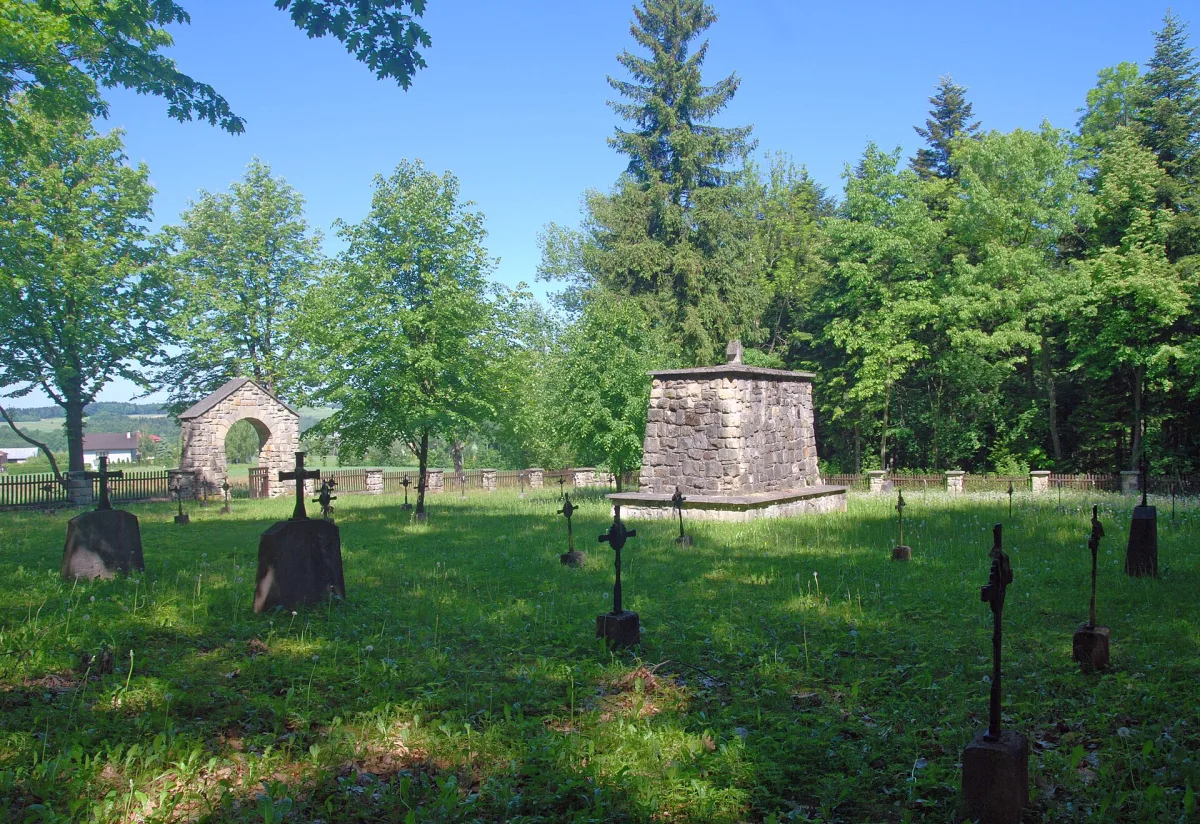
Cemetery no. 46 lies in the summit part of the Beskidek hill, near the Polish-Slovak border. On an area of just over 2,000 m² 303 soldiers killed in January and February 1915 are buried: 168 Austro-Hungarian and 135 Russian. The identity of 163 of the 168 Austrian soldiers is known; 5 Austro-Hungarian and 134 Russian soldiers have not been identified. The graves form 6 collective graves and 48 single ones.
The plan of the cemetery is close to a Latin cross. The fence consists of wooden pales joining stone posts with shingled caps. The main element is a two-storey stone tower 20 m high, standing on a stone terrace, with a tall shingled roof and an iron cross. On the upper storey wooden Latin crosses are placed, and on the lower one plaques with German inscriptions. The plots of Austro-Hungarian soldiers are marked with Latin crosses, those of Russian soldiers with patriarchal crosses. Wikipedia states that the cemetery was built in 1915 and conserved in the 1960s. This year differs from 1916-1918, during which according to the entry on Jurkovič he worked in the section, and the sources do not explain this discrepancy.
Cemetery no. 51 on Rotunda
The cemetery on the summit of Rotunda near Regietów has a circular plan, surrounded by a low stone wall, with a wooden gate between stone posts. 54 soldiers killed in February and March 1915 are buried there: 42 Austro-Hungarian and 12 Russian. Originally there were five wooden tower-crosses in Lemko style, the central one 16 m high and four side ones 12 m each. On a stone plaque with a Maltese cross there is a German quatrain by Hans Hauptmann.
According to Wikipedia, in May 1979 all the towers were still clad in boards, in 1980 the cemetery was entered in the heritage register but no work was undertaken, and by the beginning of the 21st century fragments of three towers survived. Since 1995 the site has been cleared with the help of the Austrian Black Cross, and on the initiative of the Student Circle of Beskid Guides in Warsaw a reconstruction committee was formed. According to the Visit Małopolska portal, the towers were rebuilt successively in 2008, 2009, at the turn of 2014 and 2015, and in 2016. The sources give different times for the whole reconstruction: Visit Małopolska gives 2004-2017, the Góry dla Ciebie portal 2004-2016. That portal also names the Austrian Red Cross as a supporter, whereas Wikipedia writes of the Black Cross.
Cemetery no. 60 at the Małastów Pass
The cemetery lies in the western part of the Pętna hamlet in Małastów, near the mountain hut on Magura Małastowska. 174 Austro-Hungarian soldiers are buried there. On the axis of the cemetery stands a wooden chapel with a copy of the image of Our Lady of Częstochowa and a plaque with a German text, which in translation reads: "Remember in your happy days that a fierce battle raged on this land, that here thousands received mortal wounds, so that the blessing of the sun might bloom around you".
Wikipedia notes that the cemetery was renovated many times, not always carefully, and today does not have all its original elements, among them the wicket in the gate and two large crosses on the plots in front of the monument. There is a wooden matzevah of an Austrian soldier of the Jewish faith, Mendel Brod of the 4th Field Rifle Battalion. It is a copy from 2003, placed in the spot of the original, which was not recreated during one of the renovations.
Cemetery no. 62 in Banica
Cemetery no. 62 in the Banica hamlet in Krzywa covers about 300 m². It has an irregular polygonal plan, and its central element was a tall, richly decorated wooden cross by the western fence. In 1993 the cemetery was devastated during land reclamation, and in 2006 it was renovated, with new grave crosses and a memorial cross erected. In 5 collective graves and 14 single graves lie 52 soldiers killed in January and March 1915: 11 Austro-Hungarian and 41 Russian.
Other cemeteries of the district
The Góry dla Ciebie portal lists among Jurkovič's cemeteries also no. 4 in Grab, on a square plan with a wooden shingled pavilion in the middle, and no. 6 in Krempna, with a monument on stone pillars.
Be the first! Add a comment.
You need to log in to add a comment.
Log in