
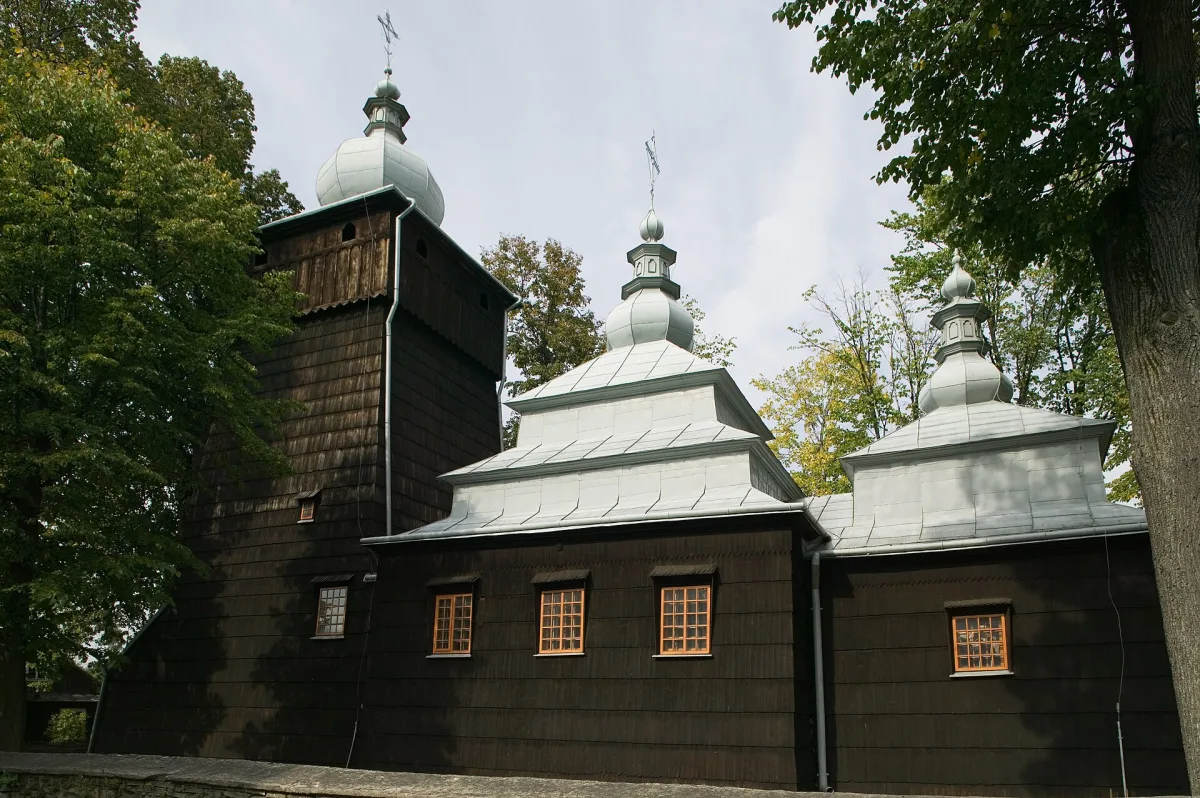
Wysowa-Zdrój lies in the valley of the upper Ropa, in the western part of the Low Beskids, close to the Slovak border. The village was founded in the second half of the 14th century on a trade route to Hungary. For centuries it was Lemko, and in the 19th century it began to develop as a spa. These two histories remain intertwined here to this day: in the spa park stands a pump room, and a few steps away a wooden tserkva (wooden Eastern-rite church) from 1779.
The first baths: three versions of the dates
The mineral waters of Wysowa have been known for a long time. According to Wikipedia, in 1775 the then owner of the village, Maciej Lanckoroński, took baths here, and in 1790 Urszula Dębieńska née Morsztyn built herself the first bathhouse. The seed of the public spa was a building erected in 1812 by the village head Ignacy Czechowicz, and in 1824 the establishment was extended.
The dates of the first bathing facilities differ depending on the source. The blog of the map publisher Compass gives the year 1808, the VisitMalopolska portal writes that the healing properties of the waters began to be used after 1812, when the first spa baths were built, and Wikipedia indicates 1790 for the private bathhouse and 1812 for the public establishment. None of these studies settles the exact year, and each describes a slightly different stage: from a private bathhouse to a public establishment.
Fame before the First World War
After a period of stagnation, the grounds of the declining spa were bought in 1880 by Abraham Feiber, who began to develop them. By 1890 Wysowa had new baths and two guesthouses, and about 2,000 patients arrived each year. The bottling of the waters became the spa's advertisement: in 1887 about 16,000 bottles were filled annually. Samples of the waters were sent to exhibitions and, according to Wikipedia, received medals in Przemyśl in 1882 and in Kraków in 1900.
The spa gained its greatest fame shortly before the First World War. The waters were then compared with the Italian springs in Merano, and the physician Antoni Gluziński set them beside the waters of Ems, Kissingen and Ober-Salzbrunn. These are comparisons from the period, not a ranking.
During the First World War the spa establishment was, according to Wikipedia, destroyed. In the interwar period it operated as a small spa, with no more than 700 patients a year. The table water Wysowianka was then bottled from the Józef spring. After the Second World War, in 1949, bottling was resumed by the Żwirowiec cooperative from Biecz, and since 1 July 1959 the State Spa Establishment Wysowa has operated here.
Springs, pump room and graduation tower
Wikipedia lists eleven springs in use, with mineralisation from 600 to 25,000 milligrams per cubic decimetre. The waters are classed as alkaline acidulous waters saturated with carbon dioxide. The springs are called Anna, Aleksandra, Bronisław, Franciszek, Henryk, Józef I, Józef II and Słone, and several have only numbers.
The mineral water pump room stands by the spa park. It is a reconstruction of the original building of 1933, which according to Compass burned down in the 1960s. VisitMalopolska says that the present wooden pavilion was rebuilt in 2006, and the previous one burned down half a century earlier. The park also has publicly accessible intakes of the Aleksandra and Józef I brines, and beside it stands the old Spa House from the early 20th century, today housing a restaurant and accommodation. About 100 metres from the pump room stands a brine graduation tower, built in 2023 according to the data on the site.
The Tserkva of St Michael and the Lemko village
The oldest monument in Wysowa is the wooden tserkva of St Michael the Archangel from 1779, built on the site of a church burned down in 1777. It is a two-part building of the western Lemko type. The interior is decorated with a late Baroque iconostasis. It was formerly Greek Catholic and is today the seat of an Orthodox parish. It is on the Lesser Poland Wooden Architecture Route, as is the church of the Assumption of the Blessed Virgin Mary from 1936-38, built with the spa's guests in mind. Other tserkvas survive in the area, for example the tserkva in Uście Gorlickie from 1786.
The displacements of 1945-1947
Before the Second World War Wysowa was a mostly Lemko village. Sources give different figures. The website Apokryf Ruski, citing Kubijovyč, lists 730 inhabitants in 1939: 650 Ukrainians, that is, Lemkos, 40 Poles and 40 Jews. Compass writes of about 800 inhabitants, of whom 700 were said to be Lemkos. The differences concern both the numbers and the terminology, so we give them as they appear in the sources.
After the Second World War the Lemko inhabitants of Wysowa were resettled: in 1945-1946 to the Ukrainian SSR, and in 1947, in Operation Vistula, to the so-called Recovered Territories. Some families returned in the 1950s and keep up the traditions of their ancestors. Local studies give the numbers of people displaced in individual transports, but these could not be confirmed in primary publications, so we do not quote them here.
Jawor: the mountain and the account of apparitions
On the slope of Mount Jawor stands the Tserkva of the Protection of the Mother of God, built in 1929. For the Lemkos, Jawor is a holy mountain. According to the faithful's account, in 1925 one of the women of Wysowa experienced an apparition of the Mother of God here. According to this account, a cross was set up there, a chapel was built and an icon was painted, and a spring gushed from the site of the apparition. We describe here only the tradition of the place, as tourist sources relate it, without assessing it.
After the war the building was used as an Orthodox church in 1969-2017, and since 2017 it has been a Greek Catholic sanctuary. Pilgrims come from both Poland and Slovakia, and the celebrations take place on 12 July and 14 October. The founding of the Monastery of the Protection of the Mother of God, an Orthodox men's monastery in Wysowa, refers to these apparitions according to the description of the site.
Mountains around the spa
Around the spa rise the peaks of the Hańczowa Mountains. A trail from Wysowa leads to Kozie Żebro and to Lackowa, the highest peak of the Polish part of the Low Beskids. A wooded area in Uście Gorlickie municipality was covered in 2024 by the Markowiec-Gródek nature reserve, protecting Carpathian beech forest, and nearby lies Lake Klimkówka.
Be the first! Add a comment.
You need to log in to add a comment.
Log in