
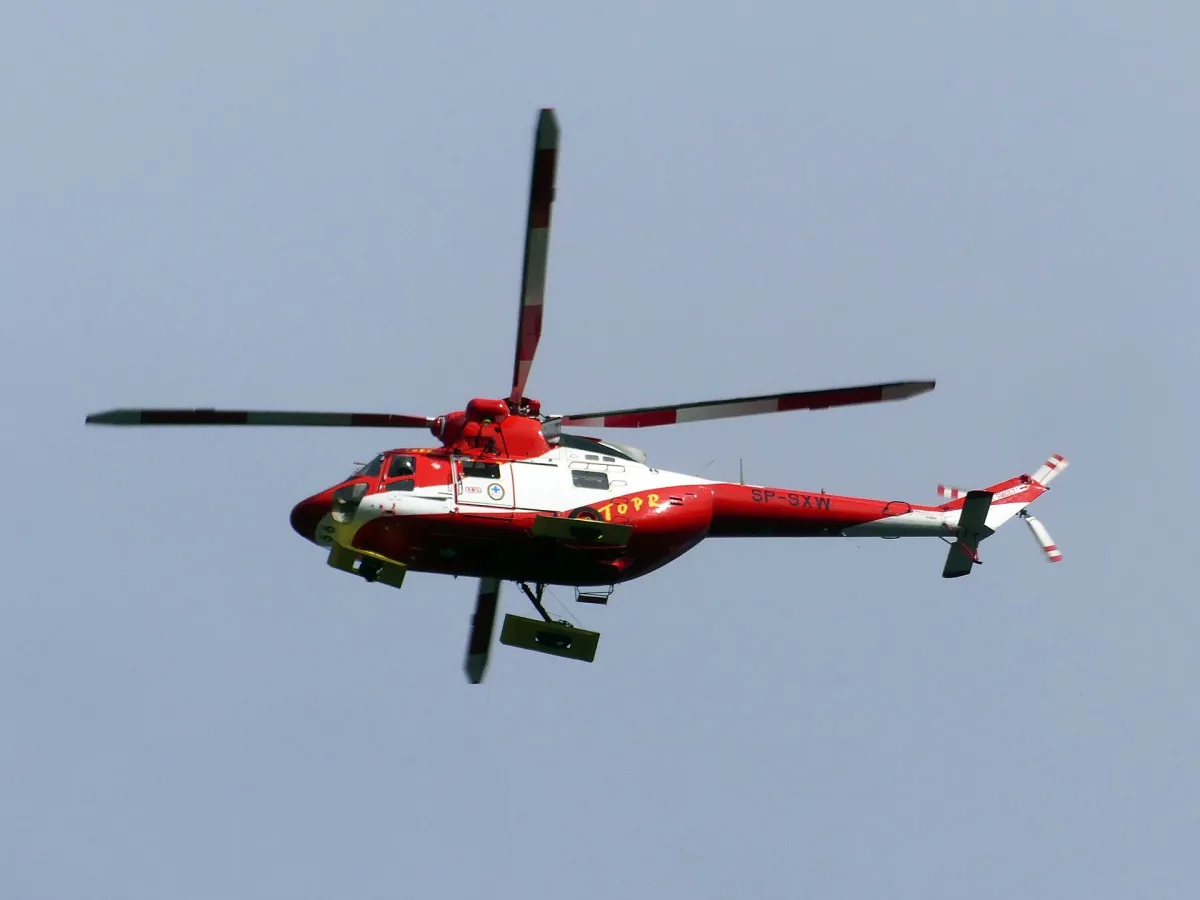
The Tatra Volunteer Rescue Service (Tatrzańskie Ochotnicze Pogotowie Ratunkowe), TOPR for short, is an association that carries out mountain rescue in the Polish Tatra Mountains (Tatras). Its history began in 1909, and an organisation made up of highlander (górale) guides and mountaineers grew into a service that today uses a helicopter. Below are the main stages of that path, with a note where the sources give different versions.
An avalanche, a project and registration in 1909
The idea of founding a rescue association appeared in 1907, when the composer Mieczysław Karłowicz published a project for establishing a rescue service. His death hastened it: Karłowicz died on 8 February 1909 in an avalanche below Mały Kościelec. His memory is recalled by a plaque in the Cemetery of Merit at Pęksowy Brzyzek in Zakopane.
The organisation of the rescue service was taken up by Mariusz Zaruski, a painter, sailor, exile and independence activist, who in 1907 moved to Zakopane because of his wife’s health. According to Wikipedia he was the initiator of the founding of TOPR, the author of the rescuers’ oath and of the regulations, and its first chief. The oath, which according to Histmag is still in force today, binds the rescuer to report on every summons by the chief regardless of the season, time of day and state of the weather.
Dates from this period differ depending on the source. Wikipedia states that the organisation was registered on 29 October 1909 in Lwów and that its president was Dr Dłuski, although the sources differ on his first name: Wikipedia writes Kazimierz, the Histmag portal Klemens. Histmag, for its part, writes that on that day the Austrian authorities in Galicia approved the statute, and that the board and the chief were elected in December. The same portal mentions the first rescues as early as September 1908, but this is information from a single source, so we treat it with caution. Wikipedia, on the other hand, mentions the participation of the emerging rescue service in the search for Prof. Ernest Weiss in mid-1909. The date of registration and the identity of the first chief are certain.
The first years and the death of Klimek Bachleda
From the start, Tatra guides took part in the rescue work. One of the most active members was Klemens Bachleda, known as Klimek, a first-class guide and the first Polish mountain rescuer to die in action. In August 1910 a group of rescuers went to help the mountaineer Stanisław Szulakiewicz on the north face of Mały Jaworowy Szczyt. When the chief, concerned for the lives of his men, ordered the operation to be broken off, Bachleda went on without orders and died in a rockfall. He was buried in Zakopane on 17 August 1910. His gravestone bears the inscription “He gave himself and died”. Commemorative plaques in his honour are found in the Tatra Symbolic Cemetery below Osterwa and on the wall of the Tatra Station (Dworzec Tatrzański) in Zakopane.
Zaruski led TOPR until 1914, when after the outbreak of war he joined the Polish Legions. His successor was Józef Oppenheim, chief until 1939.
The war, GOPR and the return to the old name
During the Second World War, according to Wikipedia from 1940, the rescuers accepted the occupier’s proposal and restored the rescue service’s activity, which operated under the name Freiwillige Tatra Bergwacht. Histmag lists among the rescuers active members of the resistance movement: Helena Marusarzówna, her brother Stanisław and Bronisław Czech. In 1952 TOPR was incorporated into the structure of the Mountain Volunteer Rescue Service (GOPR), and from 1956 it operated as the Tatra Group of GOPR. The organisation returned to its original name and independence in 1991.
Avalanche dogs and the helicopter
Wikipedia describes changes in rescue equipment and methods year by year. In 1963 a helicopter was used for the first time: an SM-1 piloted by Tadeusz Augustyniak carried a tourist with a broken leg from the Valley of the Five Polish Ponds to hospital in Zakopane. In 1974 the first dog, a German shepherd named Cygan, obtained an avalanche dog licence. In 1982 the rescuer Monika Rogozińska was sworn in.
In 1992 President Lech Wałęsa handed the rescuers a PZL W-3 Sokół helicopter, which had a higher hovering ceiling than the Mi-2 used earlier and a greater payload, which allowed it to operate safely in the higher parts of the mountains and to carry more rescuers. In 1994 a helicopter crashed in the Olczyska Valley, killing two pilots and two rescuers. In 1995 TOPR began to use a new Sokół operated by the Air Rescue Service (Lotnicze Pogotowie Ratunkowe), and from 2000 the machine has been permanently stationed in Zakopane. Since 2005 the helicopter has been operated directly by TOPR. In 1999 the organisation was admitted to the International Commission for Alpine Rescue (IKAR).
Wikipedia states that in 2020 TOPR had 281 rescuers, including 41 professionals. A candidate goes through a probationary period lasting from 1.5 to 3 years and must demonstrate knowledge of the topography of the Tatras and skills in climbing, skiing, rescue and caving.
Today: where to seek help and information
A TOPR rescue station operates in the complex of the mountain huts at Morskie Oko.
According to the information on the TOPR website, in the event of an accident in the Tatras you should call the emergency number 985, and when reception is weak or absent, 112. When there is no mobile coverage, TOPR advises sending a light or sound signal six times a minute, that is every 10 seconds. The rescuer on duty asks above all about the place of the accident, what happened, the condition of the casualty and the number of people needing help.
Rescue in the Polish Tatras is, according to TOPR, free of charge. It is different on the Slovak side of the border, where the local service operates and assistance is paid for, which TOPR reminds people choosing border trails. Information on tourist conditions is published daily by Tatra National Park, and avalanche bulletins by TOPR. When a helicopter approaches, secure your belongings, sit or crouch, and raise your arms in the shape of the letter Y to signal that help is needed. Do not grab a rope lowered from the helicopter.
Be the first! Add a comment.
You need to log in to add a comment.
Log in