
Rabka-Zdrój is known today as a spa town for children, but its history begins with salt, not with children. Brine was extracted here and disputes over rights to it were already under way in the Middle Ages, the spa was established in the 19th century, and its focus on children only took hold after the Second World War. Below we set out the dates from two sources, Wikipedia and the town's website, and mark the places where they disagree.
Salt in the Middle Ages: what the 1254 document says
The oldest trail leads to the year 1254. Wikipedia cites the information that Jan Długosz, referring to a document of Bolesław the Chaste, mentions the name "Sal in Rabschyca". According to Wikipedia, this points to the use of the Rabka brines for the needs of the Cistercian monastery. This is an interpretation, not a description of a specific saltworks, and it should be read as such.
The town's website adds further dates. In the 1230s the Voivode of Kraków, Teodor Gryfita, is said to have authorised the Cistercian monastery to settle the area and use the salt; in 1382 Louis of Hungary took Rabka away from the monastery, and the location charter under Magdeburg law was issued on 15 August 1446. Around 1448 the village passed into the hands of the Jordan family. In 1568 Jerzy Grossman obtained permission to prospect for and dig salt in Rabka.
Later the springs were banned. Here is the first discrepancy: the town's website states that in 1818 the Austrian authorities prohibited the drawing of brine. Eugeniusz Janota, the author of a guidebook from 1860, wrote instead that the springs had been filled in and guarded since 1813 on the orders of the Austrian government. The five-year difference may stem from different events or from an error in one of the sources, so we do not choose one version.
From brine to spa town, 1857-1900
In 1857 the Balneological Commission of the Scientific Society took an interest in the brines, and a year later the physician Fryderyk Skobel carried out the first chemical analysis. According to Wikipedia, research from 1858 conducted by the Kraków chemist Adolf Aleksandrowicz and Skobel showed that the Rabka brines are among the strongest iodine-bromine brines in Europe. A caveat: this is an assessment quoted by Wikipedia, which gives no independent measurement here.
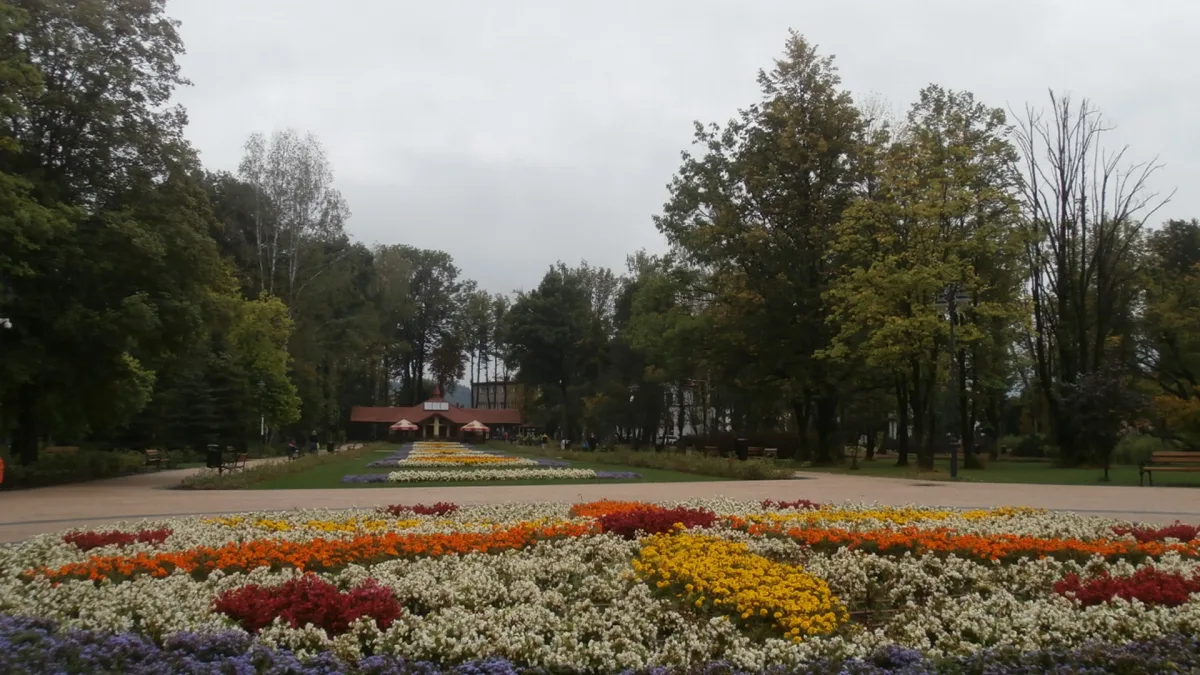
In 1861 the silted-up springs, named Maria, Rafaela, Krakus, Kazimierz and Helena, were cleared. Professor Józef Dietl supported the work. The bathing and treatment establishment was founded in 1864. At roughly the same time Julian Zubrzycki, then the owner of Rabka, laid out the Spa Park, which was later extended by another owner of the spa, Kazimierz Kaden. Today the park covers about 30 ha.
The spa grew quickly. In 1882 it had 15 guesthouses with 240 rooms. The number of patients rose from 164 in 1884 to 1148 in 1889. The railway connected Rabka with Kraków in 1885, a sewage system was built in 1896, and electricity arrived in 1900. The spa grounds were bought by the Kaden family in 1895.
Children: two dates, one tradition
Where, in fact, did the specialisation in children come from? The sources give two different starting dates. Wikipedia says that eight years after the establishment of 1864, that is in 1872, an institution for treating children was opened. The town's website, on the other hand, mentions that in 1889 Julian Zubrzycki donated a plot for a colony for children with scrofula. These may be two different undertakings, but neither source settles the matter.
Attendance grew: 6729 patients in 1914, 27,452 in 1938 and 30,153 in 1939. After the war the spa was taken over by the State Treasury. On 11 July 1946 the Council of Ministers passed a resolution to create a Complex of Sanatoria for Children with Tuberculosis, and the first observation sanatorium opened on 10 June 1947 in the Wiosna villa. According to the town's website, in the 1960s the medical profile changed: respiratory diseases began to dominate instead of tuberculosis.
Today, as Wikipedia states, the spa has nine deep-water intakes reaching down to 1200 m, the first of which was made in 1858. The waters are classified as iodide-chloride-sodium-bromide, and their temperature reaches 30 degrees. According to the same source, Rabka specialises in disorders of the respiratory and circulatory systems, mainly in children. Doctors, not a description on a website, decide who the treatments help and how.
Rabka received town rights on 21 September 1953. In 1999 the name was changed to Rabka-Zdrój to emphasise the spa character of the town.
The City of the Children of the World and what remains of it
Rabka received the title of City of the Children of the World in 1996. The town's website says this happened on 1 June 1996 during the 1st World Gathering of Knights of the Order of the Smile, and Wikipedia adds that the title was awarded by the Lesser Poland Voivode at the request of the International Chapter of the Order. The Museum of the Order of the Smile is connected with that ceremony: it opened in June 1996 and in 2003 moved to a new home in Rabkoland. It tells the story of a decoration that adults receive from children.
The theatre tradition has two accounts. The town's website says that the little theatre Rabcio-Zdrowotek was created through community effort and in the 1970s became a state theatre. The page of the Rabcio Puppet Theatre states that a professional theatre was founded in 1949. These are two narratives about the same institution, which we were unable to reconcile.
A walk around the centre usually begins in the park. In 2009, as Wikipedia reports, a new cylindrical brine graduation tower was put into operation, replacing the one burnt down during the Second World War. According to the entry for the site, the graduation tower runs on brine from the Helena borehole, and it was opened on 22 June 2009. We write about other graduation towers in the region in separate articles.
Rabka also has a wooden church from 1600-1606, which houses the Władysław Orkan Museum. It is a branch of the museum in Orkanówka in Poręba Wielka, which we cover in the article on the Gorce. The Main Beskid Trail to Turbacz also starts in Rabka-Zdrój.
Be the first! Add a comment.
You need to log in to add a comment.
Log in