
A short list of dishes regarded as Kraków's
The food journalist Magdalena Kasprzyk-Chevriaux, in an interview published on the city website, notes that Kraków cuisine is harder to talk about than it seems. The city lies in a place in Europe where the influences of many cultures intermingled, and historians treat the very notion of national cuisines with caution. Local cuisine is easier to speak of, and the townsfolk cuisine of Kraków, in her view, has to be reconstructed from the days of the Austro-Hungarian monarchy. In the same interview the words of Leszek Horwath were recalled, that there are few traditional Kraków dishes, and one of the few is maczanka.
Below are three flavours from this townsfolk tradition: maczanka, liptauer spread and tiered sandwiches from the old breakfast bars. Each has a different history and a different reliability of sources, so for each we note what we rely on.
Maczanka: pork neck in a roll soaked in sauce
According to the text of the Historic Kraków Culinary Trail, prepared by the historian Dr Marcin Gadocha, the basis of maczanka was pork neck roast slowly with onion and caraway. It was served in a bread roll (bułka wodna) well soaked in the roasting sauce, usually with a pickled cucumber. The trail points out that the secret of the taste lay in simplicity: good meat and a roll that absorbs the whole aroma of the roast.
In the 19th century maczanka was a favourite mainly of students and cab drivers. The trail writes that from 1892 crowds were drawn by an eating house on the corner of Grodzka and Poselska streets. The dish was also mentioned by Antoni Wasilewski, describing Kuczmierczyk's place on św. Anny Street: a spot gladly visited by Kraków's bohemians, famous for kidneys, hot pork tenderloins and maczanka with "an excellent sauce running down the fingers".
The same publication notes that some see in maczanka a distant relative of the modern hamburger, but regards it as a speciality clearly linked with Kraków. It is worth remembering that according to Wikipedia the same word means a completely different dish in Belarusian and Ukrainian cuisine, for example a thick sauce with pieces of meat in which blini are dipped. Kraków's maczanka is a separate dish.
Liptauer: a spread of Liptov bryndza
Liptauer, according to Magdalena Kasprzyk-Chevriaux, is a spread that has to be dusted off by reaching back to Austro-Hungarian times. The name comes from the German name of Liptov, a region in northern Slovakia. Traditionally it was based on sheep's bryndza, and in Habsburg times Liptov bryndza enjoyed enormous renown. Today a low-fat curd cheese is more often used.
This example shows well that not everything served in Kraków was a Kraków invention. Liptauer has many versions and names in Central Europe: in Hungarian körözött, in Slovak šmirkás, in Czech liptovská pomazánka, in Serbian urnebes, and in Austrian and German cuisine liptauer. In northern Italy one meets a distant counterpart in which the bryndza is replaced by ricotta and stracchino cheese. What links it with Kraków is therefore above all the Habsburg era and the townsfolk table, not its origin.
Tiered sandwiches from the breakfast bar
At the end of the 19th century "breakfast bars" (lokale śniadankowe) began to operate beside Kraków's grocery, delicatessen, dairy and butcher's shops. According to a Wikipedia entry based on the Encyclopaedia of Kraków, these were modestly furnished eating houses where people ate standing up, often in a small room at the back with an entrance from the hallway. Open from breakfast until late in the evening, they served what the shop they were attached to offered: pork knuckles, tripe, crayfish, delicatessen products, dairy and sandwiches.
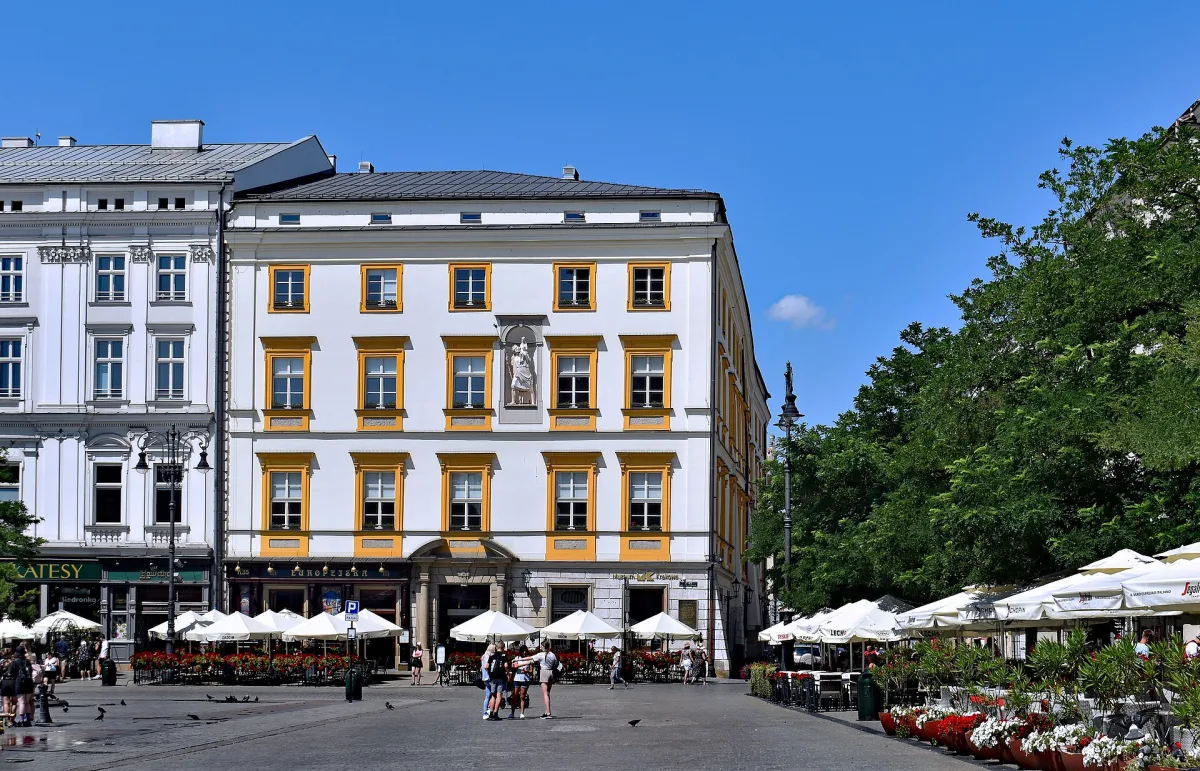
The best sandwiches were famous at the bar of Antoni Hawełka. In 1876 Hawełka opened a grocery shop "Pod Palmą" in the Red Tenement House (Kamienica Czerwona) on the Main Market Square, and in 1889 moved it to the Pod Krzysztofory Palace on the same Main Market Square. At the back of the shop his breakfast bar operated. It served tiered sandwiches, tall and many-layered. For example: on a fresh roll spread with butter a piece of lobster was laid, covered with mayonnaise and a slice of raw cucumber or a hard-boiled egg was added. Another sandwich had bryndza with paprika, salmon, caviar and Swiss cheese.
Magdalena Kasprzyk-Chevriaux notes that Kraków was famous for sandwiches that have grown many legends, and the tiered sandwich from this bar was the most famous. The culinary trail adds that mustards from Jan Lebenstein's Kraków factory, which at first operated in Zwierzyniec, could have been used for such sandwiches. This is a cautious wording by the source: there is no certainty about which mustard was actually used.
Where to find knowledge about old recipes
The cuisine researcher advises looking for recipes in Kraków homes: according to her every self-respecting family had several recipes passed down from generation to generation, and home notes are the most valuable to a researcher. Information about Kraków dishes also turns up in the notes of cooks from other countries. As an example she gives the Kraków schnitzel Cracovies, that is veal meatballs with Parmesan in sauce, found in the kitchen notes of a cook at the castle in Kliczków, written down in 1790 for Baron zu Solms-Baruth.
Be the first! Add a comment.
You need to log in to add a comment.
Log in