
In southern Lesser Poland, from the area around Nowy Sącz to the Wiśnicz Foothills, there are several small museums devoted to what the countryside produces: honey and milk. Three show beekeeping from the old tree hives to the modern apiary, and one a former dairy. None is a major institution, but together they make up a trip through the trades that shaped the local landscape.
From tree hive to beehive
Forest beekeeping (“bartnictwo”) consisted of keeping bees in natural or hollowed-out tree cavities known as “barcie”. According to Wikipedia the trade reached its peak in Poland in the 16th and 17th centuries and began to die out in the 19th century with the development of hive beekeeping. The rights of forest beekeepers were set down in the Wiślica Statutes of 1347, regarded as the oldest codification of Polish law. In December 2020 beekeeping culture was inscribed on the UNESCO Representative List of the Intangible Cultural Heritage of Humanity; Poland submitted the application together with Belarus.
A trace of this trade survives in the names of places, for example in Bartne in the Low Beskids, which has a separate article on the portal. Today the easiest way to learn about bees is in the private museums that grew out of beekeepers' passion.
Kamianna and Stróże: hives, tools and an apiary
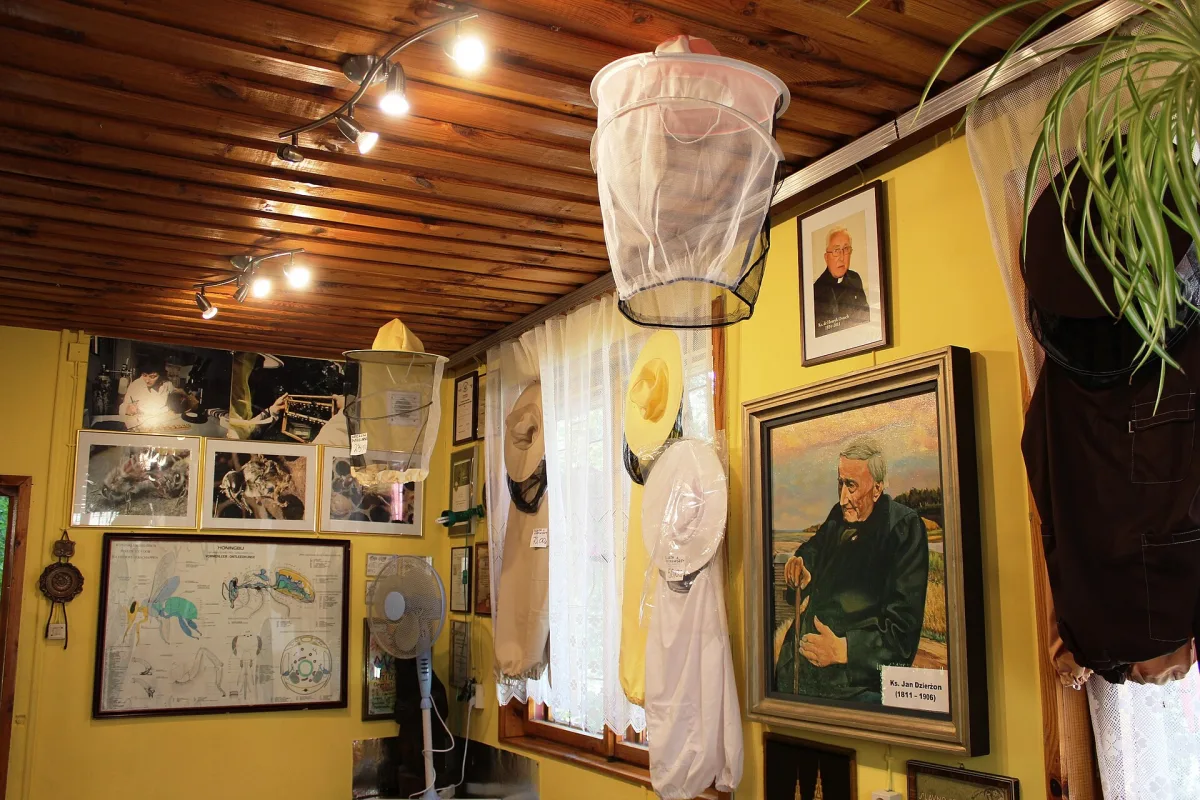
The Beekeeping Museum in Kamianna is private and stands on the grounds of the Barć Apiary. It consists of two exhibitions. The first tells of Fr Dr Henryk Ostach, a priest and beekeeper, for many years president of the Polish Beekeepers' Association. The second shows beekeeping equipment and tools from the last two hundred years. Next to it stands the Bartnik Farmstead, an open-air display of figural hives and sculptures, including St Ambrose, patron of beekeepers. Nearby there is also the House of the Polish Beekeeper of the Polish Beekeepers' Association.
The Beekeeping Museum in Stróże is named after Bogdan Szymusik, a Kraków beekeeper and collector whose collection of hives became the basis of the exhibition. The museum was founded in 2000 and, according to Wikipedia, operates as an open-air museum. There are exhibitions on the inside of a hive and the life of bees and on the history of beekeeping, with publications from the 17th to 19th centuries, and outdoors a collection of more than a hundred hives of fanciful shapes, for example a monk, a devil or a highland cottage. Two hives date from 1822: a log hive for five bee colonies and a straw-skep hive. The collection also includes a 15-metre monument to the bee, the Carpathian Millennium Bee Tree (Karpacka Barć Milenijna), which houses a working hive.
Apilandia in Klecza Dolna
Apilandia is an interactive beekeeping centre, science museum and theme park in the historic cellars of a former manor farm in Klecza Dolna. It opened on 25 August 2018. The farm of Przecław Sławiński from the early 20th century was nationalised after 1944 and renamed the State Machinery Centre. The renovation of the cellars for the centre took more than two years.
In four rooms there are several dozen interactive exhibits. The topics are the protection of bees, work in the apiary from building a hive to extracting honey, the making of beekeeping equipment, and the biology and habits of bees. Visitors also tour an educational apiary wearing protective hats. Wikipedia calls Apilandia the only place of its kind in Poland devoted to beekeeping; this is the description of a single source, which is why we give it with a reservation.
The Dairy Museum in Królówka
The Dairy Museum in Królówka, in Bochnia County, is a branch of the Wiśnicz Land Museum in Nowy Wiśnicz and is housed in the building of a former dairy. It was founded in 1888 by the local parish priest. From 1896 the plant operated as a dairy company, then as a cooperative, and after the Second World War as part of a district dairy cooperative. It worked without interruption until the 1970s, and in 1991 the building was taken over by the municipality of Nowy Wiśnicz. Butter, cheeses, cream and buttermilk were produced here, which according to surviving documents went to the court of Emperor Franz Joseph I.
The museum holds complete machines and equipment for the production of dairy products, some from the 19th century, and documents on the work of the plant. It shows what a milk-processing plant looked like before large works took over. Because it is a branch of a museum, it is worth checking the opening hours beforehand with the Wiśnicz Land Museum.
Be the first! Add a comment.
You need to log in to add a comment.
Log in