
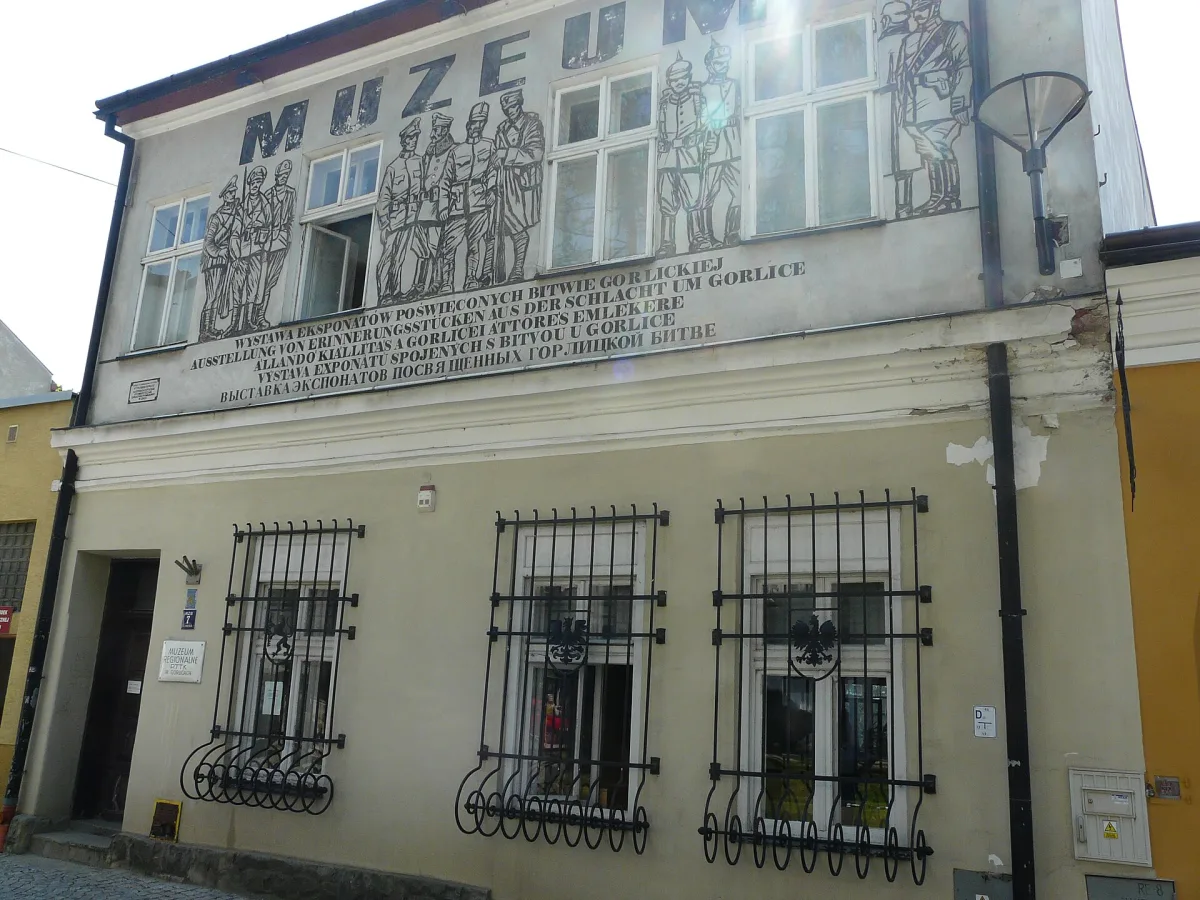
Why the blow fell at Gorlice
In the spring of 1915 Austria-Hungary was in a critical position. The Russian offensive of winter and early spring had broken the front in the eastern part of the Low Beskids, and Galicia, apart from a western strip with Kraków, was in Russian hands. The Austro-Hungarian army had no reserves left, so it asked its ally for help. The idea of breaking through the front in the Gorlice area is linked with the Austro-Hungarian chief of the General Staff, Franz Conrad von Hötzendorf. The German chief of staff, Erich von Falkenhayn, long refused support because he was counting on a decision on the western front. In the end the Germans sent eight divisions to Galicia, twice as many as the Austrians had asked for.
The plan of the offensive was approved on 13 April, and on 28 April German troops took up their assigned positions. The main blow, on the sector from Ropica Ruska to Rzepiennik Strzyżewski, was to be delivered by the 11th Army under General August von Mackensen, with Colonel Hans von Seeckt as chief of staff. It comprised eight German divisions and the Austrian VI Corps. Further north, from the area of Gromnik and Zakliczyn, the Austro-Hungarian 4th Army of Archduke Joseph Ferdinand attacked. On the Russian side the 3rd Army of General Radko Dimitriev defended, stretched along a long front and exhausted by the winter fighting.
Numbers that depend on the source
The strength of the two sides is described in different ways, depending on which sector and which moment is counted. In one place Wikipedia gives, for the 35 km long sector of the main blow, about 126,000 soldiers of the Central Powers against 60,000 on the Russian side, and in another about 217,000 attackers and no more than 80,000 Russians in the Gorlice area in the initial phase of the fighting. The Visit Malopolska portal writes of almost 200,000 soldiers and about 60,000 Russians on a sector of about 32 km. All the sources agree on one thing: the attackers had a clear superiority in men and above all in artillery, whose more than a thousand guns and mortars were an unprecedented firepower on the eastern front.
2 May: from bombardment to assault
At 6.00 a.m. on 2 May 1915 German and Austrian guns opened fire on the Russian positions. The bombardment lasted almost four hours, and the Russian artillery barely replied, so as not to reveal its positions. At 10.00 the fire was shifted to the rear of the defence and the infantry advanced to the attack. It then turned out that the artillery preparation had not worked everywhere. The Bavarian 11th Division, attacking the hills above the Sękówka valley, suffered heavy losses and only towards evening, after several assaults, took the first Russian position.
The town itself was attacked by the XLI Corps of General Hermann von François. German infantry broke into the Gorlice cemetery but became bogged down in street fighting. The defenders laid down their arms only after another artillery bombardment lasting several hours. A witness was Bronisław Świeykowski, author of the account “Z dni grozy w Gorlicach”: “all the houses went up in flames. The burning town slowly passed into the hands of the attackers”. This quotation comes from the Visit Malopolska study, which refers to his account.
Pustki in Łużna
The fighting was particularly heavy for the Pustki hill in Łużna in the Ciężkowice Foothills. It was stormed by the Austrian 12th Infantry Division, made up mostly of Poles: the soldiers of the line regiments were recruited from Galicia, the 56th Regiment from Kraków and the 57th from Tarnów, which is why the division was called the Kraków division. The first two lines of trenches were taken without major losses, but in the following ones, hidden in the forest and untouched by the bombardment, the Russians defended themselves fiercely. The resistance was broken at about 11.00 a.m. in bayonet fighting. The Polish regiments lost nearly 900 soldiers. The division's success is attributed largely to the commander of its artillery, Colonel Ludwig Riedl.
The balance of the first day according to Wikipedia: the first defensive positions were taken along the whole sector, about 17,000 Russians were taken prisoner, and as many were killed or wounded. The German units alone lost more than 8,000 soldiers.
3 to 5 May: breakthrough and pursuit
The breakthrough was therefore not a single blow on 2 May but lasted several days. On 3 May the troops of the Central Powers took Zagórzany, Kobylanka, Libusza and Lipinki, and the fighting moved to Biecz. The next day Dimitriev made a last attempt to improve the situation: south of Biecz the reserve III Caucasian Corps counterattacked, and in the area of Cieklin several German battalions were routed. Even so, the second and the poorly prepared third defensive position were forced almost everywhere. Wikipedia regards this moment as the turning point: the Russian 3rd Army suffered defeat, and its front was broken on 2-5 May.
The Russian high command initially did not believe the reports and ordered the Wisłoka line to be held, which proved impossible. On 5 May the Germans reached Żmigród, and on 6 May they crossed the Wisłoka also north of Jasło. Jasło, Tarnów, Krosno and Rzeszów fell. By 12 May the Central Powers had taken 140,000 Russian soldiers prisoner. Przemyśl was recovered on 3 June, and Lviv in the second half of June. The Russian army lost the initiative in Galicia and no longer threatened the centre of the Austro-Hungarian monarchy.
Remembering the battle
Visit Malopolska states that more than 20,000 soldiers of various nationalities died in the battle: Russians, Germans, Austrians, Hungarians, Poles, Ukrainians, Slovaks and Czechs. Other studies give other estimates, and there is no single, generally accepted figure for the losses. Mementoes of the battle were being collected in Gorlice as early as 1919, and today an exhibition about it, opened in 1995, is part of the PTTK Regional Museum (Muzeum Regionalne PTTK). Since 2010 a reconstruction of the battle has been held in Sękowa at the end of April, and the local wooden church was, according to the entry for the site, severely devastated at the turn of 1914 and 1915 during the fighting around Gorlice.
Be the first! Add a comment.
You need to log in to add a comment.
Log in