
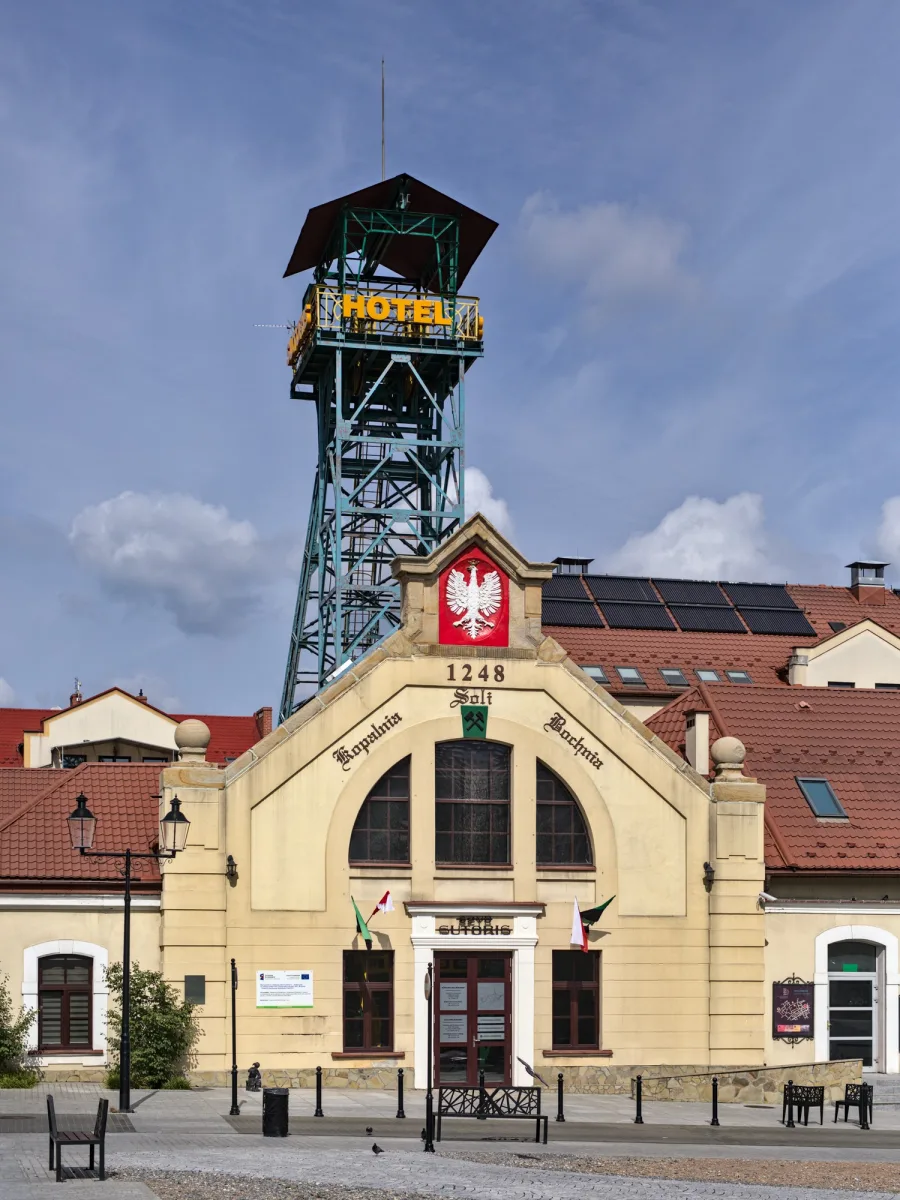
Campi Shaft: a field outside the town and six years of digging
The Bochnia mine grew up around the two oldest shafts, Sutoris and Gazaris, in the town itself. In the 16th century the miners reached the western part of the deposit, known as Nowe Góry, and for its needs the shafts Regis, Bochneris and Campi were sunk. According to Wikipedia, Campi was sunk in 1556-1568 under the direction of Jan Faigel, and construction was prolonged by problems with quicksand, that is water-saturated sand that breaks into the shaft.
The name comes from the Latin word campus, meaning field. A Polish version, the Polny shaft, was also used, which according to Wikipedia is connected with the location of the shaft outside the town. Initially people also spoke of Faigel's shaft, after the builder's surname. This explanation of the name comes from a single source, the Wikipedia entry on the mine, and we treat it as such.
Wikipedia states that in 1792 Campi reached 212 metres. The same figure appears in the table of the mine's levels: the August level lies 177 metres below the collar of Sutoris and 212 metres below the collar of Campi, because the shafts have their collars at different heights. For this reason the literature uses a double numbering of levels, relative to one shaft or the other. According to Wikipedia the whole mine reached a depth of 468 metres, although the deepest, youngest workings were closed after extraction ended in 1990. The mine now consists of nine levels, with names such as Danielowiec, Sobieski, August and Sienkiewicz,.
From human muscle to steam
For centuries the ore and people were hauled up by muscle power and by horse-driven gins. The last horse, Kuba, worked in the mine until the 1960s, and its name is now borne by the tourist train in the August gallery. Steam arrived late. According to Wikipedia, in 1874 the first steam-powered winding engine in this mine was installed over the Sutoris shaft, and in 1883 a steam winding engine was installed at Campi.
In 1909 the reconstruction of Campi began. It was interrupted by a partial collapse of the shaft and the need to widen the works, which were completed in 1912. In the building by the shaft a steam engine brought in 1909 has survived, which according to the same entry operated the lift for carrying people and ore until 1996. Today it is an exhibit. Wikipedia also writes of a working, occasionally started drive of the lifts in the shafts and calls it a unique operating technical monument in Europe, but that is a single source, so treat this assessment as the opinion of the entry's authors.
The shaft was also connected with the town from the outside. In 1900 an aerial cable railway 1,020 metres long was built, from the Campi shaft head to a building near the railway station, and in 1922 a railway siding, which residents called the Kolejka. The siding went out of use in the 1980s, and part of a cycle path and pavement now runs along its former track. On 19 July 1930 a fire destroyed the salt mill, the loading station and the locomotives, and the shaft was partly damaged. According to Wikipedia this threatened the closure of the mine, and the workforce saved it by retiring, working shorter hours and giving up part of their wages for the rebuilding.
The fire of 30 December 1875
Fire in mines with wooden shafts and galleries was a constant danger. Wikipedia lists earlier fires: in 1441, described by Jan Długosz, when the shaft lining burned; in 1580, which lasted 15 weeks and cost the lives of more than thirty miners; and in 1586 in the Gazaris shaft, which claimed about ten people. In 1747 Jan Borlach drew up the first fire safety instructions for the mine.
The fire at the end of 1875 took place soon after the steam engine was installed in Sutoris. According to Wikipedia it broke out on 30 December because of the carelessness of the engineer operating the steam engine in that shaft, and in a short time spread through the whole mine. The management decided to cut off the oxygen supply by sealing the shafts and closing the ventilation. After the fire was put out, director Andrzej Furdzik, mining counsellor Edward Windakiewicz and two experienced miners decided to go down into the mine for an inspection, against the warnings of the miners. They were lowered in a basket on a rope into the depths of the shaft and according to the accounts of the press at the time they died there. Furdzik's body was not found.
Wikipedia states that the fire and the attempted inspection killed 12 people, who were buried in the cemetery on Oracka Street. We know the number, dates and course of events from this one source. The biography of Edward Windakiewicz's son states that his father, director of the mine in Pecz, died in 1876 during a fire-fighting rescue operation in the Bochnia salt mine. The year therefore differs from the date of the fire, which may mean that the inspection took place after the turn of the year, but the sources do not settle this.
A reminder is the plaque in the St Kinga Chapel in the mine, dedicated to the victims of the 1875 fire. Through this largest of the mine chapels run the tracks of the underground train, and its furnishings include, among other things, a pulpit carved in salt from 1922 and statues of Casimir the Great and John Paul II.
What you can see today
In the Bochnia Salt Mine three shafts survive: Sutoris, Campi and Trinitatis, the last only for ventilation. According to Wikipedia, Campi is the main tourist shaft. According to the same source the train has a route of about 1,000 metres, three stations (Campi, Kinga and Sutoris), and the boat crossing of a chamber partly flooded with brine is about 120 metres long. The mine's website calls this crossing the only one of its kind underground in Europe, and information on routes, variants and opening hours is best checked there. The history of the salt works themselves, that is the enterprise shared by both mines, is described in a separate article, and you will find the other mine in Wieliczka.
Be the first! Add a comment.
You need to log in to add a comment.
Log in