
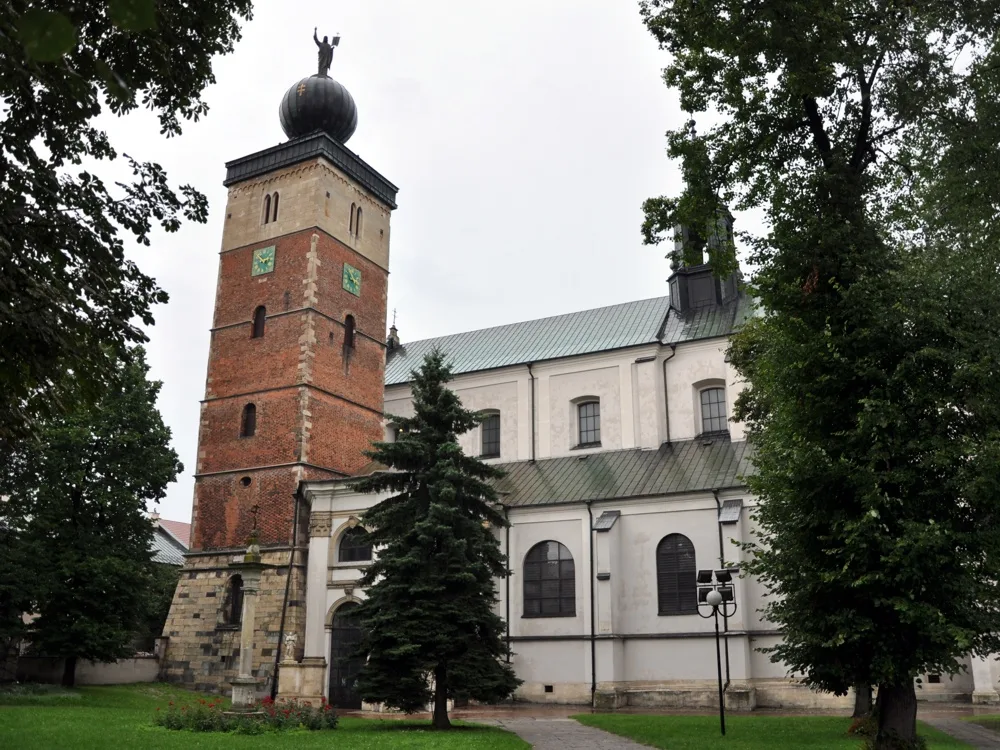
Miechów, a town on the Miechów Upland, was for more than 650 years the seat of an order whose name comes from the Tomb of Christ in Jerusalem. The Canons Regular of the Holy Sepulchre, known in Poland as the Miechovites (miechowici), took their name from this very town. Their history begins with a single founder and ends in 1819 with a decision of the authorities of the Russian partition.
Jaksa Gryfita and the pilgrimage to the Holy Land
The founder was Jaksa Gryfita, called Jaksa of Miechów, a Lesser Poland magnate who according to Wikipedia was born in 1120 and died around 1176. Jaksa's origin is not certain, although most researchers assign him to the Świebodzic-Gryfita family. Some historians consider him the same person as Jaksa of Kopanica, who in 1145 married Agapia, daughter of Piotr Włostowic, and later ruled in Köpenick. The identity of the two Jaksas therefore remains a matter of dispute.
The Wikipedia biography states that in 1162 Jaksa set out on a pilgrimage to the Holy Land and returned after a year, bringing with him a canon of the Holy Sepulchre, Marcin Gal. He then founded a monastery in Miechów. The entry on the town itself says that he brought from Jerusalem several knights of the Holy Sepulchre order and several canons of the Rule of St Augustine and built for them a collegiate church and a monastery in 1162. As an endowment he gave them the villages of Miechów, Zagórzyn and Komorów.
The sources diverge on the year. Wikipedia in the entry on the town and in Jaksa's biography gives 1162, but the entry on the basilica, the entry on the order and the website of the basilica's parish give 1163. The parish adds that Jaksa took with him a monk of the Holy Sepulchre and soil from the Tomb of Christ. It does not follow from these studies whether the discrepancy comes from counting the expedition and the foundation differently, so both years should be treated as approximate.
Where the order came from
According to Wikipedia the order was founded in Jerusalem in 1099 by Godfrey of Bouillon, adopted the Rule of St Augustine in 1114 and obtained papal confirmation in 1122. The same encyclopaedia states that in the 16th century there were 32 centres of the Holy Sepulchre canons in Poland. The main monastery in Miechów was their centre, and over time it received numerous grants from princes and bishops. A document of Patriarch Monachos of 1198 confirmed, according to the parish website, the independence of the Miechów monastery.
A town under the monastery's rule
The town was the property of the monastery. Town rights under German law were granted to it in 1290 by Przemysł II. In 1294 Miechów was twice invaded and plundered by Bolesław I of Masovia, during the princes' struggles for the Kraków throne. In 1311 a Hungarian unit in the pay of Władysław the Elbow-high expelled the Holy Sepulchre canons from the monastery, but the Elbow-high returned it to them after several years. As a result of the military operations the town lost its town rights for a time. In the 18th century the Miechów councillors, wishing to honour the memory of Jaksa, composed the town's coat of arms from the emblem of the Holy Sepulchre canons and the Griffin, the coat of arms of the Gryfita family.
A church that burned many times
The first church was consecrated around 1170. A Romanesque church was built in 1235-1293. After a fire in 1379 the present Gothic basilica arose (1394-1406). Wikipedia also mentions fires in 1506 and 1745. After the last one the church was rebuilt in the Late Baroque style, and the work lasted until 1802. Today it is a three-nave basilica with Romanesque elements, with thirteen altars and one tower.
A separate building is the Chapel of the Holy Sepulchre, according to Wikipedia built around 1530 as a copy of the chapel in Jerusalem. In 2008 and 2009 Renaissance paintings were discovered on its dome. The title of minor basilica was given to the church by Pope John Paul II in 1996, and the parish website gives the date 3 November 1996. A detailed description of the monument is in the entry on the Collegiate Basilica of the Holy Sepulchre in Miechów.
The year 1819: dissolution of the order
In 1819, as a result of the dissolution of the Holy Sepulchre order in the Russian partition, the last monks left Miechów. They were headed by the parish priest of the Church of the Holy Sepulchre and at the same time the last provost of the order, Tomasz Nowina-Nowiński. After the dissolution the monastery church became a pastoral centre of the diocese. Wikipedia writes about the order on a national scale: in 1819 the Russian authorities abolished the order in Poland, and its last member, Piotr Franciszek Pękalski, died in 1874. In the crypt of the basilica are buried, among others, Samuel Nakielski and Tomasz Nowiński.
What remains of the Holy Sepulchre canons
In the former monastery buildings is the Museum of the Miechów Land, which holds about two hundred liturgical textiles from the monastery treasury and a digitised Chronicle of the Poles by Maciej of Miechów from 1512. In the basement of the former monastery buildings there is a contemporary art gallery. The basilica is also the starting point of the Lesser Poland Trail of the Holy Sepulchre Canons, which links ten historic churches connected with the order.
Be the first! Add a comment.
You need to log in to add a comment.
Log in