
For centuries Wawel Cathedral has served as a necropolis. Rulers, military commanders and presidents rest in it, and since 1890 poets too. In this text we have gathered who is buried where, with the crypts and dates given according to Wikipedia and its bibliography. Details of visiting and the interiors themselves are described in the entry on the Archcathedral Basilica.
The royal tombs beneath the cathedral
The first rulers of the restored Kingdom of Poland after 1320, up to the death of John I Albert in 1501, were buried under monuments or under the floor of the church. The first crypt was built only under the Sigismund Chapel. In 1872-1877 Teofil Żebrawski, Józef Łepkowski and Jan Matejko directed the tidying and arrangement of the crypts, which were joined by new passages, so that they can be visited.
The visit begins in St Leonard's Crypt, built in 1090-1117. In its centre lies Bishop Maurus, who died in 1118 and whose grave was discovered in 1938. Buried here, among others, are King John III Sobieski, his wife Marie Casimire, King Michael Korybut Wiśniowiecki and General Władysław Sikorski, whose body was brought back on 17 September 1993. In this crypt Father Karol Wojtyła celebrated his first Mass on 2 November 1946, and on 9 June 1997, by then as Pope John Paul II, he celebrated it once more on the fiftieth anniversary of his ordination.
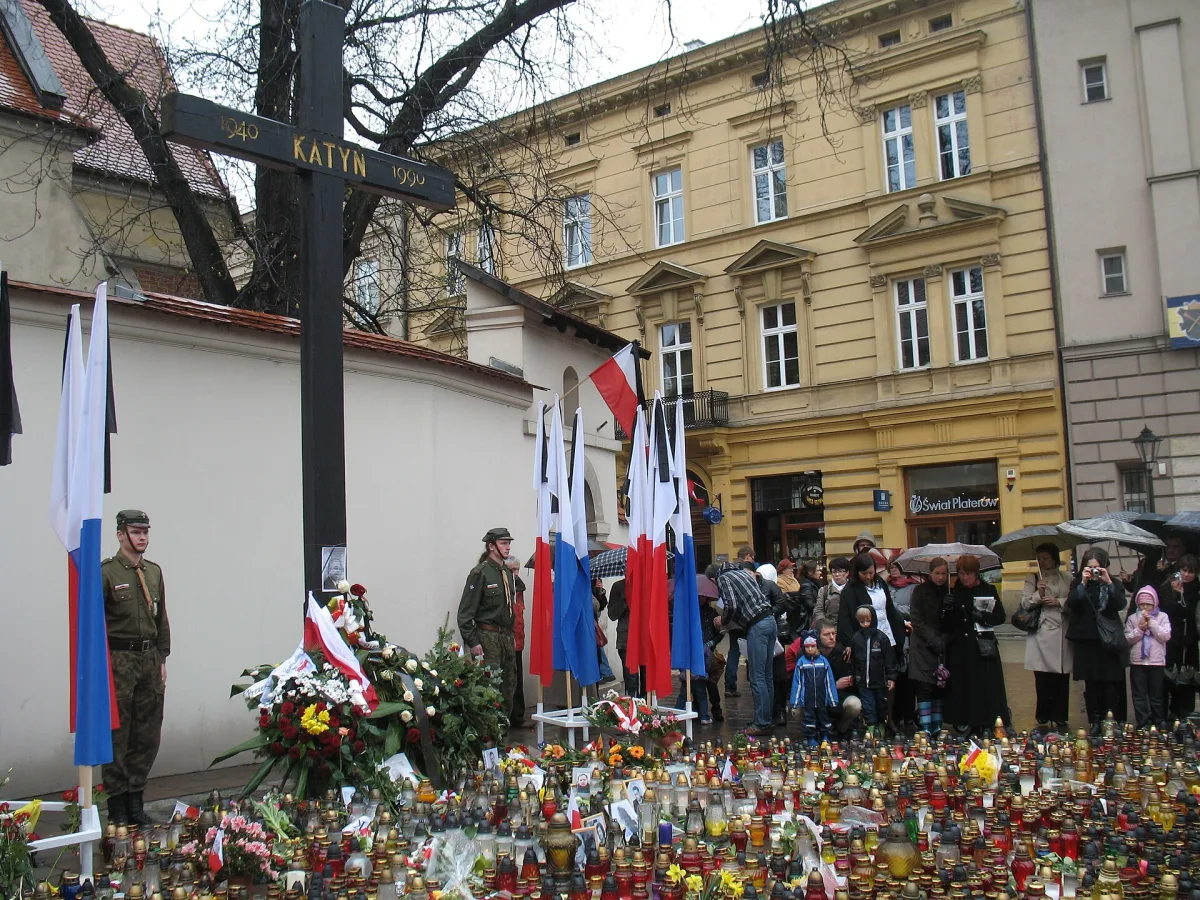
The following crypts have their own names. In the crypt beneath the Mary Chapel rests Stephen Báthory, buried on 23 May 1588, in a pewter sarcophagus from a Gdańsk workshop. This sarcophagus underwent a third conservation, which lasted nine months and ended in January 2016. The family of Władysław IV Vasa has a separate crypt. In the Sigismund Crypt lie Sigismund II Augustus, Anna Jagiellon and other members of the dynasty, as well as an urn with the ashes of Stanisław Leszczyński, placed here only in 1938. Beneath the Sigismund Chapel, in a stone sarcophagus, rests Sigismund I the Old with his son Olbracht. In the Vasa Crypt lie Sigismund III Vasa, Constance of Austria, as well as John II Casimir and Marie Louise Gonzaga. On leaving this crypt one passes an urn with soil from Katyn and a plaque of 1990 commemorating the fiftieth anniversary of the Katyn massacre. The memory of it in the city is also preserved by the Katyn Cross at the foot of Wawel.
National heroes in St Leonard's Crypt
After the Congress of Vienna the idea arose of burying the most distinguished Poles at Wawel, as a sign of the continuity of the history of a nation deprived of its own state. The first to rest here were Prince Józef Poniatowski and Tadeusz Kościuszko. Poniatowski's funeral ceremonies took place on 22 and 23 July 1817, and he had died on 19 October 1813 in the waters of the Elster near Leipzig. Kościuszko died on 15 October 1817 in Solothurn. The consent of Tsar Alexander I for a burial at Wawel was obtained in February 1818, and the ceremonies took place on 22 and 23 June 1818. The coffin was placed in a marble sarcophagus in complete secrecy on 21 December 1832, because of the situation in the Polish lands after the fall of the November Uprising. In 1977 a bronze plaque was hung next to the sarcophagus, a gift of the United States Congress on the bicentenary of the Battle of Saratoga. Kościuszko is also commemorated by the monument on Wawel Hill and by Kościuszko Mound, raised in 1820-1823.
The Crypt of the National Bards, 1890
The idea of burying Adam Mickiewicz in the cathedral arose right after his death in 1855. It was returned to in 1869, when a special committee was set up, and then in 1879, and only after eleven years did the efforts succeed. In June 1884 the cathedral chapter gave its consent to the burial, stipulating however that the poet would not rest in the royal crypts, which were regarded as closed once and for all. A separate crypt was therefore created.
The task of arranging it was given to Sławomir Odrzywolski in January 1890. He adapted one of the existing crypts under the northern arm of the ambulatory, before the entrance to the Lipski Chapel, and covered it with a barrel vault with shields bearing the arms of Poland, Lithuania and Ruthenia. On the eastern wall an altar table was placed, and above it a mosaic with the image of Our Lady of the Gate of Dawn, made in the workshop of Antonio Salviati in Venice. The delegation to collect Mickiewicz's remains set out on 20 June 1890 for the cemetery in Montmorency, and the solemn funeral in the cathedral took place on 4 July of the same year. The sarcophagus of Częstochowa marble was designed by Odrzywolski. The poet's memory is also expressed by the monument on the Main Market Square, unveiled in 1898.
The ashes of Juliusz Słowacki were brought from Paris's Montmartre in 1927, after many efforts, with the consent of Metropolitan Adam Sapieha. For his resting place an empty crypt adjoining Mickiewicz's crypt was chosen, and the wall between them was demolished, creating a single chamber. The work was directed by Adolf Szyszko-Bohusz. The funeral took place on 28 June 1927, and the coffin was placed in a sarcophagus of black Krzesławice marble with a simple cross on top. Above it stands an urn with soil from the grave of the poet's mother, Salomea Bécu, from the cemetery in Kremenets. The poet's name is borne by the Kraków theatre on Holy Spirit Square (plac Świętego Ducha), named in 1909.
Norwid and Chopin: commemorations in the crypt
Two more artists are commemorated in the crypt. On 23 May 1993 an epitaph plaque to Cyprian Kamil Norwid was unveiled. In 2001 his symbolic burial took place, because the poet's remains could not be found or identified. Soil was taken from the communal grave in Montmorency, and the urn was blessed in Rome by John Paul II. On 24 September 2001, the 180th anniversary of the poet's birth, the urn was placed in a small niche next to the plaque.
On 28 February 2010, the bicentenary of the birth of Frédéric Chopin, a medallion of the composer was unveiled, a copy of the likeness from his tombstone at the Père Lachaise cemetery in Paris, with the inscription “To the great artist, the nation”. It is not a burial, but a commemoration. The medallion was placed opposite Norwid's slab, and was funded by the authorities of Kraków.
The Marshal and the President: the last crypt
In the last crypt, designed by Adolf Szyszko-Bohusz in the Romanesque tower (the Silver Bells Tower), rests Marshal Józef Piłsudski, moved here from St Leonard's Crypt, where he was originally buried. In accordance with his will he is accompanied by a clay urn with soil from the grave of his mother, Maria née Bilewicz Piłsudska, buried at the Rossa cemetery in Vilnius, as is the Marshal's heart. Piłsudski is also commemorated by the mound in the Wolski Forest.
In the vestibule of this crypt, in the sarcophagus on the left, are buried President Lech Kaczyński and his wife Maria, who died in the air crash near Smolensk on 10 April 2010. On 10 September 2010 a plaque of light sandstone was unveiled there with the names of all the victims of the crash and the Latin maxim Corpora dormiunt, vigilant animae, that is “bodies sleep, souls keep watch”. The same words appear on the canopy above the exit from the crypts, designed by Szyszko-Bohusz. The columns of the canopy come from the demolished Cathedral of St Alexander Nevsky in Warsaw.
Objects connected with the royal burials, including finds from the royal tombs, are shown by the Cathedral Museum, and the exhibitions on the hill are described in the entry on Wawel Royal Castle.
Be the first! Add a comment.
You need to log in to add a comment.
Log in