
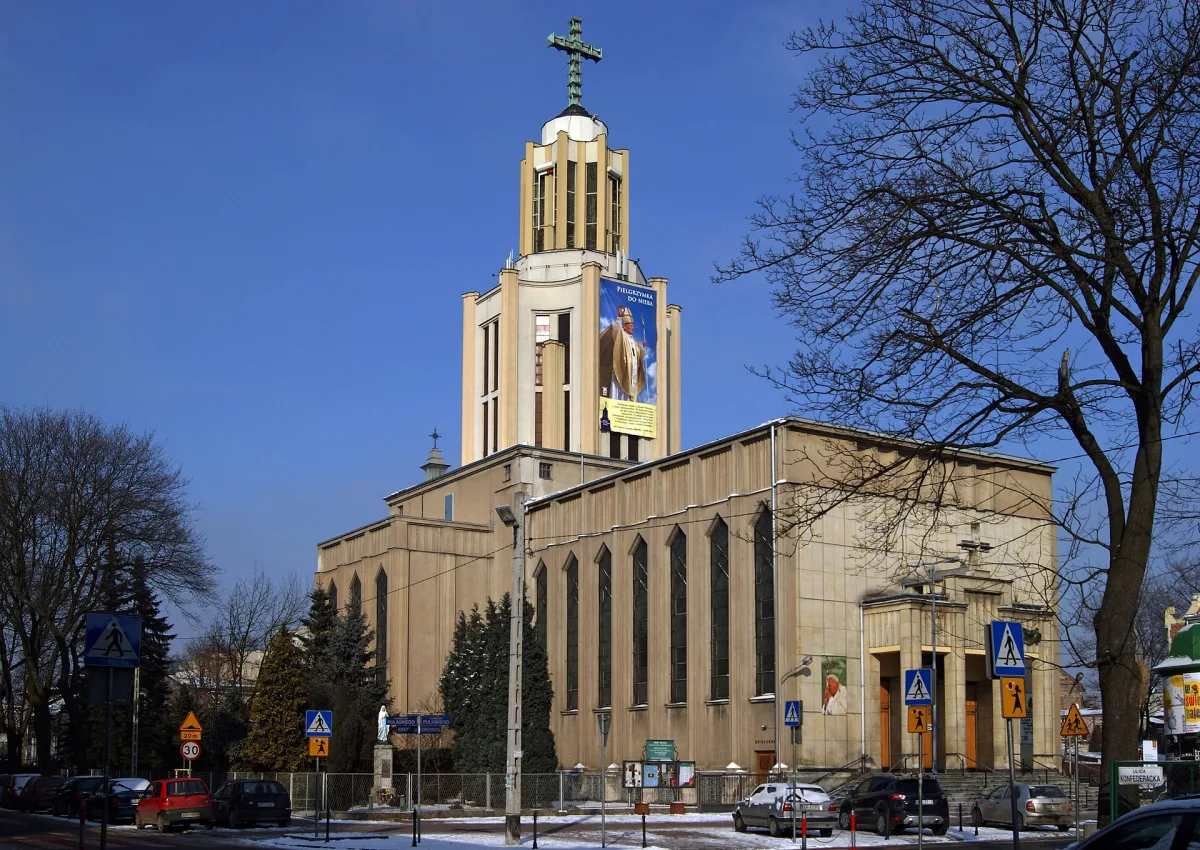
The house on Tyniecka Street and a university that was missing
Karol Wojtyła moved to Kraków in the summer of 1938, after his school-leaving exams in Wadowice. He settled in Dębniki, at 10 Tyniecka Street. The entry on the Dębniki Church of St Stanislaus Kostka states that it was the house of his uncle, Feliks Kaczorowski, and that the young student took part in the consecration ceremony of this church that same summer. The entry on John Paul II, on the other hand, writes of the family home of his mother, to which Wojtyła moved together with his father. Both versions speak of the same address, and differ only in the description of whose house it was.
In October 1938 he began studies in Polish philology at the Jagiellonian University. The first year meant a literary circle, poems, Cracovia matches and the Academic Legion camp in July 1939, where he built a school and roads. Then came the war. On 6 November 1939 the Germans arrested 184 people, mainly professors and lecturers of the Jagiellonian University and of the Mining Academy, and most of them ended up in the Sachsenhausen camp. The meeting to which the lecturers were summoned took place in the building of Collegium Novum. According to the entry on John Paul II, the occupation took from Wojtyła the possibility of continuing his studies.
In February 1940 he met Jan Tyranowski, who ran a religious study circle for young men. There he read the writings of St John of the Cross for the first time. On 18 February 1941 his father died after a long illness, and Karol moved into the house of his friend Juliusz Kydryński, at 10 Felicjanek Street.
The quarry at Zakrzówek
Wojtyła was first a messenger in the shop of a relative, Józef Kuczmierczyk, and from autumn 1940 he worked as a manual labourer for the Kraków Solvay Soda Factory, which the Germans called Ostdeutsche Chemische Werke. According to the website of the John Paul II Institute of Intercultural Dialogue, the date of employment was 11 October 1940. Another subpage of the same website gives the period of work in the quarry as from September 1940 to October 1941.
Limestone from Zakrzówek, on Wyłom Street, was the raw material for the production of soda. It was blasted from the rock with explosive charges, and then carried by narrow-gauge railway to the factory at Borek Fałęcki. Wojtyła loaded crushed stone into wagons, laid tracks and placed charges in the rock. The website describes this work as very hard. The entry on John Paul II says briefly: in autumn 1940, for a year, in the quarry at Zakrzówek, and then at the water treatment plant.
The quarry no longer exists in its old form. In 1992 water flooded the excavation and the Zakrzówek Lake was created, with a park around it. According to the entry on the lake, under the water lies a granite plaque commemorating Karol Wojtyła, who worked in this area during the Second World War. The plaque lies under water.
The Solvay factory and the walk in wooden clogs
In autumn 1941 Wojtyła was transferred to the factory itself on Zakopiańska Street and employed in treating water for the boiler house. According to the Institute's website he carried buckets of lime water across a long courtyard and moved sacks of reagents. The same website writes that he walked to work from 10 Tyniecka Street, in wooden clogs, and that it took him about an hour one way. These are details from a single website, so we treat them as an account and not as a fact confirmed by several sources. Similarly, the website itself gives the dates inconsistently: in photo captions it speaks of the quarry from autumn 1941, that is a year later than in the text.
The Institute's website links these experiences with the later teaching of the pope on work, but that is its own interpretation. The Wikipedia entry adds that in this period Wojtyła became involved with an organisation called Unia.
The Rhapsodic Theatre and the clandestine seminary
On 22 August 1941, in a private flat at 7 Komorowskiego Street, a secret meeting took place of the group that formed a theatre under the direction of Mieczysław Kotlarczyk. Among the participants was Karol Wojtyła. The first performance, "King-Spirit" by Juliusz Słowacki, was staged on 1 November 1941, and the theatre took its name from the rhapsodic recitation of this work. By March 1943 six premieres were staged, in private flats, for specially invited audiences. Wojtyła belonged to the company in 1941-1942.
In 1942, to Kotlarczyk's disappointment, he left the theatre and entered the clandestine Metropolitan Seminary. The Germans dissolved the official seminary in 1941, and the Metropolitan of Kraków, Archbishop Adam Stefan Sapieha, organised underground structures then. It was he who decided to admit Wojtyła. He studied theology at the clandestine Faculty of Theology of the Jagiellonian University.
To ordination in 1946
From April 1945 to August 1946 Wojtyła worked at the university as an assistant. On 13 October 1946 he became a subdeacon, and a week later a deacon. On 1 November 1946 Cardinal Sapieha ordained him a priest in the chapel of the Bishops' Palace at 3 Franciszkańska Street. The next day, 2 November, as a newly ordained priest he celebrated his first Mass in the Crypt of St Leonard in the cathedral on Wawel Hill. The website of the Institute of Intercultural Dialogue adds that on All Souls' Day he celebrated three Masses there, because on that day a priest may celebrate three Masses. On 15 November he left for Rome to study.
He returned to the palace on Franciszkańska Street years later: according to Wikipedia he moved into it in 1964, as archbishop, and lived there until his election as pope. These later places, from the Papal Window to Mogiła and Łagiewniki, are covered in a separate text.
Be the first! Add a comment.
You need to log in to add a comment.
Log in