
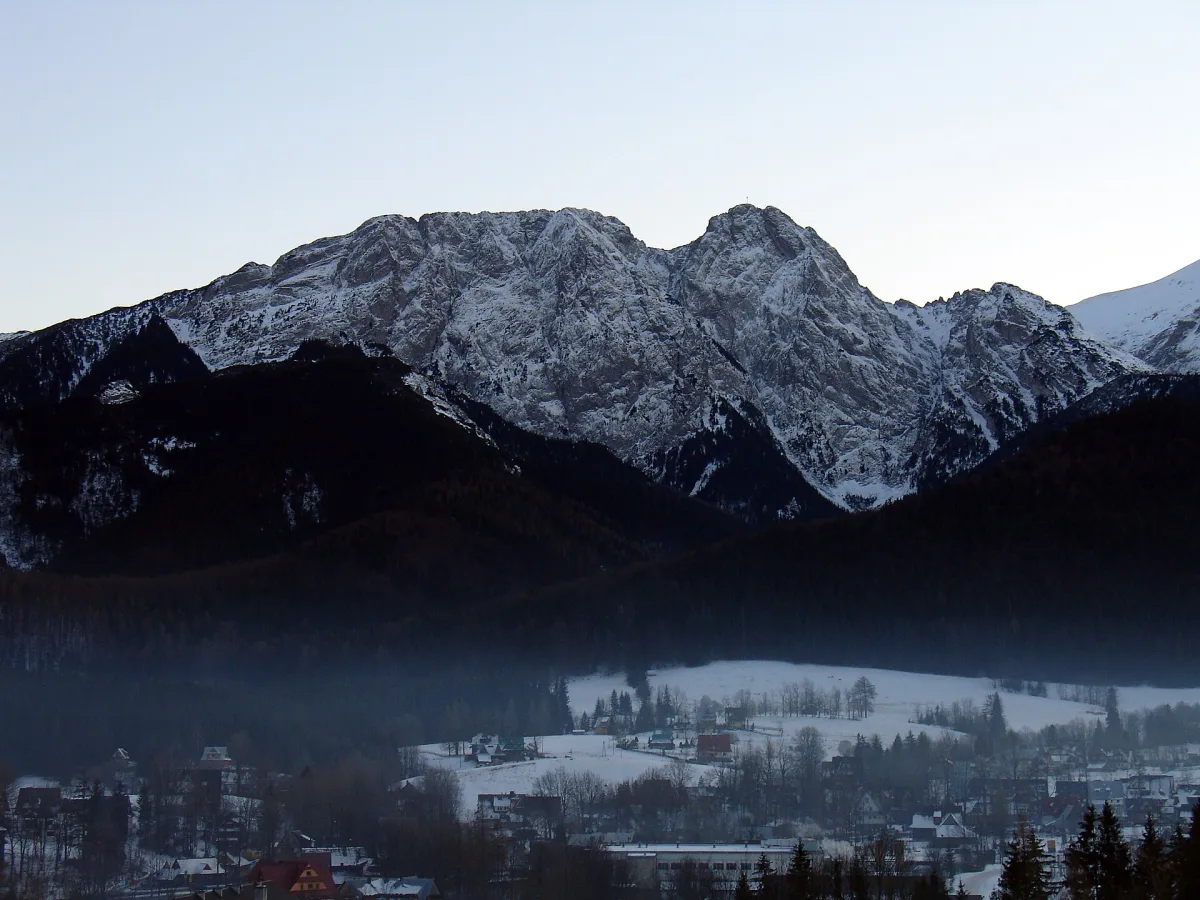
The Tatra Mountains have their own body of stories, told among highlanders (górale) and climbers for decades, and often for centuries. Below we have collected three: the knights sleeping in Giewont, the blacksmith from Kościelisko and the Black Lady of Zamarła Turnia. All of them are tales and should be read as such. Where the source names the person who wrote one down, we say so.
The sleeping army in Giewont
Giewont is a mountain that serves as a symbol, and its outline is associated with the silhouette of a sleeping knight. According to Wikipedia, one version of the legend of knights sleeping beneath the Tatras, who will wake when Poland is in great danger, places them beneath this very mountain. This is linked with the many caves in its walls, among them the Cave of the Sleeping Knights and the Upper Cave of the Sleeping Knights in Mały Giewont.
Klub Podróżników cites the story that the enchanted army in the underground passages of Giewont is a tradition known for centuries in Podhale, Orava and Spiš, and similar tales are also told in Slovakia. A king watches over it, and his likeness is carved in the rock. The army is to rise when injustice and human suffering increase in the world. According to this story some people then speak of the end of the world, but the highlanders do not believe it.
The shepherd Kuba from Jaworzyna
In the version prepared by Stanisław Kałamacki, a young shepherd, Kuba from Jaworzyna, is looking for a lost sheep and reaches the foot of Giewont. Tracks lead him to a cave, where he meets an old man in a crown, the king of the enchanted army. The king leads the shepherd into a second cave, where sleeping knights lie along the walls, and asks Kuba to tell them what is happening in the world. The shepherd speaks of human wrongs and poverty, but also of good people, and of the brigands who were said to punish the rich and help the poor.
The knights ask whether it is time to rise. The king answers that it is not yet, and the knights fall asleep again. Kuba returns with the sheep he has found to the shepherds' hut and remembers the king's words for the rest of his life. He tells no one where he has been.
The blacksmith Kuba from Kościelisko
The second story, also prepared by Kałamacki, concerns Kuba from Kościelisko, who was the best blacksmith in the area. One day an old man comes to his cottage asking him to shoe several hundred horses. The blacksmith sets off with him towards Giewont. In front of a cave there is a clap of thunder and a block of rock slides apart. Inside, knights sleep in one chamber and their horses stand in another. Kuba works for two days and shoes them all.
When one of the knights asks whether it is time to rise, the old man answers that it is not yet, because the army is to set out only when bad times come for the country. The blacksmith is given a small bag of money. When he leaves the cave the rock closes, and Kuba, despite his attempts, never finds the right cave again. This is a folk tale, not an account of events.
The origin of the name Giewont and another legend of the mountain
The name of the mountain has no established origin. According to Wikipedia the oldest documents mention the existence in the 16th century of a copper mine called Gyewant in this mountain, and the name probably derives from the German word Wand, meaning wall or rock face. Mariusz Zaruski, by contrast, believed that, like many other Tatra names, it comes from the surname of a highland family, the Giewonts.
The same mountain has one more legend in the stories. In the version published by Klub Podróżników, Giewont is the youngest son of a dragon and Magura, a knight defending his siblings against King Frost. Frost freezes the ground beneath his feet, and Giewont falls asleep, wrapped by a merciful Winter in a white shawl of snow. The author of this version is not given in the source.
The Black Lady of Zamarła Turnia
Other tales grew up among the climbing community. Portal Tatrzański writes that repeated accidents at Zamarła Turnia aroused speculation, and in time people began to tell of an apparition. The Black Lady was said to be a middle-aged woman in a black veil and a long dress. According to the tales she pushed climbers into the abyss, and everyone who died on this crag was said to see her just before death. The early attempts to climb the face were full of accidents involving experienced climbers, such as the Skotnicówna sisters.
The portal also reports that some climbers linked the origin of the legend with the death of Bronikowski, because his mother, in mourning, often sat beneath the face where her son had died. In the short story “Flirt z Czarną Panią” Jan Długosz presented the apparition as a good, helpful being who is wrongly blamed for every misfortune in the area.
A story about the ghost of Bronikowski also arose. According to it, a few years before the war a tourist set out from the Valley of the Five Polish Ponds to Morskie Oko by way of Szpiglasowa Pass and was caught in a storm. At the pass a stranger in old-fashioned clothes, carrying a small lantern, began to accompany him. When he pointed to Mnich and said that he was heading there, he introduced himself as Bronikowski. This is a climbers' tale, not a fact.
The Kościeliska Valley as a setting for the tales
The Kościeliska Valley, according to Wikipedia the second largest valley in the Polish Tatras after the Chochołowska Valley, is often linked with the tales of Kuba from Kościelisko and of brigands. A road to Slovakia once ran through it, and the memory of the brigands survives in the names of rocks such as the Zbójnickie Okna (Brigands' Windows) and Zbójnicka Turnia (Brigands' Crag).
Be the first! Add a comment.
You need to log in to add a comment.
Log in