
The story of a king hiding from his enemies in a cave, with a spider spinning its web across the entrance, is one of the best-known legends of the Kraków-Częstochowa Upland (Polish Jura). It gave its name to a cave in the Sąspowska Valley, to the chambers inside and to the grille at the entrance. It is worth reading alongside what the historical sources say about Władysław the Elbow-high (Łokietek) and alongside the history of the cave itself, which begins much later than the king's time.
The legend: a king, a pursuit and a cobweb
The tale says that Władysław Łokietek took shelter in the cave for about six weeks, fleeing from Kraków before the army of the Czech king Wenceslaus II. The national park places the story at the turn of the 13th and 14th centuries. According to the legend, the king slept on a stone bed in the last chamber, today called the Bedroom, and prepared his meals in a small recess in the Kitchen, known as the "fireplace". Local peasants were said to bring him food, entering the cave through the entrance passage that is open to the sky.
The most famous motif is the spider. The legend says that a web covered the entrance, and drops of morning dew made it look untouched. The pursuers decided that nobody had gone in that way and turned back. The names of the cave and its chambers, and the grille closing the entrance, made in the shape of a spider's web, are reminders of this story. The cave's older name, the Royal Grotto, refers to the same tradition.
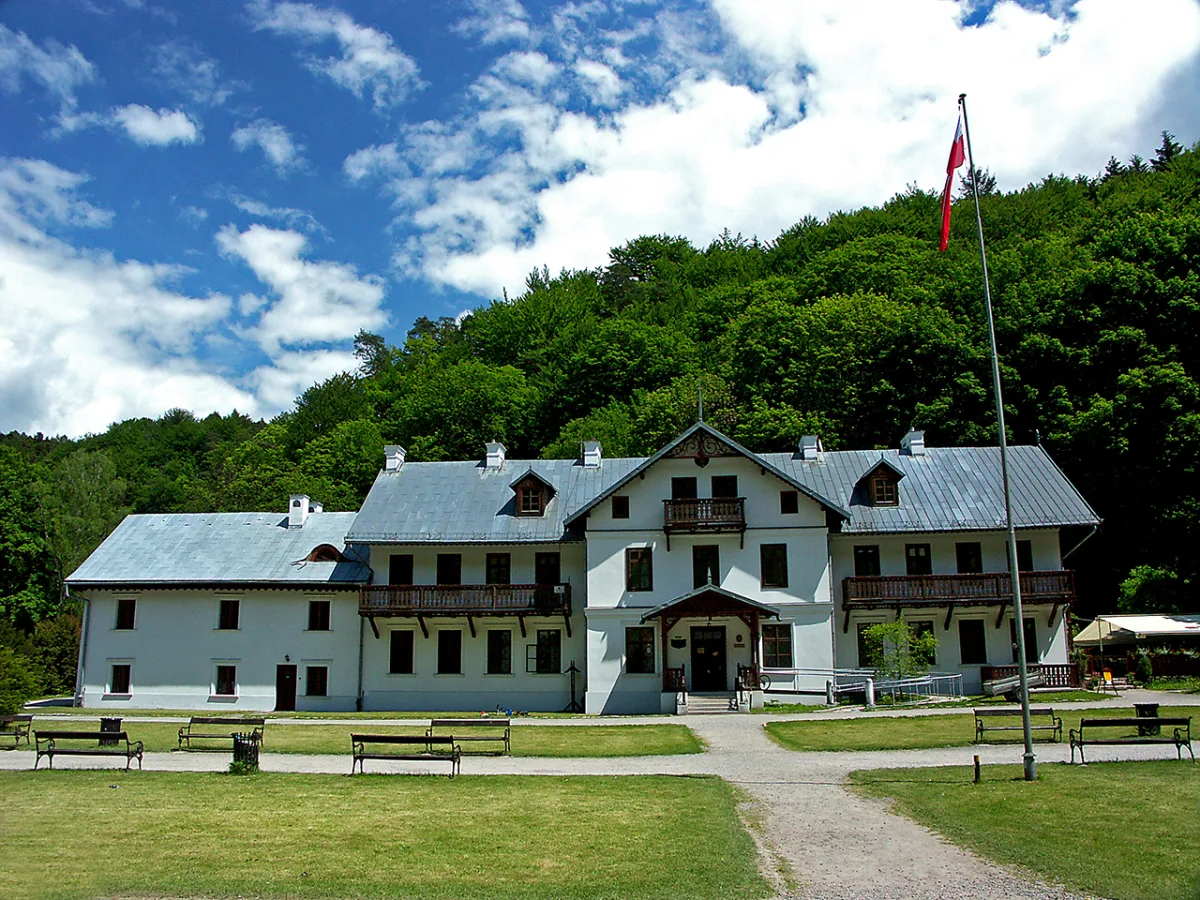
The painter Wojciech Gerson fixed the figure of the king in this area in his painting "Łokietek near Ojców". In Ojców itself the memory of the king also survives in the name of the "Pod Łokietkiem" hotel, built in 1860. Its building now houses the natural history exhibition of Ojców National Park.
What the historical sources say about Łokietek
The Wikipedia entry on Władysław the Elbow-high describes his life in great detail but does not mention a cave in the Sąspowska Valley. Ojców appears there only in the caption of Gerson's painting. This does not mean the story is invented from beginning to end, because the period in which the park sets the legend really was a time of defeats and flights for the prince.
In 1289 Łokietek took Kraków, but soon had to leave, escaping from the city with the help of the Franciscans. In 1292 Czech forces besieged him in Sieradz, and the agreement of 9 October that year forced him to pay feudal homage to Wenceslaus II. When Wenceslaus organised a military expedition in 1300, the prince had to save himself by fleeing the country. According to Wikipedia, it is not known where exactly he stayed in 1300-1304. Tradition mentions Rome and the jubilee of 1300, and Halych Ruthenia and Hungary, including present-day Slovakia, are also considered likely. He returned to Poland in 1304, and on 1 September 1306 he entered Kraków in a formal procession.
Each of these versions fits the legend only in general terms. None of them leaves room for a place or date that would allow six weeks in a cave near Ojców. The legend is therefore a story about a king in need, preserved in local tradition, and not a fact confirmed in the chronicles.
The tale about the name of Ojców is treated in the same way. According to tradition, the stronghold was originally named "Ociec" (Father) by Casimir the Great himself, in memory of the struggles of his father, who found refuge in the caves of the area. In fact, research shows that Ojców Castle was built on the orders of Casimir the Great in 1354-1370, and its first mention dates from 1370. The name of the village is thus much younger than Łokietek's supposed hiding.
Two centuries of visitors
According to Wikipedia, the first mentions of the cave come from the end of the 17th century, when it was called Spelunca Regia, that is the Royal Cave. It has been a tourist attraction since the end of the 18th century: it was visited together with the neighbouring Dark Cave (Jaskinia Ciemna) during trips to Ojców, which was popular at the time. The national park puts it more cautiously: the cave had been visited often for a long time, and regularly probably since the 18th century. The expression "two centuries" is therefore justified, since more than two hundred years have passed since the close of the 18th century, but the sources do not give an exact date of the first visits.
In the 19th century the cave also came to the attention of science. Jan Zawisza carried out excavations in it in 1871, and Stanisław Jan Czarnowski in 1886 and 1899. They found mainly cave bear bones, as well as Jerzmanowice points, a trace of early human presence. According to the park, the cave was not a comfortable shelter for people in past epochs, and the remaining part of the deposits is undisturbed. During the First World War it served as a temporary shelter for the local population, mostly from nearby Czajowice.
In 1927 the cave was declared a historic monument, and in 1987 electric lighting was installed. According to Wikipedia, it is adapted for mass tourist traffic, among other things with wooden stairs. The passage to the Bedroom was cut artificially in 1974 by miners from the "Bolesław" Mining and Metallurgical Works in Bukowno.
The cave in numbers
According to Ojców National Park, it is the largest cave in the park, 320 metres long with a vertical range of 7 metres. In one place Wikipedia gives the same 320 metres, while in its description it estimates the total length of passages and chambers at about 270 metres, so the figure should be treated as approximate. The cave consists of several passages and two large chambers, the Knights' Hall and the Bedroom, as well as two smaller ones, including the Kitchen. The temperature is about 7-8 degrees Celsius all year round, and in winter "stalagmites" of ice sometimes form in front of the entrance, called chłopki.
It is also an important bat hibernation site: the park notes that 11 species have been recorded in Łokietek's Cave, the greatest diversity among the caves of the park. The manager provides details of the visiting rules, and the cave can be read alongside the entry for Łokietek's Cave in our database of attractions.
Be the first! Add a comment.
You need to log in to add a comment.
Log in