
The high altar of St Mary's Basilica is one of those works about which people in Kraków speak almost without dissent: a Gothic altarpiece of 1477-1489, around which over the centuries more history has gathered than around many castles. This text sets in order what is known about the altarpiece from the sources: who made it, from what, how it survived the war and how many times it returned to the hands of conservators.
A sculptor from Nuremberg and twelve years of work
The story begins in 1442, when the vault of the chancel of St Mary's Church collapsed. The rebuilding of the church lasted years, and in 1477 Veit Stoss (Wit Stwosz), a sculptor associated with Nuremberg, came to Kraków and received the commission for a new high altar. According to Wikipedia he lived in Kraków for twenty years and worked on the altarpiece for twelve. The work was to be ready for the church's patronal feast, the Assumption of the Blessed Virgin Mary, on 15 August 1489. Stoss left Kraków in 1496 and returned to Nuremberg.
What the altarpiece is made of
The altarpiece takes the form of a pentaptych, that is a five-part retable, with a central shrine, movable and fixed wings and a crowning. There are more than two hundred figures. The figures were carved from solid blocks of lime wood, the load-bearing structure is oak, and the background is made of larch. The central shrine shows the Dormition of the Virgin Mary, and above it her Assumption. When the wings are opened the six Joys of Mary can be seen, and with the wings closed, twelve scenes from the lives of Mary and Jesus.
The dimensions are given differently. Wikipedia in the entry on the altarpiece itself writes of 11 by 13 metres, and in the entry on St Mary's Church of a polyptych of about 13 by 13 metres.
Dendrochronological studies have shown that the oak used for the structure came from the Niepołomice Forest, and that the trees were about 130 years old and grew in the years 1350-1472.
What is meant by the “largest” altarpiece
Wikipedia calls Stoss's work the largest Gothic altarpiece in Europe. This wording concerns one narrow category: Gothic altarpieces. The entry does not cite a comparison with other altarpieces, so we treat it as an assessment by the encyclopaedia and not the result of a measurement. The altarpiece itself is enormous and needs no additions, but if you read somewhere the sentence “the largest in Europe”, it is worth checking in what category it was made.
September 1939 and the road to Nuremberg
The sources date the start of the evacuation differently: the basilica's website speaks of the end of August 1939, Wikipedia of September 1939. The altarpiece was dismantled, and Prof. Karol Estreicher, wishing to save it from destruction, floated the figures by barge down the Vistula to Sandomierz, where they were kept in the cathedral and the diocesan seminary. According to the basilica's website the decorative elements were hidden in Kraków. According to Wikipedia the hiding place was revealed to the Germans under duress by Cardinal Adam Stefan Sapieha. The website of St Mary's Basilica puts it more briefly: the occupiers established the hiding place and took the altarpiece to Nuremberg.
Wikipedia describes the route in more detail. The figures were taken first to Kraków, then to Berlin, and in May 1940 the altarpiece appeared at an exhibition of works by Veit Stoss in Görlitz (Zgorzelec). The shrine and wings were taken directly to Nuremberg. The sculptures were deposited in the cellars of Nuremberg Castle, and the load-bearing structure at Wiesenthau Castle. In the entry on Estreicher, Wikipedia writes that the altarpiece was stolen from Kraków in 1940.
The return in 1946 and 1957
After the war the altarpiece was found by Prof. Estreicher with the help of the Americans. It returned to Kraków by train in May 1946. The basilica's website also mentions Curtis L. Dagley, who in 1946 escorted the transport and who in 2016 received the Bene Merito badge for his part in this return.
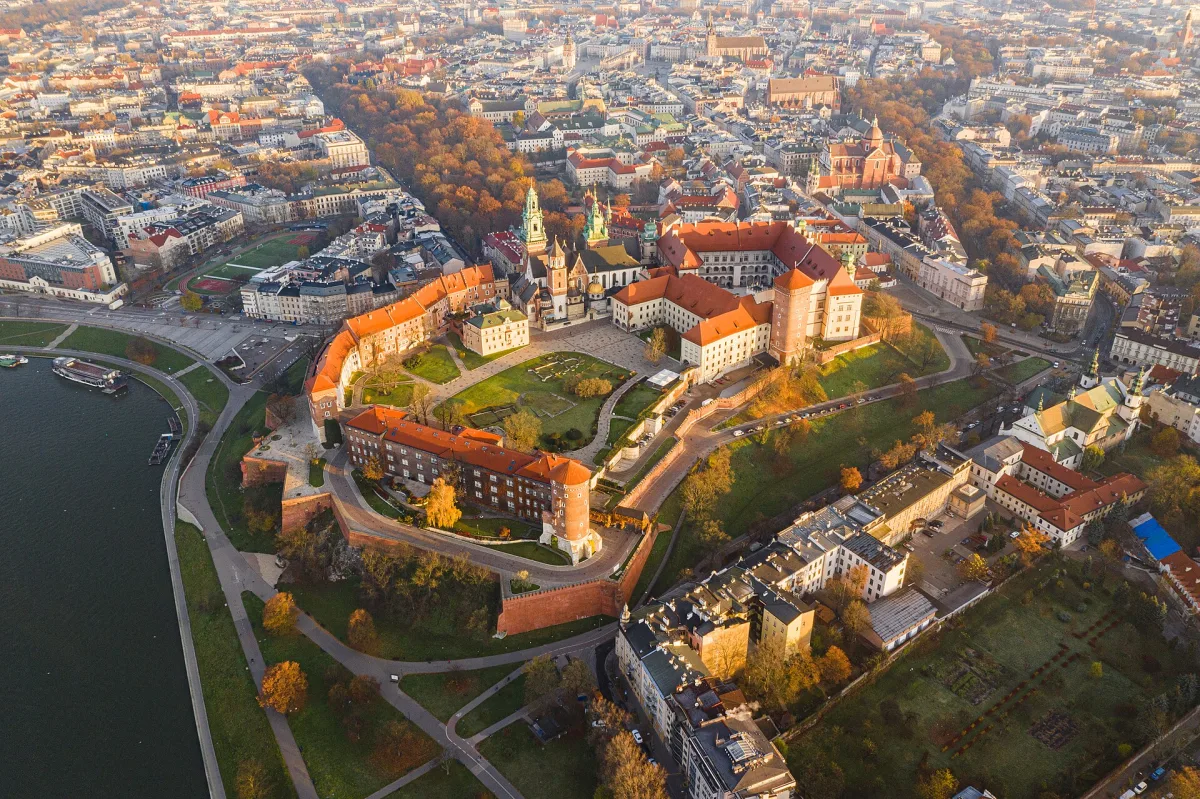
The altarpiece did not return to the church at once. It was conserved on Wawel Hill in 1946-1950, and reached its place in the basilica in 1957. The hill together with the Wawel Royal Castle can therefore be seen as a place that for several years became the conservators' workshop for the altarpiece.
Conservation in 2015-2021
The last major restoration began in 2015 and ended in February 2021. It was carried out by a team of the Inter-University Institute of Conservation and Restoration of Works of Art of the Warsaw and Kraków Academies of Fine Arts. After the overpainting was removed, a colour scheme closer to the medieval one was revealed: the red of the frames, the blue of azurite and extensive gilding. On the back of the figure of St James an inscription with the date 1486 was discovered, which changes what is known about when the main part of the work was completed. Wikipedia nevertheless still gives the period of work as 1477-1489.
Where to find the altarpiece and its surroundings
The altarpiece stands in the chancel of the basilica on the Main Market Square, next to the Cloth Hall (Sukiennice) and the Town Hall Tower. In the corner of the square also stands the Romanesque St Adalbert's Church. A detailed description of the work itself, its scenes and iconography can be found on a separate page: Veit Stoss Altarpiece in Kraków. Check the hours and rules of entry to the basilica with the church's administrator before your visit, because they vary by day.
Be the first! Add a comment.
You need to log in to add a comment.
Log in