
Which churches on the list are wooden and Gothic
The set named in the title of the subject had to be sorted out, because not all the churches listed are made of wood. According to Wikipedia the church in Grywałd is Gothic and wooden, the one in Harklowa is wooden and late Gothic, and the one in Orawka is wooden, from the 17th century. The church in Lipnica Wielka is brick-built and Baroque, and the Church of St Stanislaus in Frydman in Spiš is brick-built, Gothic in its oldest parts. We therefore describe the wooden churches of Podhale, the Pieniny and Orawa, and the brick ones only briefly, as a counterweight. Dębno, which is described at length in a separate text on the Gothic churches of Lesser Poland, appears here only as a point of reference.
Dębno: the model for the Podhale churches
The Church of St Michael the Archangel in Dębno dates from the second half of the 15th century, and its tower from 1601. In 2003 it was inscribed on the UNESCO World Heritage List together with five other wooden churches of southern Lesser Poland. It is a good point of reference, because the features seen in Dębno recur in neighbouring villages: a rectangular chancel, a shingle-covered roof and the soboty, that is wooden arcades running around the building.
Grywałd: Gothic on the edge of the Pieniny
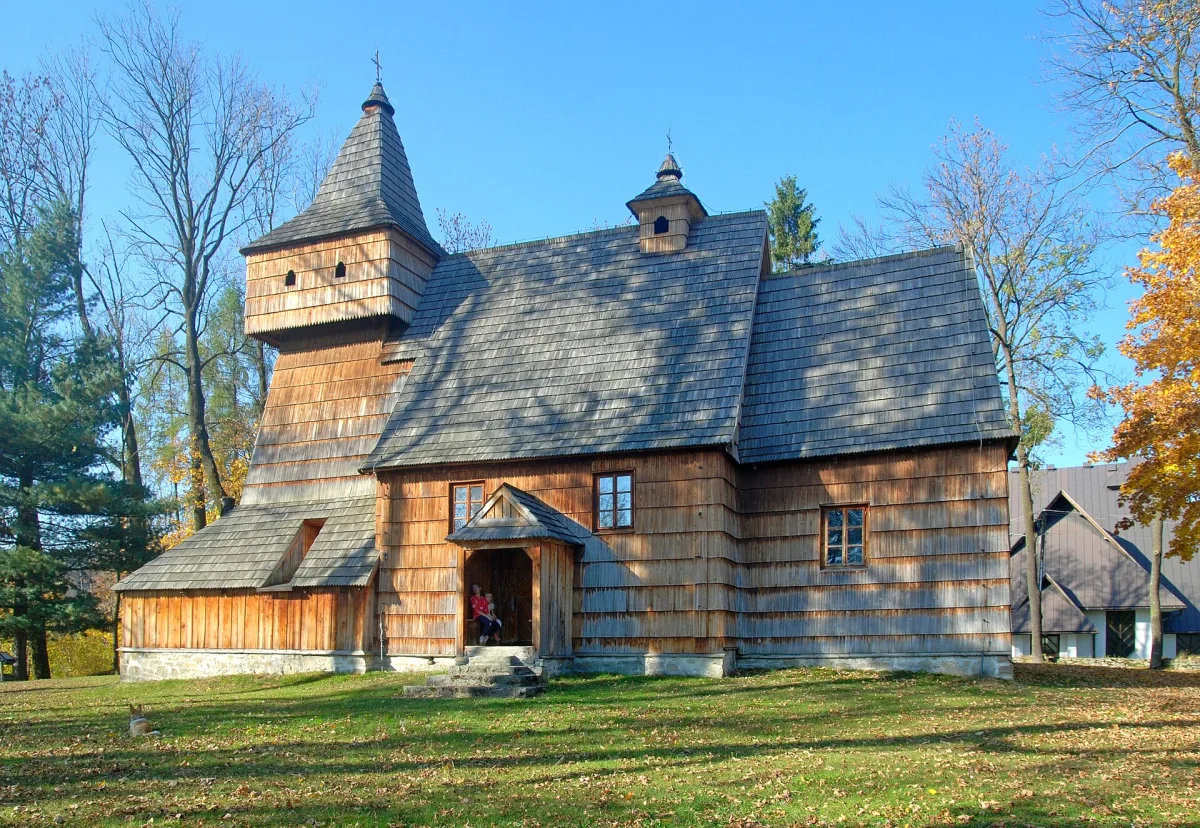
Grywałd lies in the municipality of Krościenko nad Dunajcem, already in the Pieniny. Wikipedia describes the old Church of St Martin as Gothic, wooden, built in the second half of the 15th century on the site of an earlier church. According to a tale a pagan gontyna (shrine) was said to have stood in the same place earlier, but this is only a legend and there is no confirmation in the sources. Before 1618 the church was extensively rebuilt: the structure of the roof and ceilings was changed, a tower was added and the interior was covered with polychrome painting.
The chancel and nave are of log construction, and the tower is of post construction. The tower and part of the nave are surrounded by boarded soboty. Behind the high altar St Michael the Archangel is painted casting Satan, in the form of a bear, down into hell. The high altar preserves a late Gothic triptych of the 16th century with St Martin. Known renovations include the years 2008-2010 with extensive conservation work. Alongside it the old little church in the parish was replaced by the new brick Church of Our Lady of the Snows, built in 1992-1997, that is a new church, not a historic one.
Harklowa: a late Gothic church after 19th-century alterations
The Church of the Nativity of the Blessed Virgin Mary in Harklowa, a village on the Dunajec in the municipality of Nowy Targ, was built at the end of the 15th century on the site of an older church. Wikipedia places it in the group of Podhale churches and notes that considerable 19th-century alterations had an unfavourable effect on its architecture. Next to the nave an imposing four-sided domed chapel was added in 1866, and in 1877 a neo-Gothic turret for a small bell. The tower with an izba-type (izbicowa) structure dates from the 17th century.
Around 1500 the interior was decorated with patron-motif polychrome painting, but it was repainted four times. The present paintings on the vault and walls date from 1935, and the old decorations survive in fragments on the ceiling of the porch under the tower. At this building one can see that the age of the structure and the age of the decoration are two different matters. The two Rococo altars in the chapel come, according to Wikipedia, from the church in Maciejowce in Slovakia.
Orawka: the oldest wooden church of Upper Orawa
The Church of St John the Baptist in Orawka was built on the initiative of Fr Jan Sczechowicz. Preparations began in 1650, and in 1656 a visitor described walls raised to a height of about 3.5 metres. The church was completed before 1659 and consecrated in 1715. Wikipedia writes that it is regarded as the oldest wooden church of Upper Orawa, so this is an assessment, not a settled fact. The building stands on the Wooden Architecture Route, and according to Wikipedia in 2003 it was designated a Historic Monument.
The interior is covered with figural and ornamental polychrome painting. A cycle of 14 scenes from the life of St John the Baptist was made between 1656 and 1659, and a gallery of 53 saints and blessed persons connected with the Hungarian tradition dates from 1711. On the gallery stands an organ from the third quarter of the 17th century, which Wikipedia counts among the oldest pipe organs in Poland that can still be played. Orawka was among nine churches put forward for inscription on the UNESCO list in 2003, but the committee chose the oldest, Gothic churches and Orawka was not on it.
Brick churches nearby: Lipnica Wielka and Frydman
The Church of St Luke the Evangelist in Lipnica Wielka in Nowy Targ County is a brick Baroque church of 1762-1770, consecrated in 1769, with a tower raised in 1798. The furnishings are neo-Baroque and date from about 1915. It is therefore not one of the wooden churches, although neighbouring villages are famous for their wooden churches.
The Church of St Stanislaus in Frydman in Spiš is described by Wikipedia as Gothic in its oldest parts, from the turn of the 13th and 14th centuries, built of quarried stone and with later Baroque alterations. It is regarded as the oldest monument of sacred architecture in the Podtatrze region. This building shows that the Spiš villages have their own brick tradition, different from the wooden churches of Podhale and Orawa.
Be the first! Add a comment.
You need to log in to add a comment.
Log in