
The forts of the Kraków Fortress now serve very different purposes: one is a cultural centre with a song library, another a park with a restored façade, another an overgrown ruin, and some lie on military or private land. This overview sorts them by type, because the type tells you what to expect: artillery forts are large brick complexes with moats and barracks, armoured forts are low concrete structures with turrets, and from the time they were built to their present state they are often separated by several decades of neglect. The history of the whole system, from the decision of 1850 to the demolitions, is covered in a separate article on the origins of the fortress.
Two types worth telling apart
In very broad terms: the artillery forts of the 1870s and 1880s had a rampart with guns and a gorge barracks, and their armament was open. The armoured forts of the 1890s were smaller, carried no heavy guns (these went to separate batteries in the foreground) and had armoured turrets that rose out of concrete emplacements. Fort Tonie is a transitional case, built as an artillery fort and rebuilt as an armoured one. Numbers with suffixes, such as 48a or 47 ½, mark structures added next to an older fort with that number. All of this should be read with the caveat that every fort was a little different, and the line between the types is sometimes blurred in descriptions.
Armoured and auxiliary forts
Fort 44 Tonie on Jurajska Street was built in 1878 as an earth-and-timber redoubt, rebuilt in 1883-1885 as a permanent artillery fort, and in 1902-1908 as an armoured one, with two batteries of two retractable rotating turrets each. In 1914 it was among the strongest forts of the fortress, but it took no part in the fighting of the First World War, which took place beyond the range of its guns. During the occupation some of the armour was damaged. The army left it in the early 1990s. The sources give no information on the rules of entry, so treat it as a site to be viewed from the outside until the owner says otherwise.
Fort 48a Mistrzejowice on the Piastów estate is a good example of a small armoured fort. Built in 1895-1897 to a design by Emil Gołogórski, it covered the Dłubnia valley from the side. After the First World War it served as a warehouse, and later stood devastated and littered. Renovation of the façade began in 2021 and was completed in 2024, and today the fort stands in a park with paths and benches, so it can be seen from the outside during a walk.
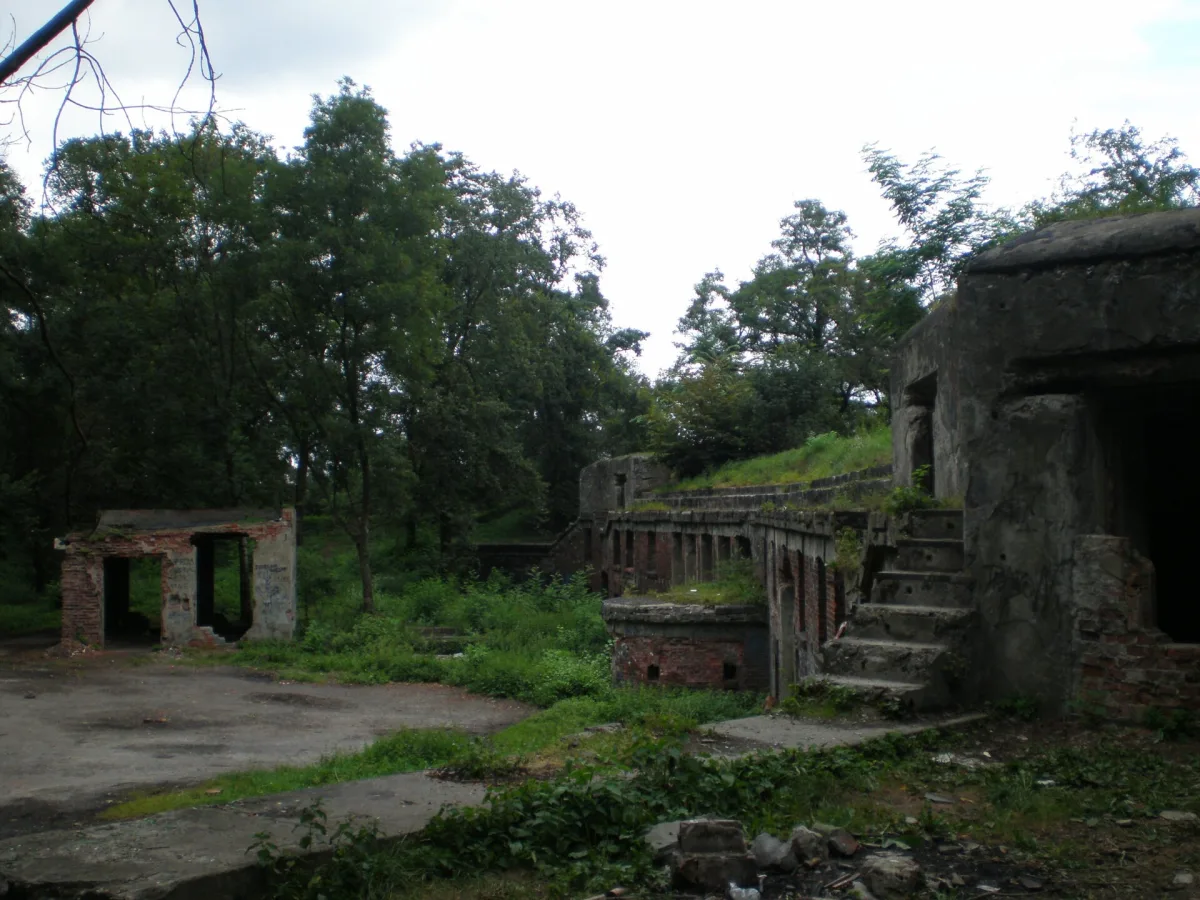
Fort 47 ½ Sudół on Powstańców Street, close to the Batowice Cemetery, was one of the smallest armoured forts of the fortress, with two armoured turrets and an observation dome on the rampart. In 1950 it was partly blown up and has been a ruin ever since. Do not enter fenced or secured areas. Fort 45a Bibice from 1895-1897, hidden in a copse above the Bibiczanka stream, looks similar: in the 1960s a soft-drinks factory was planned there, then a cultural centre, but no plan was completed and the site is largely devastated.
Fort 43a Podchruście near Modlniczka is an example of an inaccessible fort. It was built in 1896-1902, only the earth ramparts are well preserved, and for several decades it has been occupied by the army together with the neighbouring Pasternik fort. The Kraków Fortress Trail once ran along the road between them, but its route was changed and now bypasses them. Entering the military area is forbidden.
Artillery forts
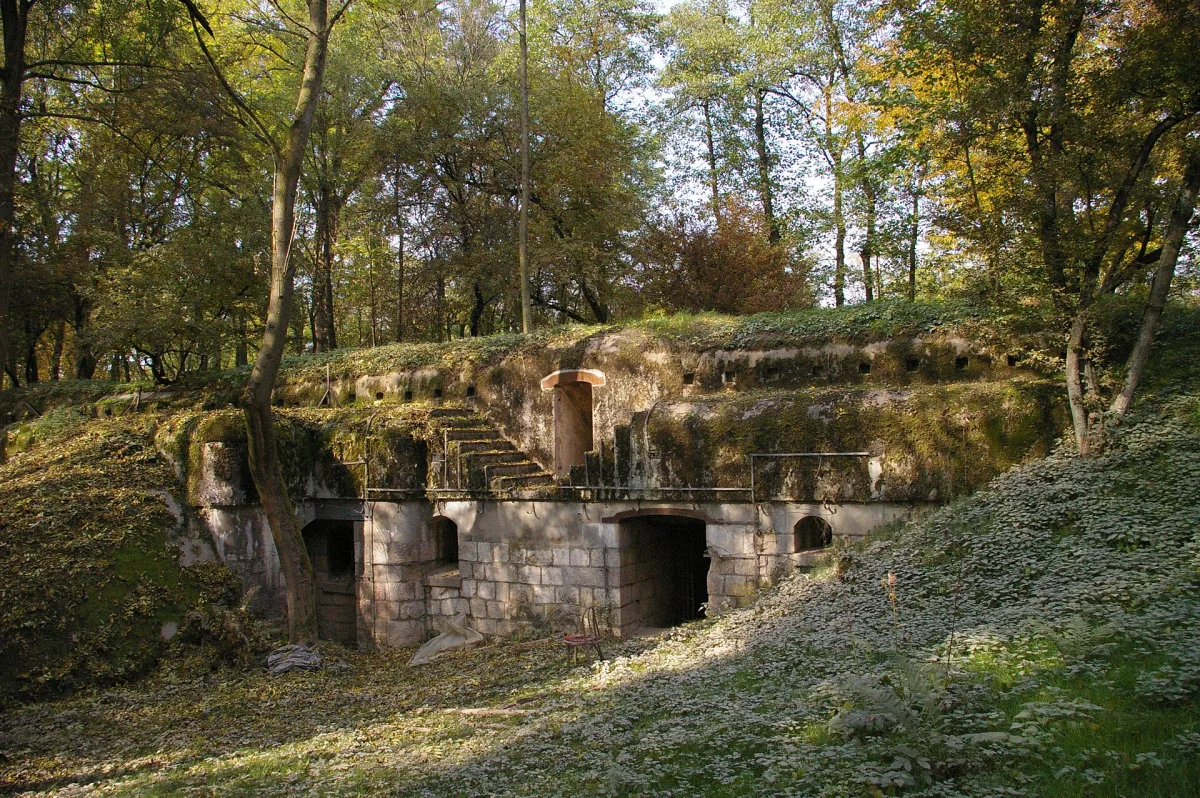
Fort 52 Borek in Swoszowice is the most successful case of adaptation. It was built in 1885-1886, most probably to a design by Daniel Salis-Soglio, and three forts of the Przemyśl Fortress were modelled on it. It is a double-rampart fort: the higher rampart served the artillery, the lower one the infantry and light guns. Inside is what Wikipedia calls the first three-level underground junction of routes for soldiers and the transport of weapons in Kraków. In December 1944 an American B-17 bomber made a forced landing in its foreground. Revitalisation was carried out in 2013-2022, and since July 2022 the fort has been managed by the Podgórze Cultural Centre and houses the Polish Song Library. The rules of entry and events are published on the institution's website.
Fort 49 Krzesławice in Nowa Huta, dating from 1881-1886, houses a Youth Cultural Centre, and its surroundings are a park. The place also has a grim history: in 1939-1941 the Germans shot prisoners from Kraków prisons in its moats. After the war the victims were exhumed and buried in a mass grave next to the fort, where a monument stands. In November 1914 the fort's artillery fired on the foreground in the first battle for Kraków.
Fort 47 Łysa Góra in Węgrzce is, according to Wikipedia, the only brick-built artillery fort of the Kraków Fortress, with an unusual asymmetrical layout and barracks in the form of a half-bastion. It was entered in the heritage register in 2006. It is not open to visitors, so it can only be viewed from the outside. Fort 45 Zielonki from 1884-1886 has gone from a horticultural and beekeeping cooperative, which left it in 1985, through a ruin and a hotel that no longer operates, to securing works, during which drawings of guns made by Austrian soldiers were discovered under layers of repainting.
Fort 53 Bodzów on Solnik Hill is a ruin with a view over a large part of the city and six caverns cut into the rock. It was built in 1887 as a semi-permanent fort and in 1913-1914 rebuilt as a permanent one. Here the sources diverge: the Wikipedia entry on the whole fortress lists Bodzów among the demolished forts, while the trail description counts it among the relics, that is, preserved remnants. The record in our database describes it as a ruin entered in the heritage register, and that is how we treat it here. Take care.
Fort 41 Bronowice Małe is an infantry fort that remained in earth-and-timber form and was never rebuilt. Today the earth ramparts remain, and according to the Wikipedia entry it has been occupied by the army since the 1950s, so it is not a site to visit.
The trail that links the forts
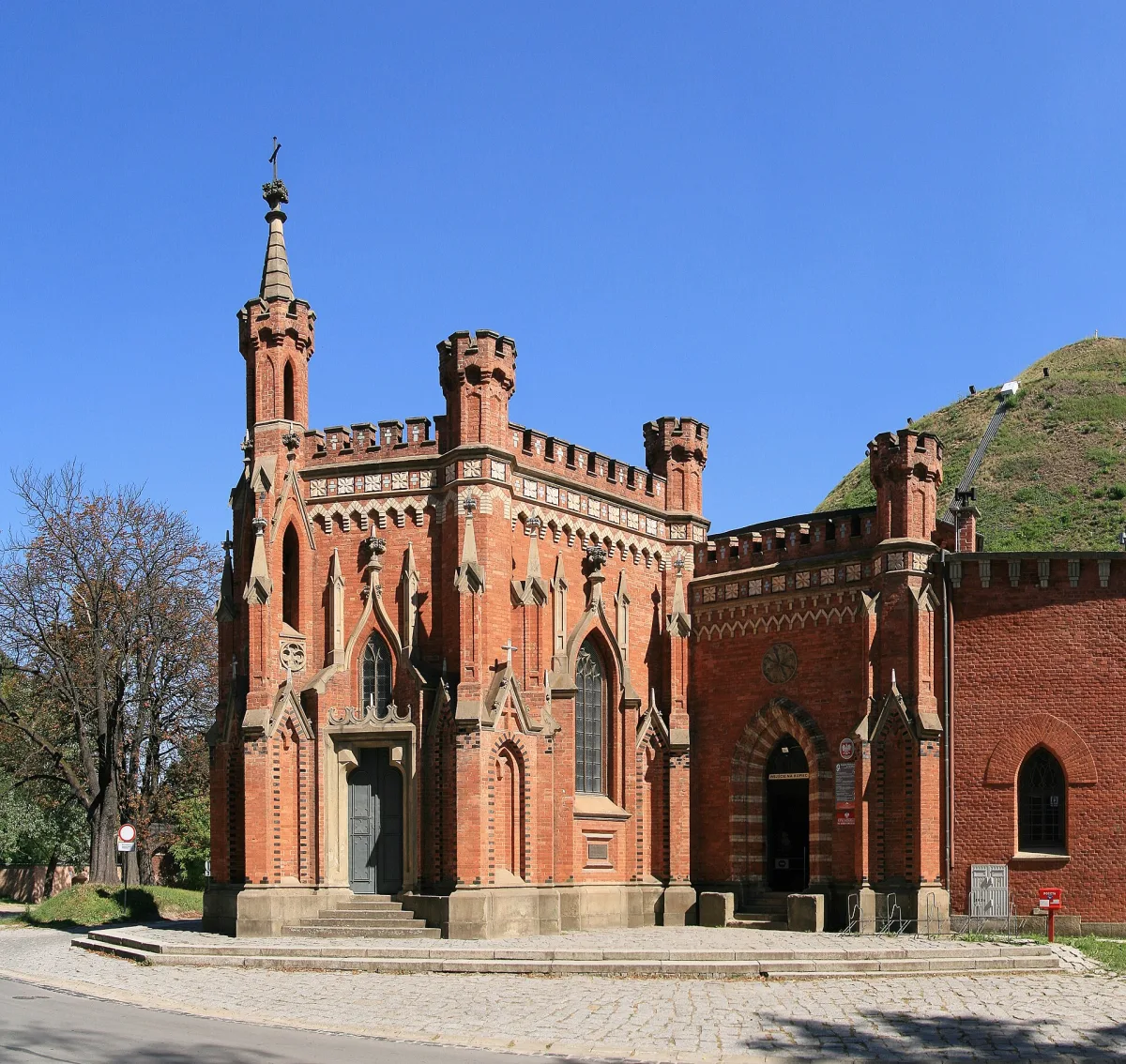
The easiest way to see the forts is on the Kraków Fortress Trail. It is a walking and cycling route marked with yellow-black-yellow stripes, referring to the colours of the Austrian Empire, and largely follows the historical lateral road. It consists of two loops: a northern one about 60 km long and a southern one about 41 km long. The northern loop runs from Fort Mogiła to Fort Kościuszko and is divided into sections of 28 and 32 km. The trail description says the whole includes about 100 structures, among them 38 large forts, which differs from the figure of 34 forts given in the entry on the fortress itself. Along the route there are developed forts, but also ones that the trail bypasses because they stand on military land.
Before you set out for the forts
- Developed forts, such as Borek, Krzesławice and Mistrzejowice, have their own managers. See the interiors on their terms.
- Łysa Góra, Podchruście and Bronowice Małe are not open to the public, so do not enter their grounds.
- Ruins, such as Sudół, Bibice and Bodzów, can be unstable. View them from the outside.
- The description of the condition of each fort is based on sources from different years, and ownership and access change, so check with the manager before you go.
Be the first! Add a comment.
You need to log in to add a comment.
Log in