
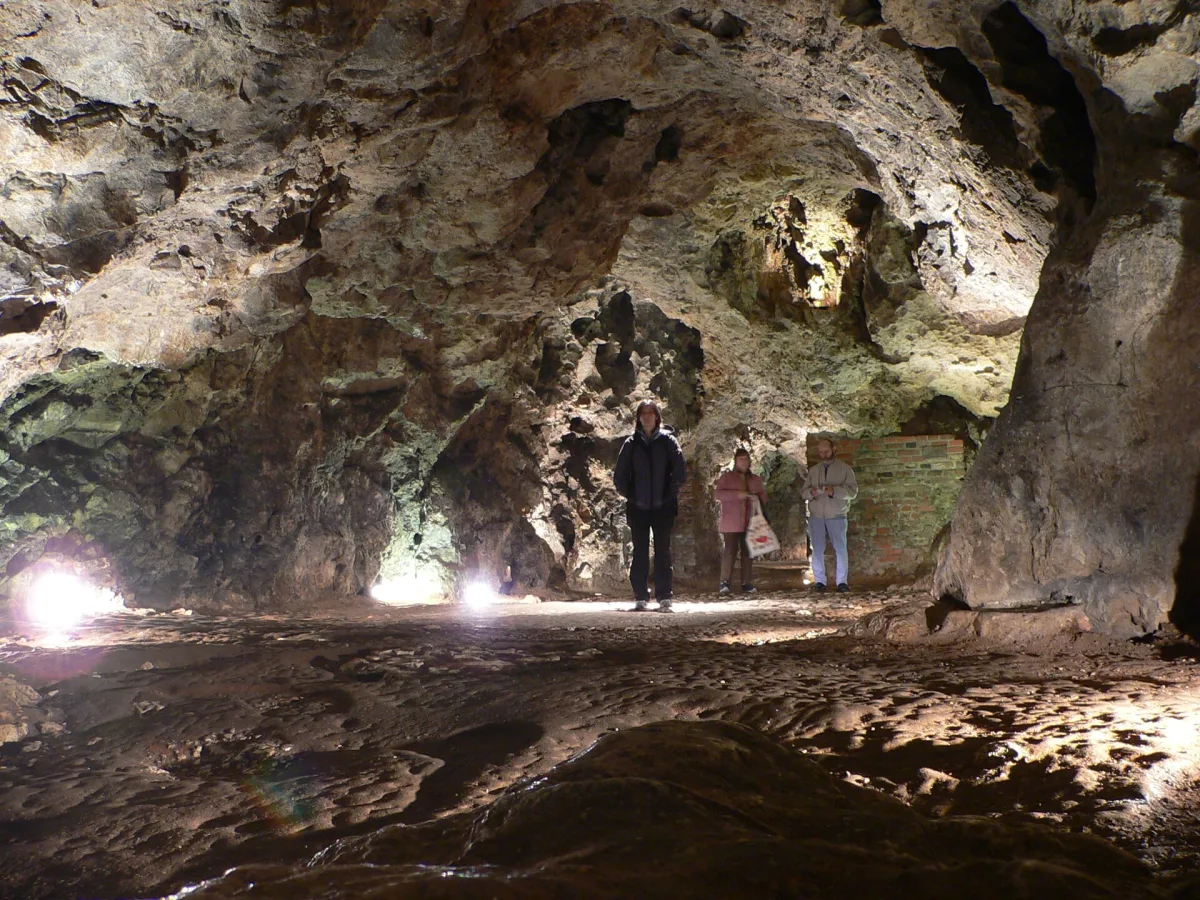
Within the boundaries of Kraków there are a dozen or so caves and rock shelters. One of them, the Dragon's Den (Smocza Jama) below Wawel Hill, has a tourist route. The others are low, narrow and often dangerous passages in Jurassic limestone, used by cavers and climbers. For a walker, the rocks and old quarries around them are more interesting. This text says what can be seen from the outside and where it is better not to go in.
The only cave with a tourist route
The Dragon's Den is a karst cave at the foot of Wawel Hill, with a total length of about 276 metres, of which the tourist route is about 82 metres. Visitors enter from the grounds of Wawel Hill by a spiral staircase and exit outside the walls, towards the Vistula, where the dragon sculpture by Bronisław Chromy from 1972 stands. The cave is mentioned in sources as early as the first half of the 16th century, and in 1565 Sigismund Augustus ordered its entrances closed for safety reasons. In 1842 the Senate of the Free City of Kraków cleared it and opened it to the public. That a dragon lived here is a legend, and the sources point to no find that would confirm it.
Zakrzówek and Twardowski's Rocks
Twardowski's Rocks (Skałki Twardowskiego) is a 34-hectare park on the Krzemionki Zakrzowskie hill, in Dębniki, about 3 km from the centre. It is built of Late Jurassic limestone, in which some karst forms hollowed out: sinkholes, caves and shelters. Limestone was quarried here for building, later for road construction, for lime kilns and for soda-producing plants, and the disused quarries in the area are Łom Bergera, Skałki Twardowskiego, Kapelanka and Zakrzówek. According to the Wikipedia entry there are at least sixteen caves and shelters in the area. The name comes from the legend of Mr Twardowski: the sorcerer was said to have had his workshop here, and when his laboratory exploded, the rocks were formed. This is a folk tale, not a geological fact.
The neighbouring Zakrzówek Park includes a lake in a former quarry, paths, viewpoints and running trails. Xerothermic grasslands and old quarries form a mosaic of habitats valuable for nature.
The caves of Zakrzówek: what is inside
- Twardowski's Cave is the largest cave of Zakrzówek. Wikipedia gives 610 metres in its catalogue data, and in the description of research says that by 2019 cavers had explored and dug out passages with a total length of about 500 metres. In 2015 it was connected through a nine-metre chimney to the Low Cave (Jaskinia Niska). The entry describes it as open to the public, but most of the passages are narrow or impassable, so from the outside practically only the opening is seen.
- The Low Cave is 40 metres long, with a tight entrance, a muddy passage and dripstone formations. The sources do not indicate that it is open to visitors, and the tight passages are a place for experienced cavers.
- The Robbers' Window (Okienko Zbójnickie) is a shelter 9 metres long with a chamber measuring 7.5 by 4 metres. A partly filled passage connects it by fissures with Twardowski's Cave. In 1997-1998 the shelter was damaged by homeless people staying there and by campfires, which is why the walls are sooty.
- The Wywiew Cave is 24 metres long and its entrance is only 60 cm high. It was discovered in May 1988 by Andrzej Górny and Czesław Łukasiewicz. It has a strong draught: in summer air flows out of the cave, in winter it flows in. It is more of a curiosity on a walk than the goal of a trip.
- The Bright Cave (Jaskinia Jasna) is 82 metres long and has a large, wide entrance portal, but its roof is crumbling. Wikipedia lists collapses in 1998, 1999, 2000, 2006 and 2007. In April 2021 the Municipal Greenery Authority fenced off the entrance with a barrier and warnings about falling boulders. We do not go inside.
Kapelanka: caves in the quarry walls
In the former Kapelanka quarry the cave openings lie in the walls, so only a person with climbing equipment can reach them. The Musza Cave is 25 metres long, its opening is several metres above the ground in a gully of the Szara Ścianka rock and it is not open to visitors. The Cave in the Anastomoses (Jaskinia w Anastomozach) is 7 metres long, and its name comes from the horizontal fissures between rock layers through which water once flowed. The land is private, and without climbing experience nobody should go there. The Kogut Cave, 23 metres long, lies in the Freney rock, and it was named after the climber Wieńczysław Kogut, who in the early 1970s dug out its openings, which were blocked with rubble.
The Freney rock itself is a wall up to 24 metres high, on which 24 routes of grades from IV to VI.5+ had been set by 2019. According to Wikipedia it is one of the most popular climbing rocks of Zakrzówek. Zakrzówek is a historic climbing area: people have climbed here for more than a hundred years.
Panieńskie Skały in Wolski Forest
The Panieńskie Skały nature reserve was established in 1953, covers 6.41 ha and protects the lower part of the Wolski Dół ravine with Upper Jurassic limestone. The name refers to the legend of the Norbertine nuns who were said to have taken shelter here during the Tatar invasion of 1241, when the rocks closed before the pursuers. A beech forest covers the ravine, and the reserve has its own protection regime, so we keep to the path.
Among the shelters and fissures in the rocks of the reserve, two sites are described here. The Kominek is a shelter under an overhang with a 2.5-metre chimney that comes out on the surface through a small window. The Winding Shelter (Schronisko Kręte) on the Sowiniec hill is eight metres long, but only about two can be walked, after which the passage is too narrow. The first mention of it dates from 1894. Both sites are viewed from the outside, and the interiors are very tight.
How to combine them into a walk
The simplest plan is to follow the path along the fence of the military unit on Krzemionki, look at the openings of Twardowski's Cave and the Robbers' Window, and then go down towards the Kapelanka quarry and the Zakrzówek lake. We watch climbers from below. Anyone who wants to enter a cave properly should choose the Dragon's Den and leave the other sites to cavers, who know their hazards and how not to disturb hibernating bats.
Be the first! Add a comment.
You need to log in to add a comment.
Log in