
The mineral springs and a family from Hungary
The name Szczawnica comes from the mineral water springs that highlanders (górale) called "szczawy". The first mention of the village dates from 1413. It became a spa town only in the 19th century, and it owes this to the Szalay family, who came to Polish lands from Hungary after 1772, together with the new partitioning administration.
Wikipedia states that in 1811 the Szczawnica estate was taken over by the Austrian treasury authorities, and in 1828 it was sold to Józefina Szalay. Together with her husband Stefan she gave names to the first springs discovered here and began bottling the water for sale. The introduction to the entry on the town, however, says that Stefan Szalay took over Szczawnica as early as 1820. This discrepancy cannot be settled on the basis of the entries alone, so let us simply note that the first spa buildings were funded by Stefan, and the development of the spa in the full sense of the word began under his son.
Józef Szalay: from 1839 until his death in 1876
Józef Szalay was born in 1802 in Drohobych, attended the grammar school in Podolínec in the Spiš region, and completed his studies at the University of Lviv. He worked as a Galician official. He took over Szczawnica from his father in 1839, which is confirmed both by the entry on the town and by his own biography. He managed the spa until his death on 11 May 1876.
According to his biography, it mattered to him that Szczawnica should match the well-known European resorts. At his initiative a spa chapel, the first bathhouses, a restaurant and guesthouses were built. He expanded the Upper Park and brought rare trees to it, built covered walkways protecting patients from the rain, and also the first section of the Pieniny Road. His name is also linked with promoting the town: he published the first guidebook to Szczawnica in 1857 and the "Album Szczawnickie" with his own drawings, and he organised the first rafting trips through the Dunajec Gorge. He was a friend of the balneologist Józef Dietl and was among the founders of the Tatra Society.
The oldest building of the spa is, according to the entry for the site, the Szalay Manor, a classicist house from 1839, that is, from the year in which Józef took over the estate. It still houses a guesthouse. The memory of Szalay is also preserved in the name of the Józef Szalay Pieniny Museum in Szlachtowa, which tells, among other things, of the 19th-century development of the spa.
Further sites grew up around the spa. The centre of the spa is marked by Józef Dietl Square, laid out after 1853, with the Dietl obelisk unveiled in 1865. The Palma Villas in the Upper Park date from the end of the 1880s. The second park, the Lower Park, was created in 1861-1868 by the springs "Szymon", "Aniela" and "Helena", after Szalay in 1860 leased the land to the Society of Domestic Spas on condition that a bathing establishment be founded.
Around 1860 there were 1,200 people in Szczawnica during the season. Among the guests Wikipedia names Wincenty Pol, Tytus Chałubiński (in 1852), Agaton Giller (in 1870), and later Henryk Sienkiewicz, Maria Konopnicka, Jan Matejko and Bolesław Prus. From 1840 the doctor Onufry Trembecki stayed here every summer, and in 1848-1883 he was the chief spa physician.
Springs with names: where they came from
Wikipedia lists the mineral springs of Szczawnica in this order: Jan, Józef, Józefina, Pitoniakówka, Wanda, Stefan, Szymon and Helena. The biography of Józef Szalay gives a different set: "Magdalena", "Jan", "Szymon", "Waleria", "Helena" and "Aniela", the last three being, according to that entry, exhausted. The lists do not coincide, and the sources do not say what causes the difference.
Most of the names are family names. We know that Józefina and Stefan were a married couple who bought Szczawnica in the 19th century and began selling the water. Wikipedia records that they named the first springs discovered, but does not spell out which name corresponds to whom. One name can be explained in more detail. The Waleria Spring (Zdrój Waleryi), written elsewhere as "Waleria", was discovered in 1840 by the doctor Trembecki mentioned above. His wife was named Waleria, and Szalay gave her name to this spring. It was made available to patients in 1853. This finding rests on a single encyclopaedia entry, the one on Trembecki. The pavilion of the "Waleria" spring on Zdrojowa Street, from 1867, is in the heritage register.
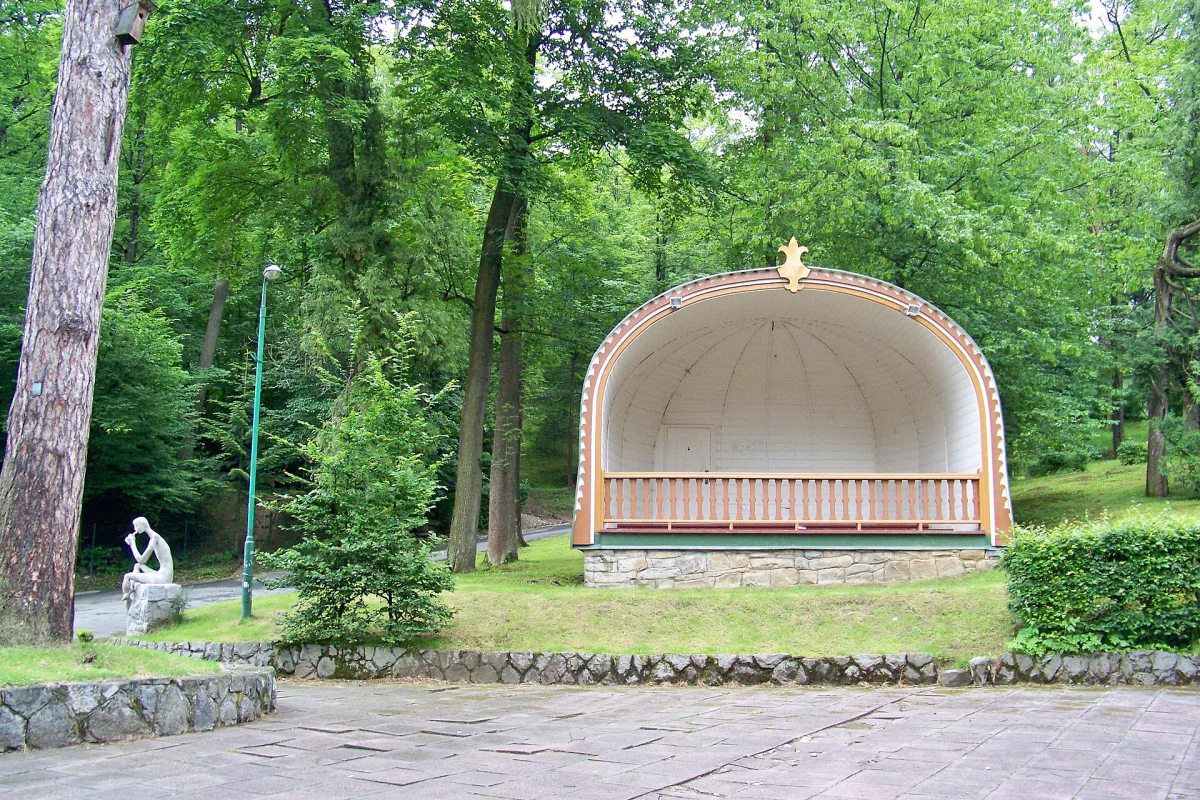
Wooden pavilions also stand in the Lower Park, where the "Wanda" spring is located, and by the Upper Park rises a neo-Gothic spa chapel. The sources give different dates for its construction: 1844-1846 or 1844-1847.
The Szalay emblems: signs instead of numbers
Walking around Szczawnica, you can notice on some houses wooden plaques with a picture and a caption, for example "under the dragon". These are the Szalay emblems (godła szalayowskie). They all share one format, a painting and a caption, but each has its own design. The idea and execution are attributed to Józef Szalay, hence the name, and according to his biography it was he who painted the first emblems of the Szczawnica families. At first they signified that a room could be rented in the house.
The oldest mention of them dates from 1860. The poet Jadwiga Łuszczewska, known as Deotyma, wrote then that every cottage has its emblem with an inscription, and that she herself lived "under the Scythe" at Miedziuś. The custom took root so firmly that nicknames of highlanders arose from the signs, for example "the Coalman from under the dragon". Most of the original emblems were destroyed by the weather. Reconstructions were made in the 1970s, 1980s and 1990s at the initiative of the Pieniny Branch of PTTK (Polish Tourist and Sightseeing Society).
After Szalay
In accordance with Szalay's will, in 1876 the spa passed into the ownership of the Academy of Learning in Kraków. The Academy leased it out, and according to Wikipedia the lessee concentrated on exporting the water and invested little, so wealthier guests began to choose Krynica, Zakopane or abroad. In 1909 the Academy sold the spa to Count Adam Stadnicki, who renovated the spa houses and extended the Upper Park. After the Second World War, on 18 March 1948, the spa was nationalised, and the town received municipal rights on 22 July 1962.
Traces of the former spa can also be seen outside the parks. The neo-Gothic St Adalbert's Church was built in 1882-1892, and in the parish cemetery founded in 1895 rest, among others, members of the Kołączkowski family of doctors. Trails into the Pieniny Mountains also set out from the town: to the Museum of Mountain Tourism and to the "Orlica" PTTK mountain hut above the Dunajec River.
Be the first! Add a comment.
You need to log in to add a comment.
Log in