
A network dreamed up by one activist
The mountain huts of the Western Beskids and the Pieniny share a hero, although he is rarely named: Kazimierz Sosnowski. According to the entry on the hut on Przehyba, it was he who in 1908 submitted to the Nowy Sącz branch of the Tatra Society a proposal to build a hut in the Sącz Beskids, and in 1923 he presented in the press the idea of a main trail with a network of huts along the route. Two huts in this article bear his name: the one on Przehyba and the one on Hala Krupowa. His name also appears in the history of the hut on Leskowiec.
Below we move from the wooden buildings of the 1930s, through post-war reconstructions, to the shepherds' huts (bacówki) of the 1970s and 1980s. We do not describe the Tatra huts here, as they have their own article. We do not give price lists or opening hours, because they change faster than the text: before setting out, check the website of the hut you have chosen.
Wooden huts of the 1930s
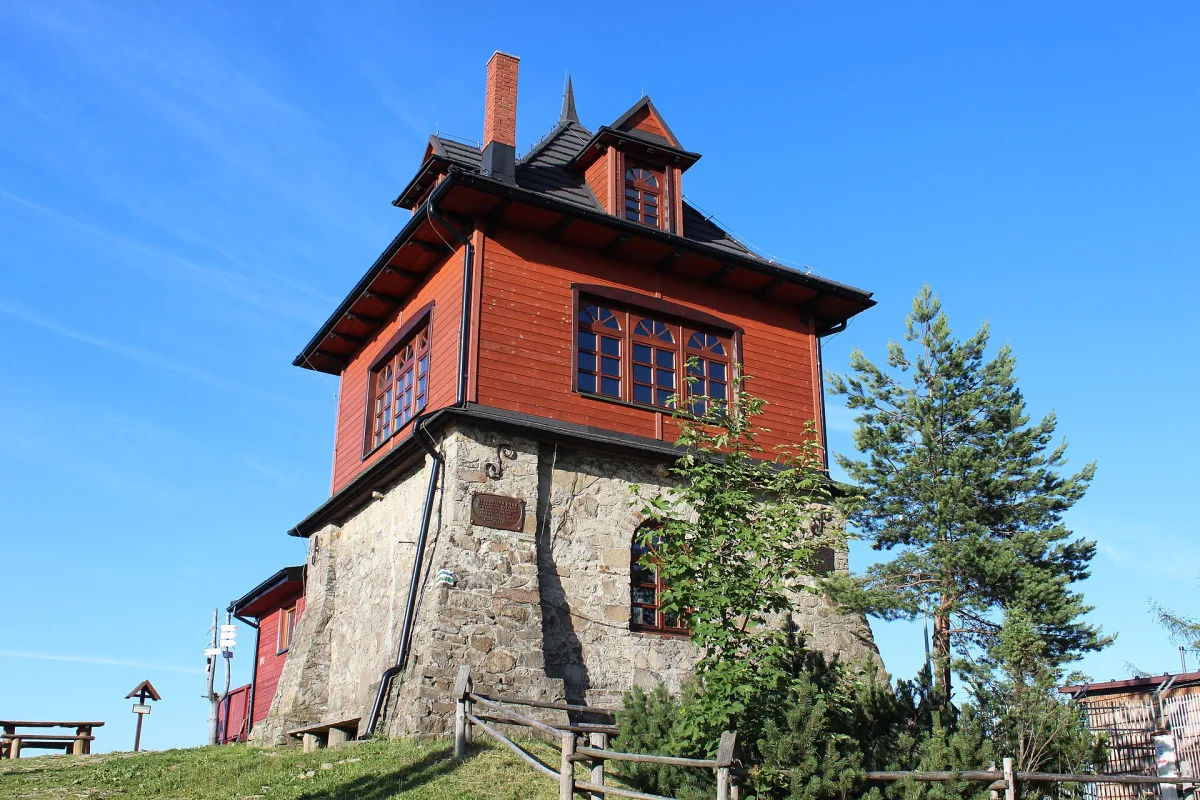
The PTTK mountain hut on Luboń Wielki in the Island Beskids stands on the summit, at an altitude of 1022 m above sea level. Construction began in June 1930, and it was put into use on 9 August 1931, to a design by Jerzy Czoponowski and Professor Stanisław Dunin-Borkowski. The building in the Zakopane style is entered in the heritage register. In August and autumn 1944 it served as a base for Home Army partisans; according to Wikipedia, it was saved from being burnt down by the Germans by the courage of the hut keeper, Karolina Kaleciak. The yellow trail from Rabka-Zaryte leads through a difficult rocky section, which is better to know about before setting out.
The PTTK Leskowiec mountain hut in the Little Beskids was built in 1932 by the carpenter Jan Bargiel from Targoszów. Wikipedia states that construction took four months, and the official opening took place on 3 September 1933. The same encyclopedia describes how in 1945 German units were supposed to burn the building down, but were treated to homemade spirits by the host and left. This is a single account, from a single source, and should be read as such. Several trails meet at the hut, and Wikipedia calls the area an important trail junction of the Little Beskids.
The PTTK mountain hut on Jaworzyna Krynicka was created as the work of the Krynica branch of the Tatra Society. Designs appeared in 1928, construction was carried out in the winter of 1933 and 1934, and in December 1934 the building was partly opened to tourists. It bore the name of Józef Piłsudski; local accounts claim that the Marshal planted a Swiss stone pine on the slope, but that is precisely an account, not a confirmed fact. Among the guests Wikipedia names Jan Kiepura and Princess Juliana, the future Queen of the Netherlands. The building burnt down in October 1944 during a roundup of partisans, and subsequent huts were built on its foundations. The present building was opened in June 1997.
The hut on Hala Krupowa has an error in its name that everyone repeats: contrary to the name, it does not stand on Hala Krupowa but in the clearing of Sidzińskie Pasionki in the Polica Range. The first hut, called Pod Policą, was opened in December 1935, and the Germans burnt it down in October 1944. The rebuilt hut was opened in October 1955. A plaque dedicated to John Paul II hangs on the building: as Cardinal Karol Wojtyła he made one of his last mountain trips here in 1978, before leaving for Rome.
The hut on Przehyba (Prehyba in some sources), at an altitude of 1138 m above sea level, was planned for more than thirty years. Building work began on 2 July 1937, and in November of the same year the hut was made available to tourists. A new building of stone was opened on 23 August 1958. The wooden part burnt down on 17 December 1991, and after reconstruction the hut resumed operation on 31 December 1997. You can reach it by four trails, and Wikipedia notes that it can also be reached by an asphalt road.
Shepherds' huts and huts built after the war
Within PTTK, the name bacówki was given to huts for qualified tourism, built on the initiative of Edward Moskała. The Pod Bereśnikiem hut above Szczawnica was opened to tourists in 1989. Wikipedia writes that it was the last of the buildings whose construction Moskała initiated, but with its different architecture and its location close to the town it is rarely seen that way today. It was given the name of its patron in August 2013.
The PTTK Bacówka above Wierchomla is housed in a granary moved from Złockie, which is why it looks different from classic mountain huts. It was officially opened on 15 October 1978. Next to it stand the Finnish Cabin (Fiński Domek) and Moskałówka, and in good weather the clearing offers a view of the Tatras.
The hut on Hala Łabowska began as a shelter with a small room and a kitchen, which the Nowy Sącz branch of PTTK built in 1953. The extension of 1973-1980 gave the building roughly its present shape. The hut has no connection to the electricity grid, and power comes from a generator, so take a torch and a power bank for an overnight stay.
The hut on Kudłacze in the Lubomir and Łysina Range is the youngest: the plot was bought in September 1989, work lasted from March 1990, and it was made available to tourists in August 1991. The foundations were dug by pupils of the secondary school in Myślenice. Wikipedia notes that according to one regionalisation the range belongs to the Island Beskids, while guidebooks usually place it in the Maków Beskids.
The Pieniny: from guesthouse to mountain hut
The PTTK Trzy Korony mountain hut in Sromowce Niżne was built in 1929-1930 to a design by Jan Biasion. It was called the Silesian Hut (Schronisko Śląskie), because it belonged to the tourism commission of the autonomous Silesian Voivodeship. During the war the Germans set up a border post here, from 1962 it was a holiday home for soldiers of the Border Protection Troops, and in 1965 the building passed to PTTK. Wikipedia states that it can be reached by an asphalt road, and the views take in the Dunajec Gorge and the Belianske Tatras.
The Orlica hut in Szczawnica was built in 1932 as a private guesthouse. In 1952 PTTK leased it and opened a mountain hut, and in 1970 the building was compulsorily purchased. It was given the name of Józef Madeja, one of the first Pieniny guides, in 1956. The Dunajec and the Pieniny Road (Droga Pienińska) are a walk of a dozen or so minutes from here.
In Jaworki, in the valley next to the Homole Gorge, there is also the Pod Durbaszką hut. You cannot reach it by car, and the walk up from the village takes about an hour according to the venue's website. The sources we used do not describe its owner, so we do not unambiguously count it as part of the PTTK network.
How to read these descriptions
Heights, numbers of beds and walking times differ between sources, and huts are rebuilt more often than guidebooks are revised. Dates of construction and the names of patrons come from Wikipedia entries on the individual huts and from the venues' own websites. The times given for trails are those from the descriptions on Wikipedia, not a guarantee: they depend on the weather and on fitness.
Be the first! Add a comment.
You need to log in to add a comment.
Log in