
Who built the cemeteries and over what area
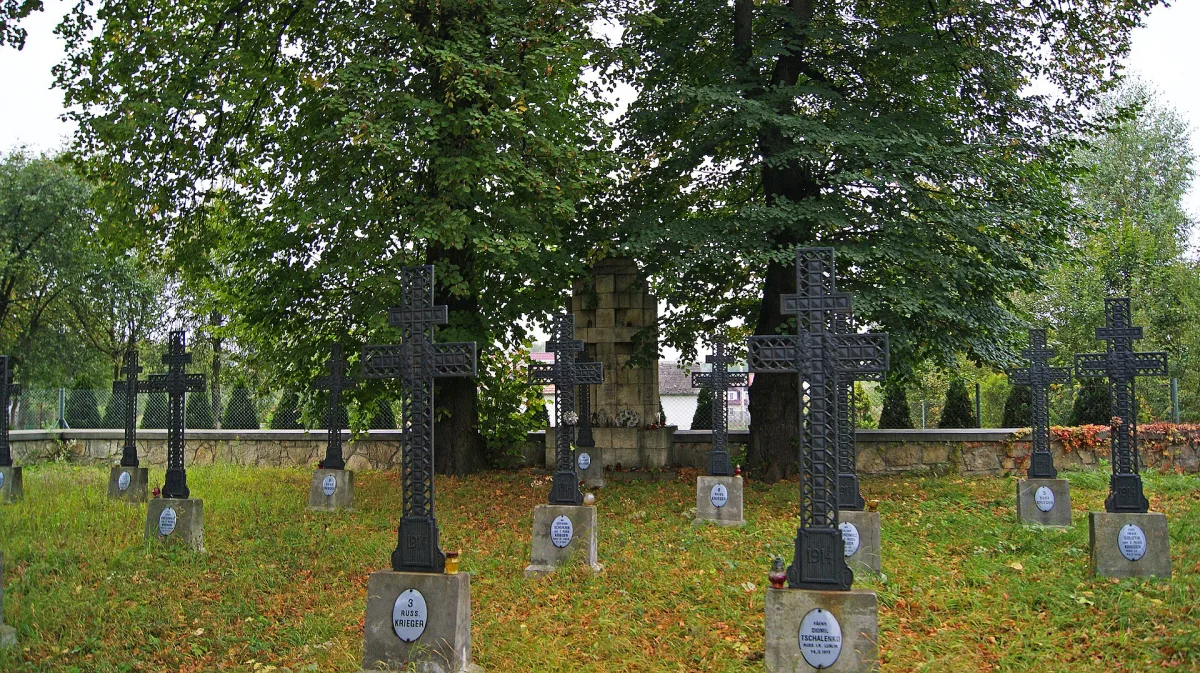
The West Galician war cemeteries are a group of more than 400 cemeteries from the First World War, scattered over an area of about 10 thousand square kilometres. They cover the territory of the former West Galicia: from the surroundings of Kraków and Wieliczka through Bochnia, Brzesko and Tarnów to Gorlice, Jasło and the Low Beskids. The cemeteries were established where fighting took place in 1914-1915 or where field hospitals operated.
Responsibility for building them lay with the War Graves Section of the Imperial and Royal Military Command in Kraków. It was one of nine war graves sections that the Austro-Hungarian Ministry of War set up in the field, and one of three in Galicia, alongside the sections in Przemyśl and Lviv. The section was subordinate to the War Graves Department of the Ministry of War in Vienna. Wikipedia entries give different dates for its creation: 3 December 1915 in one and 3 November 1915 in the other. The commander of the Kraków section was Major Rudolf Broch.
The section's tasks included recording the fallen, exhumations and moving remains to chosen sites, and designing, building and equipping cemeteries. In most cases soldiers of both warring sides, that is, the Austro-Hungarian, German and Russian armies, were buried in one cemetery.
How many cemeteries and how many buried
The numbers depend on the source and on what is counted.
- The Histmag website, in a text on the Battle of Kraków, gives 401 cemeteries and about 90 thousand buried soldiers, including about 38 thousand from the Austro-Hungarian army.
- The Wikipedia entry on the section says that 388 cemeteries were built in its area. Elsewhere in the same entry, in the data on technical work, it speaks of the founding and extension of 378 cemeteries in which 60,829 people were buried, and of the exhumation and reburial of 42,749 fallen.
- The same entry, describing the scale of the work, speaks of about 60 thousand bodies collected from the battlefields, of which about 43 thousand were exhumed and identified.
- The titles of the volumes by Jerzy Drogomir, published by the District Museum in Tarnów, speak of lists of the fallen in 400 military cemeteries.
The difference between 60 and 90 thousand is not explained in these sources. The same goes for the set of districts: the studies list eleven districts numbered from I to XI, and a twelfth, an administrative one, dealt with the collection of timber.
The cemetery districts
The battlefield was divided into districts, and in each of them one main cemetery was usually designated, larger, with a chapel or a place for ceremonies. According to the entry on the section, the numbers of cemeteries in the districts were as follows:
- Nowy Żmigród: 31
- Jasło: 31
- Gorlice: 54
- Łużna: 27
- Pilzno: 27
- Tarnów: 62
- Dąbrowa Tarnowska: 15
- Brzesko: 50
- Bochnia: 40
- Limanowa: 29
- Kraków: 22
The sum of these numbers is 388. District XI covered the cemeteries numbered 379 to 400 and five single or double graves in suburban parish cemeteries. It operated as a separate war graves section for Kraków Fortress and was headed by the Czech sculptor Karl Korschan. The cemeteries of this district are described in the article on the war cemeteries around Kraków, Wieliczka and Tarnów.
Who designed them
Each district was headed by an officer with engineering or artistic training. He was responsible for surveying the terrain, choosing the site, the technical design, the artistic concept, the supply of materials and land ownership matters. In the mountains the first task was often to mark out an access road.
The list of staff in the Wikipedia entry names as designers, among others, Dušan Jurkovič, Emil Ladewig, Gustaw Ludwig, Hans Mayr, Robert Motka, Gustav Rossmann, Franz Stark and Jan Szczepkowski. District commanders named include Siegfried Haller (District VI Tarnów) and Gustaw Ludwig (District X Limanowa). Dušan Jurkovič, according to his Wikipedia entry, headed District I Żmigród and designed about 35 cemeteries, which is discussed separately. The list of staff in the entry on the section, however, gives other names for the Żmigród district, Wilhelm Windholz and Ignaz Faigl, so the sources differ as to the leadership of this district.
In the entries for individual cemeteries, authorship is attributed to specific people: the cemetery in Gdów was designed by Gustaw Ludwig, and Cemetery No. 199 in Tarnów by Heinrich Scholz. The cemeteries of the Kraków district were usually designed by Hans Mayr. These entries rely on Wikipedia and do not settle in every case who was the author of a design and who merely headed the district.
The scale of the undertaking
According to Wikipedia, more than 3,000 people served in the section: soldiers, including prisoners of war, and civilians. Among them were Russian carpenters, Italian stonemasons, gardeners and, besides the designers, sculptors, painters, draughtsmen and photographers. The technical work was carried out by the Battlefield Clearance Command in Tarnów, with twelve detachments and a construction works in Kraków.
The entry on the section says that about 12 thousand cast-iron crosses were made for single graves and 1,400 for collective graves. Large quantities of larch timber, stone and concrete were also used, and hundreds of thousands of evergreen seedlings were brought in to landscape the cemeteries. The lists of materials in two entries do not agree in detail, so we do not give them here in tonnes.
The cemeteries are today scattered across many municipalities, and some lie within municipal, parish or Jewish cemeteries as separate sections. The condition of individual sites varies, and the rules of access are set by their custodians.
Be the first! Add a comment.
You need to log in to add a comment.
Log in