
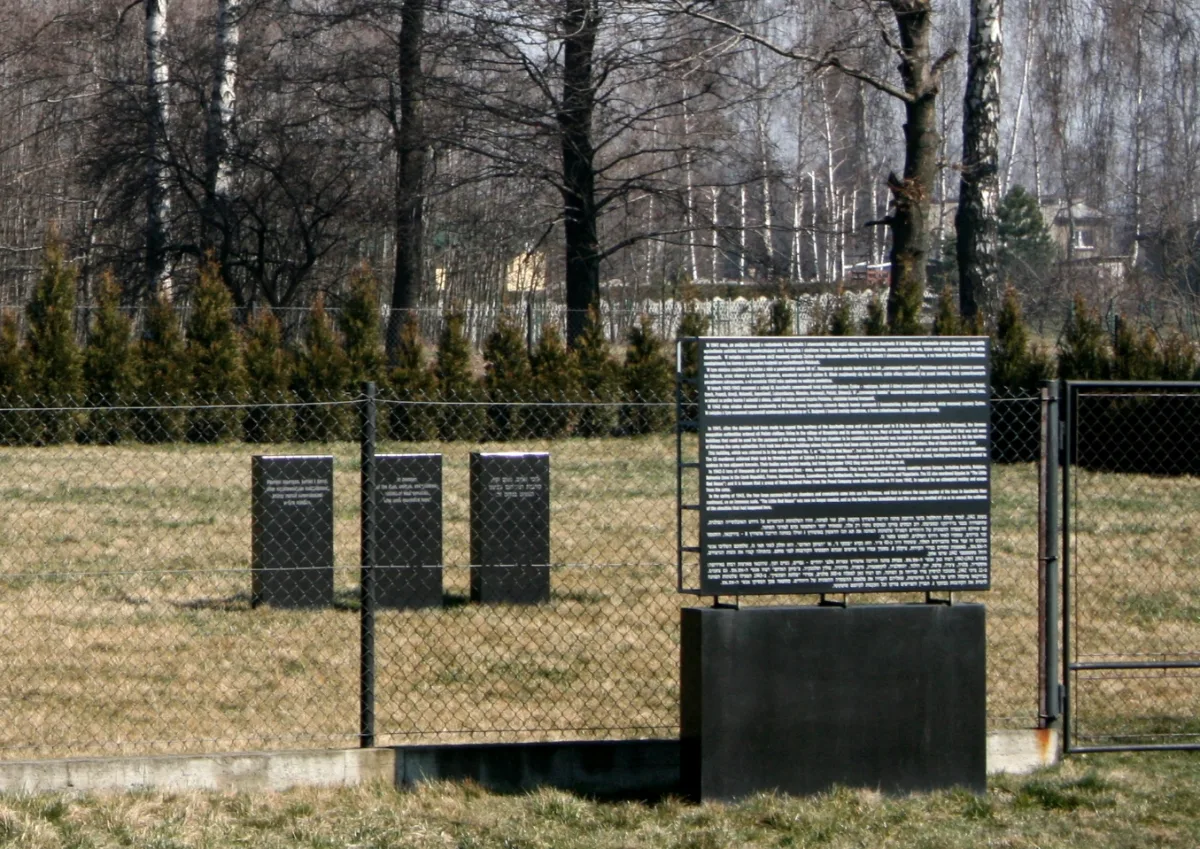
From a prisoner-of-war camp to part of Auschwitz
Birkenau, in Polish Brzezinka, was the largest of the more than forty camps and subcamps of the Auschwitz complex. When construction began in October 1941, it was intended as a camp for 125,000 prisoners of war, primarily Soviet ones. The Auschwitz Museum stresses that Rudolf Höss's account of plans from March 1941, after Himmler's first inspection, is not confirmed by documents from that period. The first surviving document is a memo of 26 September 1941 on the decision to build a prisoner-of-war camp with a capacity of 50,000, noting that work should begin immediately. The plans in autumn 1941 assumed 100,000-125,000 prisoners, and the capacity was later increased to 200,000.
The Polish inhabitants of Brzezinka were expelled in April 1941 and their houses were demolished. The village lay in the camp's zone of interest, with an area of about 40 square kilometres. In October 1941 10,000 Soviet prisoners of war were brought in to build the camp. According to the museum, more than 9,000 of them died within five months because of the conditions in which they were held.
The camp never served its original function. The museum establishes that by February 1942 at the latest the Germans had decided to incorporate it into the Auschwitz concentration camp. Soviet prisoners of war began to be directed to work in industry, and Auschwitz was designated as one of the centres for the extermination of the Jews and as a point for distributing Jewish forced labour. Birkenau began operating in March 1942. According to the museum's chronology, it began to function on 1 March 1942.
Construction and layout of the camp
The first of the four planned construction sections, BI, was built in the winter of 1941 and 1942 and during the rest of 1942. Section BII was built from 1942 to the end of 1943, and work on section BIII began in 1943 and was halted in 1944 because of the approaching front. The fourth section was never started. On an area of about 140 hectares the Germans built about 300 barracks and residential, administrative and utility buildings. The sections were separated by electrified barbed-wire fences, and the whole camp was surrounded by guard towers.
The decision to place facilities for the mass killing of Jews next to the camp under construction was taken in 1941. In 1942 two makeshift buildings, called bunkers 1 and 2, began operating, set up in the seized houses of expelled Poles. The first began operating at the beginning of 1942, probably in March, the second in the middle of the year. The site of the first is commemorated by the Red House. Between 22 March and 25 June 1943 four crematoria with gas chambers were put into operation. A railway siding inside the camp, with an unloading ramp, began operating in May 1944.
Deportations of Jews from Europe
According to the Auschwitz Museum, about 1.1 million Jews were deported to Auschwitz: about 197,000 in 1942, about 270,000 in 1943 and more than 600,000 in 1944. The museum's chronology gives, among others, the following numbers of deportees: about 69,000 from France and 27,000 from Slovakia (from March 1942), about 300,000 from Poland and 23,000 from Germany and Austria (from May 1942), about 60,000 from the Netherlands (from July 1942), 25,000 from Belgium and 10,000 from Yugoslavia (from August 1942), 46,000 from the Protectorate of Bohemia and Moravia (from October 1942), 55,000 from Greece (from March 1943), 7,500 from Italy (from October 1943). On 16 May 1944 the deportation of almost 438,000 Jews from Hungary began, and from August 1944 that of 67,000 from the Łódź ghetto. On another museum page the number of Hungarian Jews is given as 430,000.
Transports arrived at three ramps. Most of the Jewish transports of 1942-1944 were unloaded at the ramp between the Auschwitz and Birkenau camps, on the grounds of the Oświęcim freight station. The third ramp, inside Birkenau, was brought into use in May 1944. From 4 July 1942 regular selection was carried out: SS doctors decided who would be sent to work. According to the museum, on average about 20 per cent of the people in a transport were selected. Of the roughly 1.1 million deported Jews, about 200,000 were entered in the camp register, and the remaining roughly 900,000 people were killed in the gas chambers without being registered. Children under 16 (under 14 from 1944) and older people were as a rule sent to their deaths.
The numbers: the museum's estimate and other values
The figures below are given by the Auschwitz-Birkenau Museum following the research of Franciszek Piper (the book “Ilu ludzi zginęło w KL Auschwitz”, Oświęcim 1992). They are estimates, because most of the victims were not entered in the register. In total about 1.3 million people were deported: about 1.1 million Jews, 140,000-150,000 Poles, 23,000 Roma and Sinti, 15,000 Soviet prisoners of war and 25,000 people of other nationalities. About 400,000 people were registered, including about 205,000 Jews and 195,000 non-Jews. In total about 1.1 million people died:
- Jews: about one million,
- Poles: 70,000-75,000,
- Roma and Sinti: about 21,000,
- Soviet prisoners of war: about 15,000,
- other groups: 10,000-15,000.
The museum estimates that about 90 per cent of the camp's victims, that is about one million people, died in Birkenau, and more than nine in ten of them were Jews. A significant part of the more than 70,000 Poles and about 20,000 Roma and Sinti also died in Birkenau. Beside the table of deportees the museum notes another estimate: according to Georges Wellers the number of deportees was 1,433,405 people.
From February 1943 a separate family camp for Roma and Sinti operated in Birkenau; it was liquidated on 2 August 1944, when according to the museum about 4,200 of its prisoners were killed. From September 1943 there was a camp for Jews from the Theresienstadt ghetto, liquidated on 10-12 July 1944. From 12 August 1944 about 13,000 Poles arrested after the outbreak of the Warsaw Uprising were brought to the camp. On 7 October 1944 a revolt of the Sonderkommando broke out, in which three SS men and 450 prisoners died. In November 1944 the mass killing in the gas chambers was halted.
Liquidation and liberation
From 17 January 1945 the SS evacuated about 58,000-60,000 prisoners into the interior of the Reich, and the evacuation route is commemorated by the Auschwitz Prisoners' Evacuation Trail. The SS burned camp documents. On 20 January crematoria II and III were blown up, on 26 January crematorium V, and on 23 January the warehouses with property plundered from the victims were set on fire. On 27 January 1945 soldiers of the 60th Army of the 1st Ukrainian Front entered the camp and found about 7,000 prisoners in the three camps. The museum notes that more than 230 Soviet soldiers died in the fighting for the camp and the town, and the bodies of about 600 prisoners were found in the camp.
The Birkenau site today
The Auschwitz-Birkenau State Museum, established by an act of 2 July 1947, covers the two surviving parts of the camp: Auschwitz I and Birkenau. In 1979 the site was inscribed on the UNESCO World Heritage List, and since 2007 the inscription has borne the title “Auschwitz-Birkenau. German Nazi Concentration and Extermination Camp (1940-1945)”. The museum is responsible for protecting the whole area, which according to its data contains 155 buildings and about 300 ruins and other remains of the camp, including the ruins of four gas chambers and crematoria in Birkenau, more than 13 kilometres of fencing, the ramp and the railway siding. The whole covers almost 200 hectares. The preserved site is a place of remembrance and documentation, and its history as part of the Auschwitz-Birkenau complex is presented by the museum. The rules for visiting are given by the museum.
Be the first! Add a comment.
You need to log in to add a comment.
Log in