
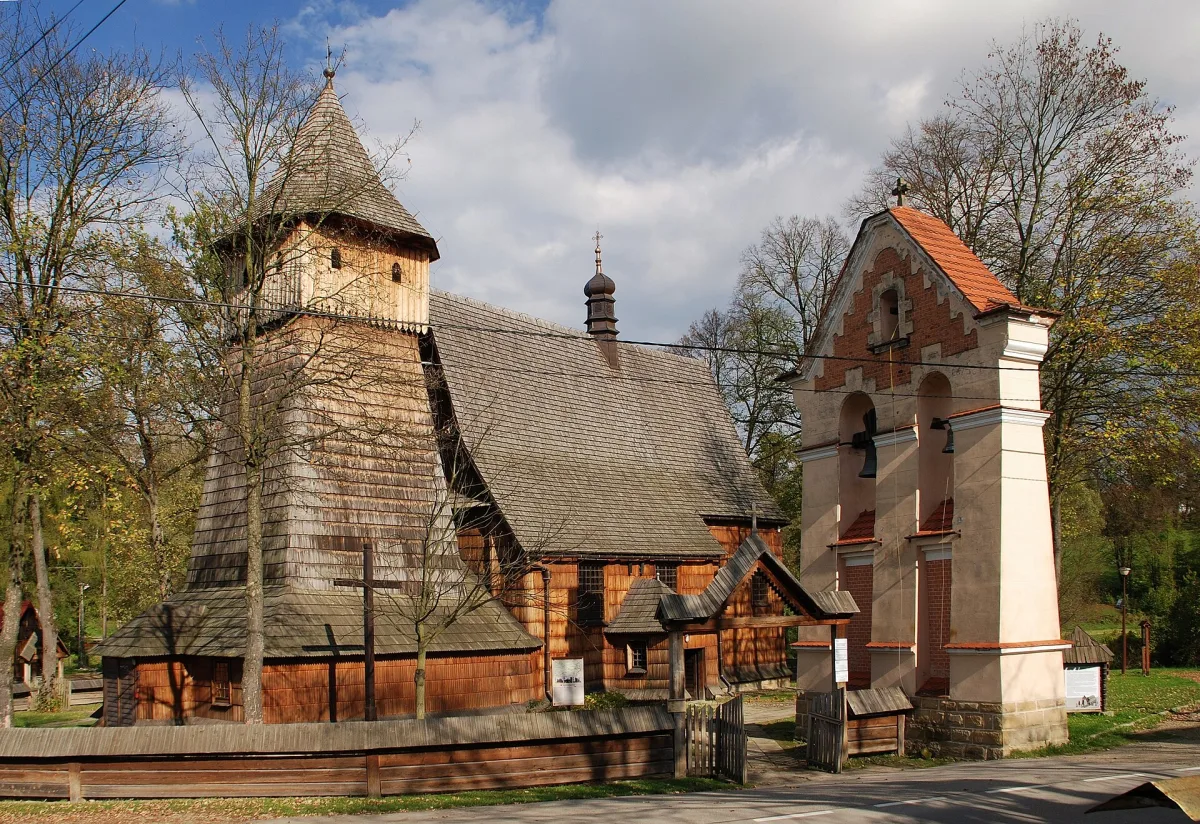
Gothic in wood has survived in Lesser Poland (Małopolska) in several dozen churches, and those from the turn of the 15th and 16th centuries are among the oldest. They were built of horizontally laid logs, that is in log construction, covered with a steep shingle roof, and their interiors were painted from floor to ceiling. This text covers the churches of the 15th and 16th centuries on the Wooden Architecture Route of Lesser Poland. The churches of the 17th and 18th centuries are described separately, in the article on the Baroque in wood.
Four churches on the UNESCO List
In 2003 the group of wooden churches of southern Lesser Poland was inscribed on the UNESCO World Heritage List, under criteria III and IV. Wikipedia lists six churches in it: four lie in Lesser Poland, while Haczów and Blizne lie outside its borders. The Lesser Poland ones are Binarowa, Dębno, Lipnica Murowana and Sękowa.
Binarowa
The Church of St Michael the Archangel in Binarowa dates from about 1500. A wooden parish church stood here as early as 1415, and the present one was built after the previous one burned down. The tower was added in 1596, and in 1641-1650 the church was thoroughly rebuilt. In the chancel, Late Gothic plant patterns on the ceiling and Baroque painted cycles on the walls have survived. The justification for the UNESCO inscription speaks of a harmonious combination of historical, architectural and artistic values.
Dębno
The Church of St Michael the Archangel in Dębno was built in the second half of the 15th century on the site of an older one. The first mention of a church in Dębno comes from 1335, and dendrochronological research confirmed that the building and the roof were made in the same period. The tower dates from 1601. The polychrome from about 1500 has, according to Wikipedia, 33 colours and 12 layouts with 77 motifs, mainly plant and geometric, but also animal. Wikipedia counts it among the oldest fully preserved polychromes on wood in Europe. Around the nave and chancel run soboty, roofed arcades on posts.
Lipnica Murowana
The Church of St Leonard stands in the cemetery in Lipnica Dolna, part of Lipnica Murowana, above the Uszwica stream. Wikipedia states that it was probably built at the end of the 15th century, while local tradition ascribes the construction to the year 1143 or 1203. The polychromes in the nave date from the end of the 15th century, those in the chancel from the 16th century, and there are also paintings from 1689 and 1711. Three triptychs were stolen in 1992, recovered and handed over to the diocesan museum in Tarnów, and copies hang in the church.
Sękowa
The Church of St Philip and St James in Sękowa was built around 1520, at the latest in 1522, as shown by the date on the stone font. The walls of larch logs are covered with shingle. In the 17th century a tower and spreading soboty were added, which give the building its characteristic appearance. At the turn of 1914 and 1915, during the Battle of Gorlice, the church was devastated, and the wood was used to build trenches and as fuel. Reconstruction began in 1918. For its conservation work the church received the Europa Nostra medal in 1994.
Churches that did not make the UNESCO List
On the route there are also churches just as old, though less well known. Some of them changed their appearance after centuries of alterations.
Łopuszna and Paczółtowice
The Church of the Holy Trinity and St Anthony the Abbot in Łopuszna was built in the second half of the 15th century, and in 1504 it was consecrated by the Bishop of Kraków, Jan Konarski. In the main altar stands a Gothic triptych from 1460 with the Coronation of Mary by the Holy Trinity. The tower was added in the 17th century, and in the nave hangs a Lenten veil from 1753.
The church in Paczółtowice was built by one of the co-owners of the village from the Paczółtowski family before 1515, or according to another dating in 1518-1520. It was formerly thought to have been built of larch, but research showed spruce. Inside there is a Late Gothic triptych from 1460-1470 and a bronze font cast in 1533. Next to it stands a belfry from 1968, in which hangs a historic bell from 1535.
Around Grybów
The Church of All Saints in Ptaszkowa is dated to 1555, and the builder was the carpenter Jan Joachim Kukla of Grybów. In 1880-1883 the tower was raised, the walls were clad with boards and the roof was covered with sheet metal. In 1929 two chapels were added, forming a transept. Inside, a Gothic sculpture of the Virgin and Child from 1420 has survived. Since 2016 the church has served a supporting function.
The Church of St Andrew the Apostle in Polna is Late Gothic and dates from around the middle of the 16th century. According to tradition the first church stood here in 1297. Around 1820 the nave was lengthened to the west and two porches were added. The greatest value lies in the 16th-century polychrome with 29 scenes from the life and Passion of Christ.
Głębowice, Radocza and Osiek
The Church of Our Lady of the Scapular in Głębowice dates from 1518, but alterations have changed it the most of the whole group. In 1782 the original tower was encased in a new structure, in 1860 the Dunin chapel was added, and in 1931 the wooden chancel was replaced by a brick one. In the pillar of the entrance gate is set the tombstone of Jakub Saszowski from 1546.
The Church of the Transfiguration in Radocza was completed in 1535. In 1568-1598 it served the Calvinists, and it returned to the Catholic Church in 1624. Because of the poor condition of the structure it was dismantled in 1981-1985 and recreated according to measurements, and it was reconsecrated in 1999. When judging its age, one must therefore remember that the walls are to a considerable extent the work of the 20th century.
The Church of St Andrew in Osiek was built in 1538-1549, probably founded by Seweryn Boner, and the tower was added in 1610-1617. It stands on a cemetery hill among old trees. The double-ridged roof is a feature closer to Silesian churches than to Lesser Poland ones. Inside, the flat ceiling has Renaissance coffers, and the 16th-century font combines Gothic with Renaissance. Until 1908 the church was the parish church, and then it was replaced by a Neo-Gothic church.
How to read these dates
Sources rarely give a single year, because wood does not leave documents as readily as stone. Hence entries such as "around 1500" and differing datings, as in Paczółtowice or Lipnica. Dendrochronology, that is dating by tree rings, has settled the matter only in some churches, among them Dębno. In many churches Gothic often means the layout of the nave and chancel and fragments of the furnishings, not the whole of the original fabric.
Be the first! Add a comment.
You need to log in to add a comment.
Log in