
Karol Wojtyła walked in the mountains as a student, priest, bishop and cardinal, and some of those routes were marked years later as papal trails. This article gathers the places in the Gorce and the Tatras where traces of those walks are best documented. We describe the Pope's visit to Podhale in 1979 and Turbacz separately.
Papieżówka: two weeks in a shepherd's hut
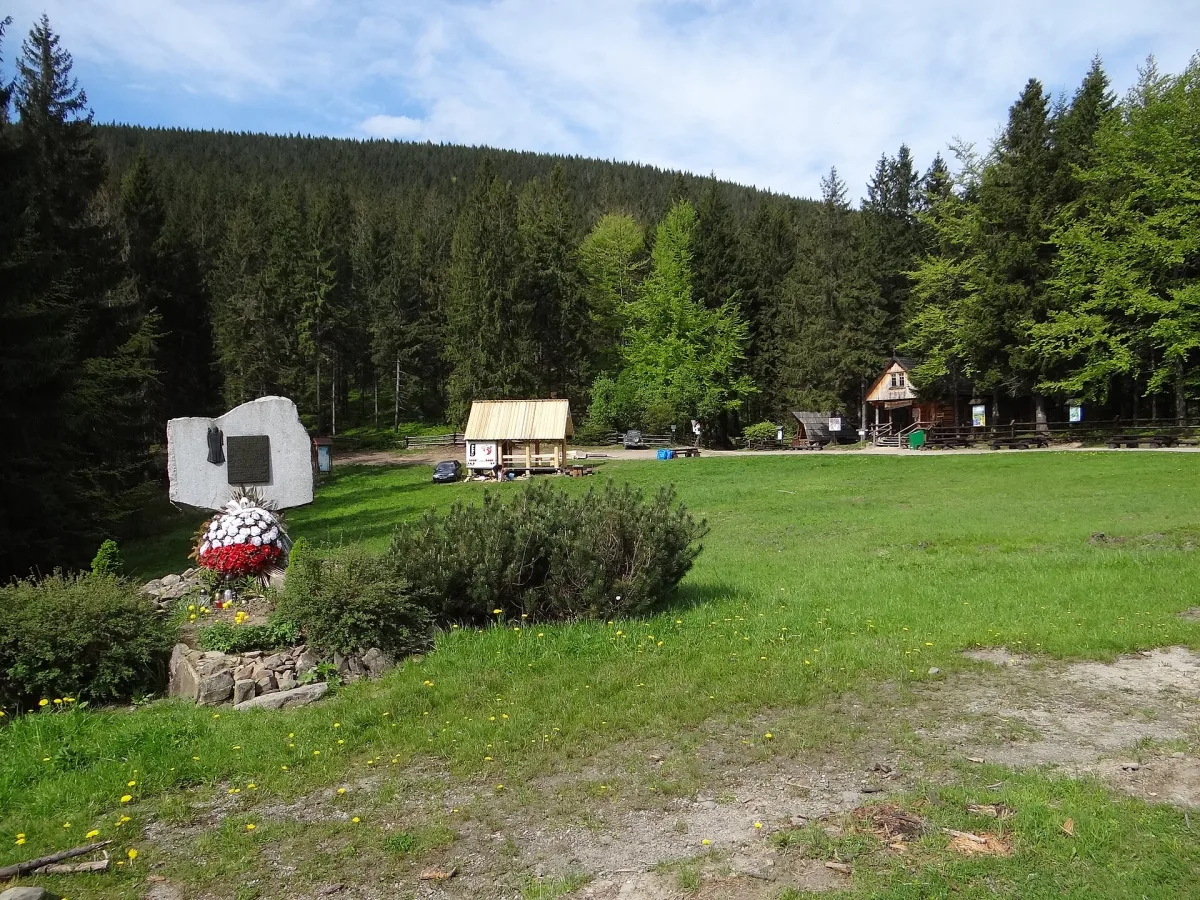
Papieżówka is a small clearing in the Kamienica valley in the Gorce, already within Gorce National Park. According to Wikipedia, in July 1976 the then Metropolitan of Kraków, Karol Wojtyła, lived here for two weeks in a hut. He was preparing for the Eucharistic Congress in Philadelphia, to which he left on 23 July. He held days of recollection and walked in the surrounding mountains. He chose the place for its remoteness and quiet.
The conditions were spartan: the only furnishings of the hut were a wooden table, a stool made from a tree stump and a bunk of branches. According to the Wikipedia entry, nobody recognised him during this stay. Today a boulder stands here with a plaque bearing the words "Keep an eye on these trails for me" ("Pilnujcie mi tych szlaków"). The hut was renovated in 2004.
The Papal Trails Foundation
The papal trails were laid out and are described by the Papal Trails Foundation (Fundacja Szlaki Papieskie). According to the John Paul II Centre "Be Not Afraid", it was established in Kraków in 2003, still during the Pope's lifetime, and its roots go back to the Organising Committee of the Papal Trails. It relies on volunteers, and its aim is to commemorate places connected mainly with the hiking and pastoral work of Karol Wojtyła, as well as with his pilgrimages to Poland.
The trails in the Gorce and the Island Beskids were laid out in spring 2003 by the Social Organising Committee of the Papal Trails in cooperation with the municipalities. The symbolic opening took place on 26 May 2003 in Rabka-Zdrój and covered papal trails in all Polish mountains at once. The basis for the routes was the recollections of people who had walked with Father Wojtyła, the booklets of the Mountain Tourist Badge and entries in parish books.
How many trails were marked in total is not given as a single number in the sources. The foundation lists more than a dozen ranges in which papal trails exist: among others the Tatra Mountains, the Gorce, the Island Beskids, the Żywiec Beskids, the Pieniny Mountains, the Sącz Beskids, the Low Beskids, the Bieszczady, the Sudetes and the Kraków-Częstochowa Upland. Some routes were laid out by local communities and municipalities in cooperation with the foundation, so not all of them are its work.
Among the trails in Lesser Poland is, for example, the route from Skawica to the Krowiarki Pass, marked by the residents of Skawica in 2000 as "The Last Excursion of Cardinal Karol Wojtyła". According to the foundation he made it on 9 September 1978, before leaving for the conclave.
Rusinowa Polana and Wiktorówki
Rusinowa Polana lies below Gęsia Szyja on the ridge joining the Tatras with the Bukowina Foothills. It covers about 20 ha and took its name from the Rusins, village heads from Groń, to whom King Sigismund III Vasa granted it in 1628. For centuries sheep and cows were grazed here. Cardinal Wojtyła visited the clearing many times. The Portal Górski adds that he brought water for tea to the highlander woman Aniela here, and Wikipedia mentions Aniela Kobylarczyk, who until her death in 1985 hosted hikers in her hut and took part with them in evening Masses.
Nearby stands the shrine at Wiktorówki, which has been looked after by the Dominicans since 1959. In 1975 Cardinal Wojtyła officially entrusted the centre to them and linked it with the parish in Małe Ciche. The chapel dedicated to Our Lady, Queen of the Tatras, is described in the entry Chapel of Our Lady, Queen of the Tatras.
The beginnings of the cult are described by a tale. It says that around 1860 a fourteen-year-old shepherdess, Marysia Murzańska, was looking in the fog for lost animals and saw a Beautiful Lady among the branches of a tree, who promised her help. The animals were found, and the shepherd placed a small picture on the tree. Wikipedia bases this version on an account written down by Father Szymon Kossakiewicz, not on documents, so it should be read as folk tradition.
Chochołowska Valley, 23 June 1983
The best-described Tatra episode is the short stay of John Paul II in the Chochołowska Valley during his second pilgrimage to Poland. In 1979 an attempt to view the Tatras from a helicopter failed because of the weather. The excursion in 1983 was kept in great secrecy.
According to the website of the Archdiocese of Kraków the Pope flew in from Kraków by helicopter, which landed on Siwa Polana. He was accompanied by Cardinal Franciszek Macharski, priests from his entourage and a government security detail. At the mountain hut he was greeted only by the manager, and he held a short conversation with Lech Wałęsa and his family. Wikipedia describes this as a meeting at the hut, which also contains a sculpture, a gift from Wałęsa to the Pope.
Then the Pope went for a walk towards the Jarząbcza Valley. Father Bronisław Fidelus, one of his companions, recalled that at the start of the road the Pope said that he could walk here on a real mountain road with stones. On the way they stopped at a shepherds' hut (bacówka), where the highlanders treated the guests to cheeses, but security did not allow the Pope to taste them. A break was made by a stream, and before returning John Paul II dipped his hand in the stream and made the sign of the cross.
According to the archdiocese's website this route became the first papal trail laid out in the Polish mountains. It runs along a section marked yellow and white alongside the red trail from Polana Chochołowska to the Jarząbcza Valley, and ends at a plaque at the place the Pope reached. A second plaque hangs on the mountain hut. The wider background of the valleys is described in the entry on the Chochołowska Valley.
The sources differ in details. The date of the visit is 23 June 1983 according to Wikipedia, the archdiocese's website and the Portal Górski, whereas the John Paul II Centre gives 22 June in its list of trails. The circumstances of the words "Keep an eye on these trails for me" also differ. The Centre attributes them to Nowy Targ in 1979, while the archdiocese's website quotes them as a farewell to the staff of the mountain hut in the Chochołowska Valley. Both versions should therefore be given.
Be the first! Add a comment.
You need to log in to add a comment.
Log in