
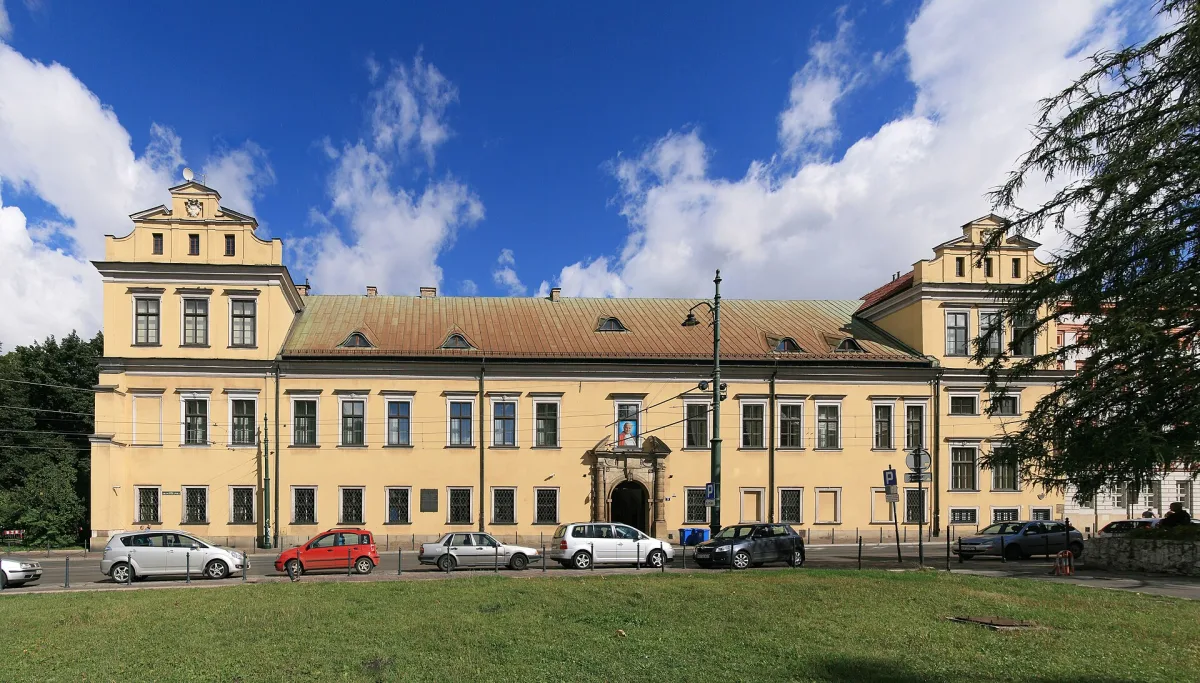
Franciszkańska 3: the palace and the window above the gate
The Bishops' Palace at Franciszkańska 3 has been the seat of the bishops of Kraków since the end of the 14th century. Karol Wojtyła moved into it in 1964, a year after being appointed bishop, and lived there until he was elected pope in 1978. According to Wikipedia, as pope he chose this palace as his place of rest during all his pilgrimages to Poland, and he addressed the faithful gathered in front of the building from the window above the Baroque entrance gate.
It first happened on 6 June 1979, on the first day of the first pilgrimage. The dzieje.pl portal quotes the pope, who told the young people beneath the window, jokingly, that when he used to be in Kraków he was quite a respectable man and never climbed out of windows. The custom of meetings beneath the window lasted until 2002. On 15 June 1999 the pope listened to a concert through the window. In 2002 the visit lasted from 16 to 18 August. On the first day he asked those gathered whether they had been to Toronto, and to the reply "Welcome home" he answered: "If anyone asks, Franciszkańska 3". He opened the last meeting, on 18 August 2002, with the words: "Unfortunately, this is a farewell meeting".
The tradition was taken up by his successors. Benedict XVI appeared at the window twice during his stay in May 2006. Francis greeted young people from it for the first time in 2016, during World Youth Day, and returned to the window several more times. After the death of John Paul II, on 2 April 2005, flowers were laid and candles lit in front of the palace for days. Vigils and concerts are often held in front of the palace, and the window is adorned with an image of John Paul II.
The first pilgrimage: Wawel, Błonia, the cemetery
The stay in Kraków on 6-10 June 1979 is described by the Institute of National Remembrance (IPN) on its website devoted to the first pilgrimage. On 6 June the pope met the faithful in the cathedral on Wawel Hill. On the evening of 8 June he met scholars, artists and students at Skałka. On 9 June he visited the sick in the Franciscan church, celebrated a service at Mogiła, prayed with women religious in St Mary's Basilica and visited the family grave at Rakowicki Cemetery. On 10 June he celebrated Mass on Błonia and said farewell at the airport in Balice.
The figures for attendance at the Mass on Błonia are estimates. The introduction by the director of the Kraków branch of the IPN, Dr hab. Filip Musiał, speaks of as many as 1.5 million people. According to the entry on Błonia, papal Masses were also held there in 1983, 1997 and 2002.
Mogiła and Nowa Huta: the place where "new evangelisation" was spoken
The pope came to the Cistercian abbey in Mogiła on 9 June 1979. In the homily delivered in the monastery gardens he used the phrase "new evangelisation" for the first time in his teaching. He linked it with the crosses that ancestors had raised on Polish soil, and in particular with the cross raised in Nowa Huta during the Millennium. The text of the homily and an account were published by the abbey.
In its first years Mogiła was for Nowa Huta more than a historic monument. In the greeting prepared for the Kraków Mass of 1999, John Paul II wrote that for many years the sanctuary in Mogiła was the only place of pastoral care for the emerging Nowa Huta. The greeting was read by Cardinal Franciszek Macharski, because the pope could not celebrate Mass then owing to illness. The plan was for a Eucharist on Błonia, beside the miraculous image of Christ Crucified from Mogiła.
Cardinal Wojtyła also visited the building sites of the Nowa Huta churches. The abbey writes that he celebrated Midnight Masses there at open-air altars, and on Easter morning led resurrection processions in Bieńczyce, Mistrzejowice and on the Krzesławice Hills. In Bieńczyce stands the Ark of the Lord, built in 1967-1977. According to Wikipedia, the foundation stone was laid there on 18 May 1969 by Cardinal Wojtyła, and the consecration took place on 15 May 1977. In Mistrzejowice, in front of the Church of St Maximilian Maria Kolbe, stands a bronze monument to the pope by Gustaw Zemła, unveiled in January 1991.
There is also a monument to the pope in Mogiła. The statue, more than three metres tall, by Marek Kordyaczny, was blessed on 14 September 2008 by Cardinal Stanisław Dziwisz, after the High Mass of the parish feast.
Łagiewniki: the stone from Golgotha and the act of entrustment
The Sanctuary of Divine Mercy in Łagiewniki grew up around the convent of the Sisters of Our Lady of Mercy, with the image of Merciful Jesus and the tomb of Faustina Kowalska. The Chapel of St Joseph at the convent was raised to the rank of sanctuary in 1992. After Faustina's beatification on 18 April 1993 and canonisation on 30 April 2000, the place grew quickly.
On 7 June 1997 John Paul II blessed a foundation stone from Golgotha in Łagiewniki. Cardinal Franciszek Macharski set it in the new basilica on 13 April 2002. The basilica itself, designed by Witold Cęckiewicz, was built in 1999-2002. On 17 August 2002, during his last pilgrimage to his homeland, the pope consecrated the church and entrusted the world to Divine Mercy in it. The act of entrustment is inscribed on the other side of the altar. Less than six weeks later, on 28 September 2002, Cardinal Macharski established a rectorate in the sanctuary, and the first rector was Fr Jan Zając. The sanctuary was also visited by Benedict XVI in 2006 and by Francis in 2016.
Białe Morza: the John Paul II Centre
A few hundred metres further on, on Totus Tuus Street, stands the John Paul II Centre "Be Not Afraid", founded on the initiative of Cardinal Dziwisz. The Church of St John Paul II, built to a design by Andrzej Mikulski, has an octagonal plan and two levels: the church of the relics and the upper church. Wikipedia states that the rite of blessing took place on 23 June 2013, and the solemn consecration on 16 October 2016. In the priests' chapel, modelled on the crypt of St Leonard on Wawel Hill, there is a slab from the pope's tomb in the Vatican Grottoes. Next to it operates the Museum of St John Paul II, which since 23 June 2013 has gathered the pope's personal belongings and the gifts he received during his pontificate. The museum gives this date as the day of consecration of the upper church, so the sources name the same rite differently.
A reminder of the pilgrimage of 1997 is also the John Paul II Mound in Dębniki, raised from 31 May to 10 June 1997 on the grounds of the Resurrectionists, the youngest and smallest of Kraków's mounds. It is 7 metres high, without the cross.
Be the first! Add a comment.
You need to log in to add a comment.
Log in