
Land that nobody wanted
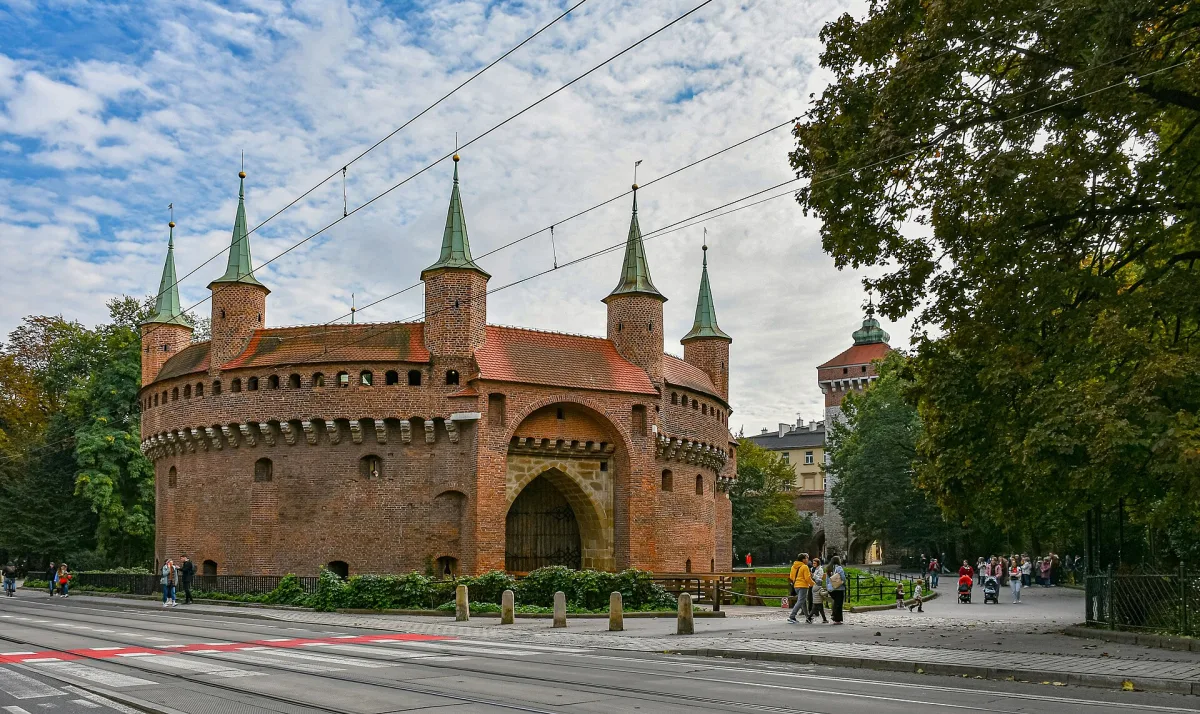
Before the park existed, a belt of fortifications ran around the Old Town: defensive walls, and in front of them a moat and earthen ramparts. According to Wikipedia, the walls were pulled down at the beginning of the 19th century. The moat and the ground in front of it were marshy, neglected land used as a rubbish tip and an outlet for sewage. It was the demolition of the walls that freed up space that could become a green ring. The walls themselves and the Barbican are covered in a separate text; here we are interested in what grew up after them.
In 1820, as the same Wikipedia states, a decision was made to create city gardens in this area. The name Planty comes from “splantować”, to level the rubble. For a long time, however, people in Kraków said Plantacye or Plantacje, and the park was also called the city promenades.
Radwański, Straszewski and the years 1822-1830
The main originator of the idea, and the author of the surveys and plans, was Feliks Radwański. After his death in 1826 Florian Straszewski took over management of the works, and in 1830 he set up a foundation to pay for the upkeep of Planty. It is usually stated that the park was laid out in 1822-1830, with an area of about 21 hectares and a length of about 4 kilometres. Wikipedia attributes to Radwański the role of originator and author of the plans, and to Straszewski the role of continuator. Both names appear in descriptions, so they should not be treated as interchangeable.
The first work consisted of levelling the ground and filling the moat with imported earth. The Barbican remained within the park. Only then was the area planted with trees, mainly horse chestnuts, but also maples, lime trees, ash trees and poplars, along with shrubs; lawns and flower beds were laid out, and paths and playgrounds marked out. From 1827 Planty also encircled Wawel Hill, where peaches were planted on the southern slopes and vineyards were established. They were removed in the 1850s, when the Austrian army began converting the hill into a citadel.
A park that grew into its surroundings
In later decades kiosks and a concert pavilion were built. The park was looked after by gardeners known as “plantowi”: regulations of 1879 divided Planty into nine districts, each with its own gardener. In 1871 a Planty Commission was set up, and on its initiative the park began to be decorated with monuments. One of the first monuments in Planty was the monument to Florian Straszewski, dated 1874 and unveiled in 1875, which commemorates the creator of the park. It stands at the junction of ulica Basztowa and ulica Westerplatte.
Planty became a place for strolling, socialising and national celebrations. It also inspired artists: Wikipedia recalls paintings by Jan Stanisławski, Witold Wojtkiewicz and Stanisław Wyspiański and a poem by Maria Pawlikowska-Jasnorzewska. Today the park is divided into eight gardens with names such as Wawel, University, Palace of Art, Barbican and Stradom. The exact set of gardens and their boundaries are described on the Planty Park entry.
What today points to the old walls
During the Second World War the park was badly devastated: according to Wikipedia the Germans cut down the shrubs and looted the metal fencing. In the post-war period work was limited to preventing further degradation. The decision to restore the park, to a design by Professor Janusz Bogdanowski, was taken in 1989. After a dozen or so years of work the small architecture was reinstated, that is lamps, fences and benches, and low stone walls marked out the former course of the defensive walls and the positions of the towers and city gates.
A walk around the Old Town therefore lets you read the line of the old fortifications, although most of the wall itself has disappeared. Near Planty stand, among others, St Florian's Gate, Collegium Novum, the Palace of Art, the Kraków Philharmonic, the Juliusz Słowacki Theatre, the Bishops' Palace and the Archaeological Museum, and to the south the park adjoins Wawel. Wikipedia counts them among the historic buildings in Planty or in its immediate vicinity.
Be the first! Add a comment.
You need to log in to add a comment.
Log in