
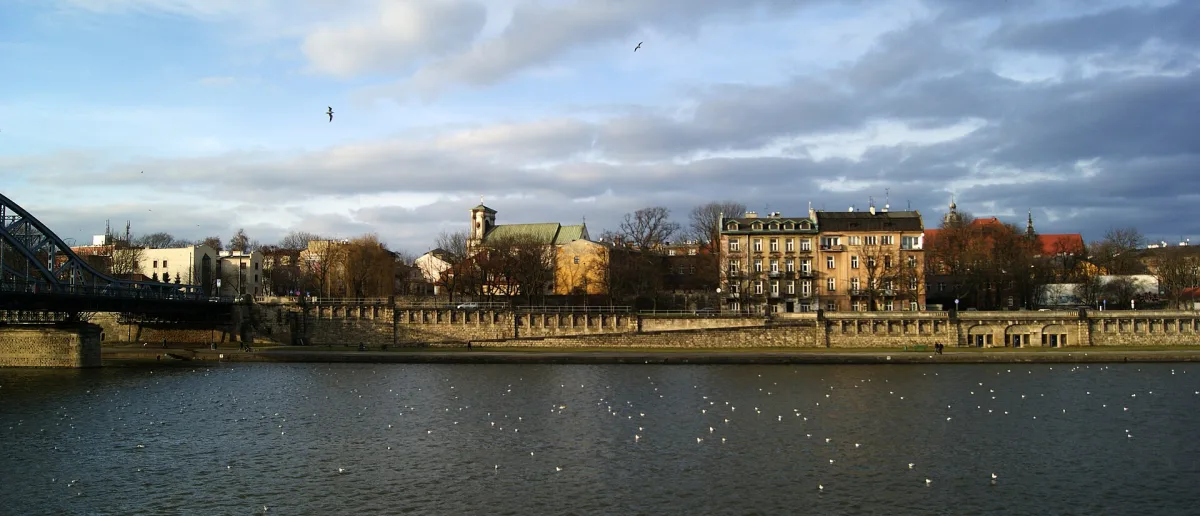
Kazimierz did not grow out of Kraków but beside it. For more than four hundred and fifty years it was a separate royal town, with its own council, market square, walls and law, and a branch of the Vistula divided it from the capital. Only at the turn of the 18th and 19th centuries did it become a district. This text tells the story of that period, from the founding charter to the incorporation into Kraków.
An island between two channels of the Vistula
According to Wikipedia, the area of the later Kazimierz was a marshy island between the present channel of the Vistula and its now vanished branch, called the Old Vistula. A trade route from Kraków to the south ran across the island, and near the princely stronghold there were several settlements. The oldest formed around the Romanesque rotunda on Skałka. To the south lay a settlement by the church of St James, which stood until 1787, and to the east, in the area of today's Szeroka Street, from the 12th century the village of Bawół with the church of St Lawrence. Neither church survives, and the second was demolished at the end of the 18th century.
The founding of 1335
Casimir III the Great issued the founding charter under Magdeburg law on 27 February 1335, two years after his coronation. The town received the king's name: Civitas Kazimiriensis. It covered about 50 hectares, compared with 70 hectares for old Kraków, so it was only a little smaller than its neighbour. The town council was elected by the inhabitants, and the reeve was appointed by the king. The people of Kazimierz received the right to sell their own products throughout the kingdom, the right to use rivers within a mile of the town and the right to weekly markets on Fridays.
Wikipedia points out that the town was not meant to be a competitor to Kraków but a complement to its craft functions. Merchants from Kazimierz could trade on the Kraków market square only in food and only on designated days. The staple right, that is the obligation to put goods up for sale in the town, Kazimierz held only for salt. The entry also mentions the possible defensive significance of the settlement from the south, but assesses this cautiously as one of the reasons.
The plan was regular: streets were laid out around a large market square, of which today's Wolnica Square is a part. On the square stood a town hall, stalls, a weigh house and a cloth-shearing house. The name Wolnica comes from the Latin Forum liberum, that is the right of free trade in meat outside the stalls, and it has functioned in this form since the end of the 18th century. Of the Kazimierz town hall an 18th-century building survives. A few years after the founding, in 1340, part of the former village of Bawół was included within the town boundaries, and after 1340 construction most probably began on the walls with corner towers and four gates: Kraków, Skawina, Salt and St Stanislaus.
Great churches and an unfinished university
The importance of the undertaking is shown by the quick building of large churches. The Corpus Christi Basilica was a foundation of the king from around 1340, and its chancel was consecrated in 1401. The Church of St Catherine belongs to the Augustinians, whom according to the entry for the site the king brought from Prague in 1342. The website of the basilica's parish also recalls a tradition about a miracle from which the Corpus Christi church was said to have begun, but this is an account, not a confirmed fact.
Wikipedia writes that perhaps on the site of the former Bawół Casimir the Great began to build buildings for the Kraków Academy he had founded, but the work was abandoned after the unfinished buildings were destroyed by a flood. The authors of the entry stress that the matter is unclear. The abandoned building still existed in the second half of the 15th century, and a plaque at 11 Wolnica Square recalls the discovery of the remains of university buildings in 1868.
1495 and the Jewish town
In 1495 King John Albert ordered the Jews, who until then had lived in Kraków, to be relocated to the area of the former village of Bawół. This created the so-called Jewish town, oppidum iudaeorum. Wikipedia names as the direct impulse the pogrom of 1494, caused by a conflict between Jewish and Polish merchants over the right to trade on the market square, with a dispute over usury and the sermons of the Franciscan John of Capistrano in the background. This is a description of causes according to a single, though factual, source, so it is worth treating as an outline, not a full explanation.
As a result a district was created, separated by fences and a stone wall, with its centre on Szeroka Street. For centuries it developed autonomously: it had synagogues, schools and cemeteries. The Old Synagogue adjoined the town walls with its eastern wall and was included in the defensive system. The time of its construction is given differently: 1407 or 1492, and according to the most recent findings at the turn of the 15th and 16th centuries. In 1557 a fire destroyed the building, and the reconstruction with Renaissance elements was carried out by the Florentine architect Mateo Gucci, until 1570.
The rabbi Moses Isserles, known as the Remuh, is connected with this district. The Remuh Synagogue has two dates in the sources: Wikipedia in the entry on Kazimierz gives the year 1553, and the heritage register 1557. The entry for the site explains that the merchant Israel ben Joseph had sought the king's permission from 1553, and after the permission was granted in 1556 and the fire of 1557 construction lasted from 1558. The cemetery by the synagogue was founded in 1551, and Isserles died in 1572.
Destruction and reconstruction after the Swedish Deluge
The Swedish Deluge and the occupation during the Northern War ruined Kazimierz. Some buildings along the main thoroughfare, today's Krakowska Street, and the church complexes survived. After the Swedes left they developed quickly, as shown by the Baroque complexes of the Pauline Fathers on Skałka and of the Trinitarians, as well as of the Missionaries in Stradom. Wikipedia also records that the Jews of Kazimierz were accused and convicted of showing the Swedes the hiding place of the silver altar of St Stanislaus. The king granted the whole Jewish town to the hetman Jerzy Lubomirski and the chancellor Stefan Koryciński, and the dispute over this donation lasted for many years.
From town to district: 1792 and 1800
In 1772-1777 Kazimierz was the seat of the Wieliczka circle in Galicia, that is the Austrian partition. As Wikipedia writes, the centuries-long development of both towns made their separateness an anachronism. During the Great Sejm (Four-Year Sejm) the Good Order Commission decided to incorporate Kazimierz into Kraków as a new district. The decision of 1792 proved not to be lasting. Finally Kazimierz lost its independent town rights and was annexed to Kraków in 1800.
The incorporation did not immediately mean the end of divisions. The wall around the Jewish district was demolished only in 1822, which allowed the Jewish population to settle throughout Kazimierz. The history of the district after 1800, including the time of the Free City of Kraków and the period of Galician autonomy, is a separate chapter. The fate of Kazimierz during the German occupation is described in separate texts in the Places of Remembrance section.
Be the first! Add a comment.
You need to log in to add a comment.
Log in