
Wooden churches of the 17th and 18th centuries form a much more numerous group in Lesser Poland (Małopolska) than the Gothic ones. They lack the medieval aura of Binarowa or Dębno, but they conceal Baroque and Rococo altars, 19th-century polychromes and sometimes dramatic histories of their own: fire, relocation, long disputes over faith. Here we describe the churches of this period on the Wooden Architecture Route of Lesser Poland. The older churches, from the 15th and 16th centuries, have an article of their own.
17th century: when the Gothic still held on
In the first half of the 17th century carpenters in Lesser Poland were still building churches to a scheme known since the Middle Ages: a single nave, a narrower chancel closed on three sides, a shingle roof.
Górka Kościelnicka in Nowa Huta
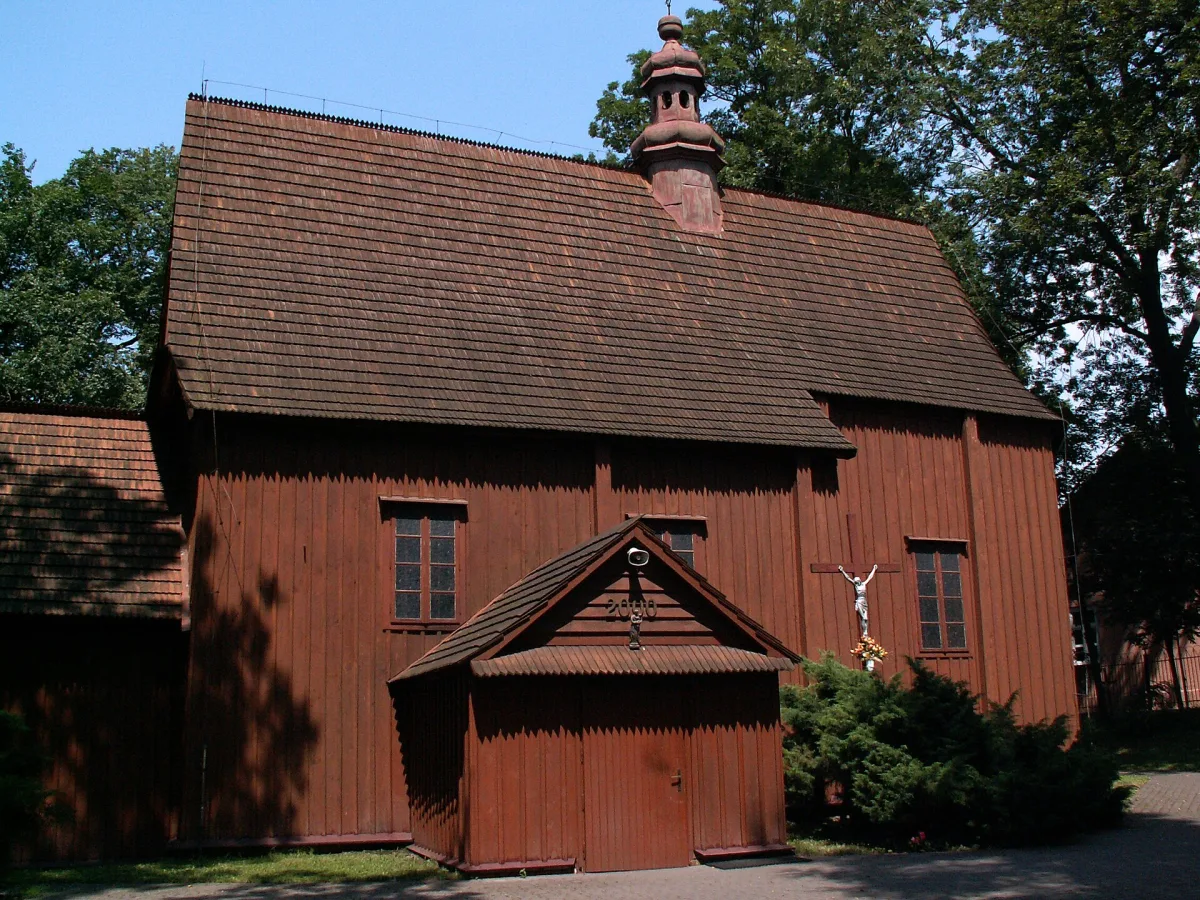
The Church of All Saints on Podbiałowa Street was built in 1646-1648, founded by Barbara Morsztynowa, the owner of Kościelniki. It was consecrated only in 1698, half a century after construction was finished. Wikipedia describes the body of the building as Late Gothic, of log construction and without a tower, with a Baroque turret for the small bell in the roof. The polychrome with saints and the Stations of the Cross dates from 1909. Next to it stands a brick gate belfry from 1823 and a small First World War cemetery.
Krzesławice: the church from Jawornik
The Church of St John the Baptist on Wańkowicza Street did not originate in Kraków. It was built in 1633-1648 in Jawornik near Myślenice as the Church of the Finding and Exaltation of the Holy Cross. After damage in 1983 it was dismantled and in 1983-1986 moved to Krzesławice. Inside, part of the polychrome from the first half of the 17th century has survived, with the Last Judgement and St Christopher. The crucifix in the Late Baroque altar dates from the end of the 16th century and came here from the church in Pleszów.
Marcyporęba
The Church of St Martin in Marcyporęba was built in 1670 and consecrated in 1677. The log walls were clad with vertical boards. The Baroque tower with a pyramidal spire was added in the 20th century, and a wooden belfry was put up in 1976-1980. A 15th-century crucifix hangs on the rood beam, and the church has a Renaissance stone font from 1545.
18th century: altars, towers and tserkvas
In the 18th century Rococo altars and polychromes with plant motifs entered the interiors, and bulbous tower spires appeared on the outside.
Wiśniowa and Iwanowice
The Church of St Martin in Wiśniowa dates from about 1730, and on 3 November 1747 it was consecrated by Auxiliary Bishop Michał Kunicki. The walls were clad with boards only in 2001. The polychrome with plant motifs was made in 1910 by Michał Tarczałowicz. Next to it stands a wooden post belfry with a bell from 1726, and by the church grows a lime-tree park with a Way of the Cross.
The Church of the Holy Trinity in Iwanowice Włościańskie was completed in 1745, founded by the owner of the village, Aleksander August Czartoryski. Earlier a Gothic church from 1408 had stood here. The church has two towers with domed spires at the front and a porch between them. Inside, Gothic sculptures have survived, among them St Christopher from 1480-1490, which Wikipedia links to the workshop of Veit Stoss.
Więcławice Stare and Chabówka
The Church of St James in Więcławice Stare was built in 1748 by the carpenter Mateusz Wydolny and consecrated in 1757 after a thorough renovation. It has three Rococo altars from the mid-18th century, but inside there is also a Gothic triptych of St Nicholas from 1477. Next to it stands a wooden belfry from 1846. The church lies on the Lesser Poland Way of St James.
The Church of the Holy Cross stands in Chabówka, on the border with Rdzawka, right by the Zakopianka road. It was built in 1757, founded by the Voivode of Sandomierz, Jan Wielopolski. The soboty, low arcades on posts, gave shelter to pilgrims waiting for the service. On the night of 2 October 1994 the church was set on fire, and firefighters from Kraków managed to save it. The polychromes from 1901 were reconstructed after the fire.
Słopnice, Kamionka Mała and Łętownia
The Church of St Andrew the Apostle in Słopnice was built in 1774-1776 on the initiative of the parish priest Jan Zwiernikiewicz, and the work was led by the carpenter Jan Golencki. The consecration took place on 25 October 1776. The church has no tower, and the belfry is a separate brick structure with three arches. Among the furnishings is a Late Renaissance painting, "Holy Conversation", from 1637.
The Church of St Catherine in Kamionka Mała was built in 1778 from the material of an earlier 15th-century church, the tower was added in 1790, and in 1884 the chancel was extended and a chapel, porch and sacristy were added. The figural polychrome from 1857 was made by Ferdynand Miklasiński. The Baroque organ was built in 1683 in Stary Sącz for the church in Brzeziny and was later bought for Kamionka.
The Church of St Simon and St Jude Thaddeus in Łętownia dates from the second half of the 18th century and stands on the site of an earlier church, which was moved to Krzeczów. The tower is of post-and-frame construction and has a Baroque bulbous spire. Inside, a Rococo pulpit from 1779, two 17th-century confessionals and a choir loft with an organ from the time of construction have survived.
What these churches have in common
Most of them are active parish or filial churches, so the interiors are usually seen during services or by arrangement with the parish. A few, like Słopnice, serve a supporting function to a newer church in the same village. Many have survived fires, renovations and alterations, so a single building holds elements from several eras side by side: a Gothic triptych in a Rococo interior, or a Baroque tower added in the 20th century.
Be the first! Add a comment.
You need to log in to add a comment.
Log in