
Before the war almost every town in Lesser Poland had a synagogue or a house of prayer. Most of the buildings survived as walls but not as places of worship: some now house a cultural centre or a museum, others a cinema, a bank or a shop, and some stand empty. Below is an overview of those that can be found on the map, and of a few of which only the site remains.
Where a synagogue serves people again
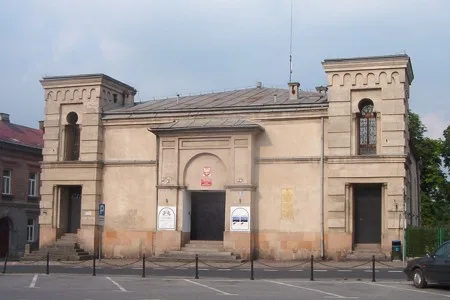
The synagogue in Dąbrowa Tarnowska on Berka Joselewicza Street is, according to Wikipedia, the largest surviving synagogue in Lesser Poland Voivodeship. It was designed by Abraham Goldstein, and the main donor was Ajzyk Stern. The dates in the sources differ: construction and finishing work is said to have lasted from 1855 to 1860, and the day the building was completed is most likely 1 April 1863. It is a red brick building in an eclectic-classicist style with Moorish motifs. The façade is flanked by two towers, with a three-storey portico between them. After the war the Germans set up a warehouse in it, which operated until 1970; in the 1970s conversion into a community centre began, but the work was halted and the building fell into decay. After securing and renovation, since 5 June 2012 it has housed the Centre for the Meeting of Cultures, exhibitions, history lessons and concerts.
The synagogue in Nowy Sącz, known as the Town Synagogue (Grodzka), stands on Berka Joselewicza Street, near the castle, in the former Jewish quarter. It was built in 1746 on the basis of a privilege of 1699, in place of an older wooden one. Wikipedia says that it was meant to be modelled on the prayer houses in Chełm and Chęciny and could not be taller than the smallest church in the town. In 1889 Stanisław Wyspiański sketched its interior, and after a fire in 1894 it was rebuilt with a new façade with two towers. In 1974 it was handed over to a museum, which for decades ran an art gallery in it. In 2015 the building was taken over by the Jewish Religious Community in Kraków, and on 23 May 2017 the Torah returned to the synagogue and prayer was resumed. According to Wikipedia this community is the heir to all the surviving synagogues in Lesser Poland.
The Chewra Lomdei Mishnayot Synagogue in Oświęcim, that is, the synagogue of the society of students of the Mishnah, is according to the website of Oświęcim County the only Jewish house of worship in the town that survived the war. The sources disagree about when it was built: the county writes of the 1930s, Wikipedia of efforts made in 1913 and of prayer from at least September 1918. The Germans set up an ammunition store in it. After the war it served a small local community until 1955, when almost all of Oświęcim's Jews left the town. It then stood empty, and from 1977 it belonged to the State Treasury, which set up, among other things, a carpet wholesaler in it. In 1998 it was returned to the Jewish community and handed over to a foundation, and after renovation it was opened in 2000. In the neighbouring building the Jewish Centre with a museum operates.
Buildings with a new purpose
Most synagogues survived as ordinary buildings. The synagogue in Nowy Targ, the main prayer house of the community, was built at the beginning of the 20th century in the Neo-Baroque style. After the war it was converted into the Tatry cinema, and a renovation in the 1970s completely erased its original appearance.
The synagogue in Brzesko, built in 1904-1905 on the site of a prayer house burnt in a fire that swept the town, has an eclectic body and a neoclassical façade with a two-storey projection topped by a gable with spires. In 1947 the town bought it from the Jewish community for a library, then it was used by a disabled people's cooperative, and the interior was altered. It was entered in the heritage register in 2008.
The synagogue on Trudna Street in Bochnia was meant to be the most modern house of prayer in the town and the surrounding area. Construction began in 1932, the community began using the unfinished building in 1936 and received a heavy fine from the town authorities for it, and the outbreak of war halted the work. In 1988, after renovation, the building was taken over by a bank. The bank left it in November 2019, and the property was bought by a private entrepreneur.
The Anshei Emes Synagogue in Kęty (from the Hebrew: Men of Truth) was built around 1900 on the initiative of an association of that name. Of the former decoration, a frieze under the roof has survived, and most of the windows have been bricked up. In Wieliczka, on Seraf Street, stands a synagogue from 1911, entered in the heritage register in 1987, which in 1939-1942 was the seat of the Judenrat. In August 1942 the Jewish community of Wieliczka and the surrounding area was, according to Wikipedia, deported and almost entirely murdered. After the war the building was altered many times and today it does not resemble a prayer house.
In Kalwaria Zebrzydowska the synagogue on Sądowa Street, from the second half of the 19th century, has kept its arch-topped windows, arcaded cornice, a door with a lion-shaped handle and the trace of a mezuzah, but it houses a furniture shop. In Brzeszcze a private house of prayer from 1934 was added to the family home by Jakub Finder. Only his family prayed in it, and after the war Henryk Finder, the only survivor of it, gave the house together with the prayer room to a family of friends.
Empty buildings and ruins
Some synagogues are described as abandoned. The synagogue in Książ Wielki, from 1846, burnt down in 1935 and was thoroughly renovated. During the war the Germans devastated the interior, after the war it housed a cooperative's warehouse, and in the second half of 2016 the roof collapsed, exposing the interior. Ten arch-topped windows of the prayer hall and the niche of the aron ha-kodesh, that is, the cabinet for the Torah scrolls, have survived.
The synagogue in Słomniki was built at the end of the 19th or the beginning of the 20th century for a community of more than 900 people. Besides the prayer hall it housed the community offices, a cheder, a school for girls and, in the cellars, a mikveh. After the war it was a cinema, then a warehouse and a workshop. In 1990 two plaques funded by the Association of Jews of Słomniki in Israel were set into the front wall, in Polish and Hebrew. In Krzeszowice, on Wąska Street, the men's house of prayer from the end of the 19th century stands with its façade partly preserved, and its interior has been ruined. The women prayed in a separate building at number 1.
Sites of former synagogues
Some prayer houses have vanished. The Great Synagogue in Chrzanów, from 1786-1787, stood at the crossing of Krakowska and Garncarska streets. After the war it fell into ruin, and in 1973, on the orders of the town authorities, it was blown up, despite the efforts of the Chrzanów museum to include it in its display. The site was not built on, and in 2022, during a ceremony commemorating the pre-war Jewish community, a new tree was planted there, named the Esther Willow (Wierzba Estery).
The synagogue in Wadowice on Gimnazjalna Street, built in 1885-1889 to a design by Karol Korn, was set on fire in October 1939, and the ruins were blown up in 1940. After the war a building with a nursery school was put up on its site, and in 1989 a plaque was unveiled dedicated to the two thousand Jews of Wadowice. The synagogue was visited in 1937 by the young Karol Wojtyła, at a concert by the cantor Dawid Kussawiecki.
The synagogues in Bobowa and in Kazimierz have their own articles.
Be the first! Add a comment.
You need to log in to add a comment.
Log in