

Lipnica Murowana, a village in Bochnia County, is associated above all with one custom: on Palm Sunday, Easter palms several dozen metres tall are raised here. The competition for them, according to Wikipedia held since 1958, draws makers from the whole area to the market square. It is one of the best-known forms of this custom in Lesser Poland (Małopolska), alongside the palms of Limanowa mentioned in the entry on Palm Sunday.
Where the palm comes from and what it means
Palm Sunday falls seven days before Easter and opens Holy Week. It commemorates Christ's entry into Jerusalem, when the people strewed branches before him. The first known records of a procession on this occasion come from the diary of the pilgrim Egeria from the 380s. In Poland the feast has been observed since the Middle Ages, and the faithful bring small palms to church as a symbol of reviving life.
The shape of the palm depends on the region. The Vilnius palm is a small roll of dried grasses and flowers, while the Kurpie palm is several metres long with paper flowers. The palms of southern Poland, which include those of Lipnica, are made of long willow, wicker or hazel rods, bound at regular intervals with twine or leather straps. At the top is a crown of pussy willow, box, yew and coloured flowers, and ribbons are attached to the rod.
The competition in Lipnica Murowana
Wikipedia writes that Lipnica is famous for the Lipnica Palms and Artistic Handicraft Competition, held since 1958. Competition palms are made in several categories, and the rules set strict conditions:
- the palm must be made of natural materials, and the use of metal or plastic elements disqualifies it,
- every palm, including the tallest, must be raised upright by human muscle power,
- only ropes and stabilising poles may be used, with no cranes or lifts,
- a palm that breaks during raising is out of the competition.
According to the same source, the tallest palms have exceeded 30 metres. The palms of Zbigniew Urbański were considered records: 33.45 metres in 2009, 35.10 metres in 2010 and 36.04 metres in 2011. The next record, 37.78 metres, was set in 2019 by Andrzej Goryl. The record height given here comes from the years stated and need not be current, because a new one can be set every year.
Wikipedia also notes a palm competition in Rabka. Both towns hold competitions for the longest and most beautiful palm, and Podhale palms are also seen during processions in Bukowina Tatrzańska and Tokarnia.
The market square, the church and St Simon
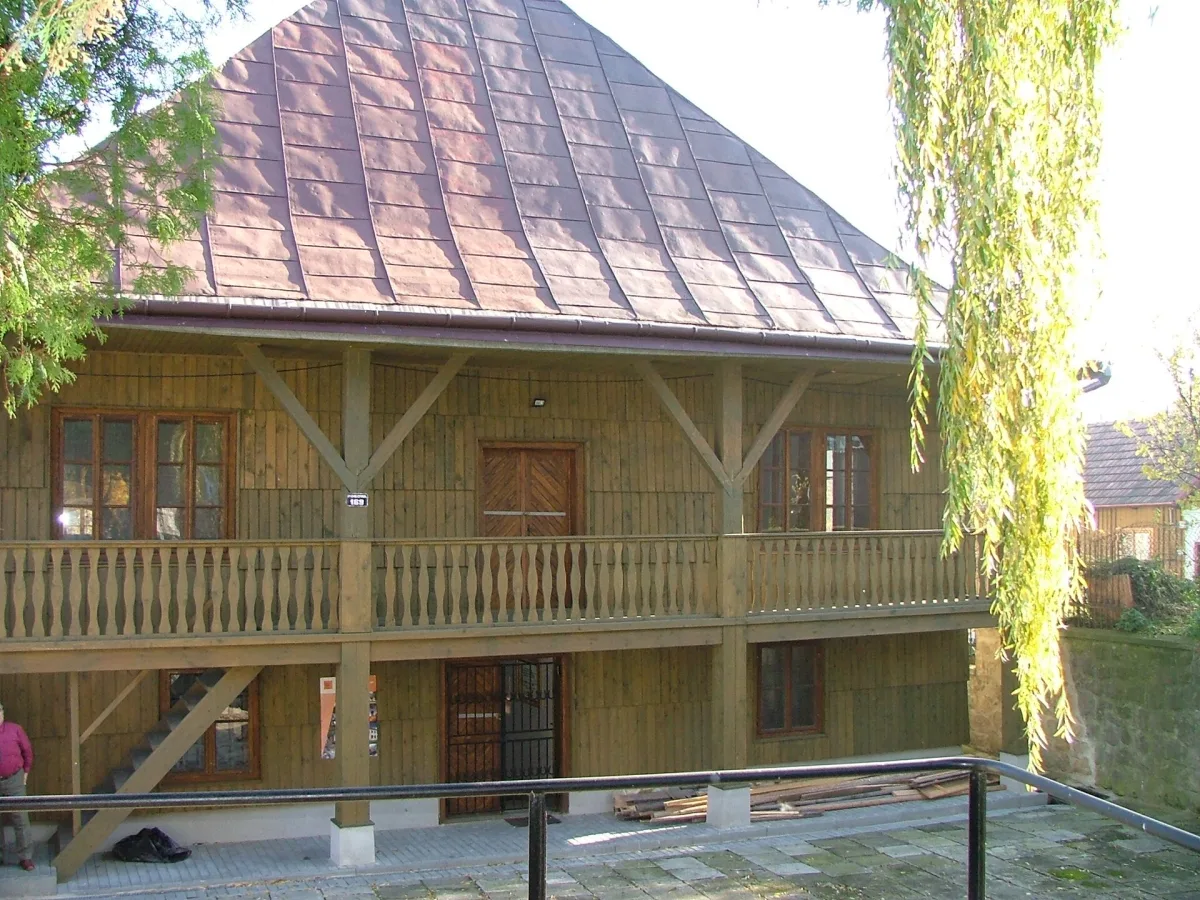
Lipnica was founded in 1326 by King Władysław the Elbow-high, and it held town rights until 1934. The medieval layout has survived to this day, with a market square of about 60 by 55 metres, surrounded by wooden houses with arcades built in the 18th century. The village lies on the Lesser Poland Wooden Architecture Route, and its surroundings belong to the Wiśnicz-Lipnica Landscape Park.
Just beyond the former town boundary, in Lipnica Dolna, stands St Leonard's Church. Wikipedia states that it was probably built at the end of the 15th century, while local tradition ties its beginnings to 1143 or 1203. In 2003 it was inscribed on the UNESCO World Heritage List, together with other wooden churches of southern Lesser Poland. This listing therefore concerns the church, not the palm competition.
Simon, a Bernardine friar, came from Lipnica. He was born between 1438 and 1440 and died in Kraków on 18 July 1482 during an epidemic, while caring for the sick. Pope Benedict XVI canonised him on 3 June 2007. St Simon's Church in Lipnica stands, as Wikipedia states, on the site of his family home. The Ledóchowski family is also linked with the area: the estate in Lipnica was taken over in the 19th century by Antoni August Ledóchowski, and after him by his wife and daughter. The former manor complex is described in the entry on the Ledóchowski Manor House. St Urszula Ledóchowska also lived in Lipnica, and the first Ursuline sisters began work here in 1939.

Be the first! Add a comment.
You need to log in to add a comment.
Log in