
Four tserkvas on the UNESCO list in Lesser Poland
In June 2013 sixteen wooden tserkvas (wooden Eastern-rite churches) from the Polish and Ukrainian parts of the Carpathians were inscribed on the UNESCO World Heritage List, eight from each country. Four of the Polish ones lie in Lesser Poland (Małopolska): in Owczary, Kwiatoń, Powroźnik and Brunary Wyżne. All four also belong to the Lesser Poland Wooden Architecture Route. What follows is the route itself, village by village. How a Lemko tserkva is built and furnished is covered in a separate text.
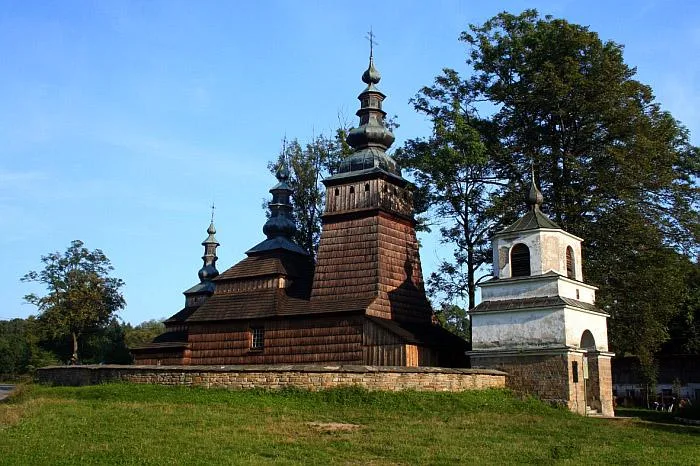
You can start with the Tserkva of the Protection of the Mother of God in Owczary, built in 1653. The first church on this site was destroyed because the ground was boggy, so the present one was built anew. The tower was added in 1783, and in 1983-1985 the building underwent a thorough renovation, with shingle restored on the roofs. In 1995 the tserkva received the Europa Nostra award. Today it is shared by the Greek Catholic and Roman Catholic parishes, an arrangement in force since 1998.
The Tserkva of St Paraskeva in Kwiatoń was built in the second half of the 17th century, although 1700 is often given as the year of construction. The tower bears the date 1743, found on one of the beams, but Wikipedia notes that it may refer to the renovation of an older tower. If the date is confirmed, it is the oldest reliably dated tower of a Lemko tserkva. The church is regarded as a model example of the north-western Lemko type. It is used by both Roman Catholics and Greek Catholics.
The Tserkva of St James in Powroźnik has existed since 1600, but only part of the original building survives, today serving as the sacristy. The reconstruction of 1813 involved moving the building to higher ground, because it was threatened by flooding. A bell from 1615 hangs in the tower. Today it is a Roman Catholic church. The sacristy, the former chancel, is covered with a polychrome dated to 1607.
The Tserkva of St Michael the Archangel in Brunary Wyżne has been preceded by several buildings. The first was built after 1616, when a Uniate parish was founded in the village, the next in 1653, and the present one dates from the 18th century and was rebuilt and enlarged in 1831. Today it is a Roman Catholic church.
The route around Uście Gorlickie and Bartne
Kwiatoń belongs to the parish in Uście Gorlickie, where the Tserkva of St Paraskeva in Uście Gorlickie stands. The first church here was built around 1539 as an Orthodox one. In 1691 the parish accepted the Union of Brest, and the present building of 1786 was already Greek Catholic. Since 1997 its sole owner has been the Greek Catholic parish.
The Tserkva of Sts Cosmas and Damian in Skwirtne was built in 1837. Wikipedia describes it as a model example of a 19th-century tserkva of the north-western type. It serves as a branch church of the parish in Uście Gorlickie.
In Bartne stands the Tserkva of Sts Cosmas and Damian from 1842, as confirmed by the date carved above the entrance to the narthex. The lower parts of the tower may be older, from the 18th century. After 1947 the church was not in use, and after the renovation of 1968-1970 it serves as a museum, a branch of the museum in Gorlice. Inside is a late Baroque iconostasis from the 18th century. Next to the tserkva is a Lemko cemetery with gravestones made by local stonemasons, and in the former parish granary there is an exhibition on stonemasonry.
The Tserkva of the Protection of the Mother of God in Wołowiec dates from the 18th century. In 1927 most of the inhabitants converted to Orthodoxy, and the church remained in the hands of the Greek Catholic minority. In the 1960s it returned to use as an Orthodox church, and since 2009 it has been the sole property of the Orthodox Church. A polychrome from the 19th century has survived inside.
Bielanka has two tserkvas. The older one, from 1753, was assigned by law to the Greek Catholic Church, and the Orthodox built their own new church, completed in September 2014. The interior of the old tserkva is decorated with a four-tier iconostasis.
Tserkvas that changed place or owner
Not every tserkva stands where it was built. The Tserkva of St Paraskeva in Bukowiec was built in 1805 in Kamianna and moved to Bukowiec in 1949. Since then it has been a Roman Catholic church. The tserkva in Wawrzka was built in 1935-1939 by the Orthodox inhabitants of the village, and after 1947 it was finished by Latin-rite Catholics. Today it is a branch church.
In Bogusza the tserkva of 1932-1937 is brick, not wooden. After 1947 it was taken over by the Roman Catholic Church, and after the renovation of 2000-2003 it serves as an auxiliary church.
The year 1947 and the later fate of the tserkvas
Many of the buildings described above changed users after 1947. Operation Vistula, carried out from 28 April to the end of July 1947, covered, according to Wikipedia, more than 140 thousand people, including Lemkos. Historians assess it differently. For the tserkvas it meant that some were taken over by the Roman Catholic Church, some stood empty, and in Wołowiec the building was adapted as a sheepfold. After 1956 some of the former inhabitants returned to some of the villages, and in some tserkvas Greek Catholic services were held again.
When planning a visit, remember that these are not museums but, for the most part, active places of worship, so access depends on the parish.
Be the first! Add a comment.
You need to log in to add a comment.
Log in