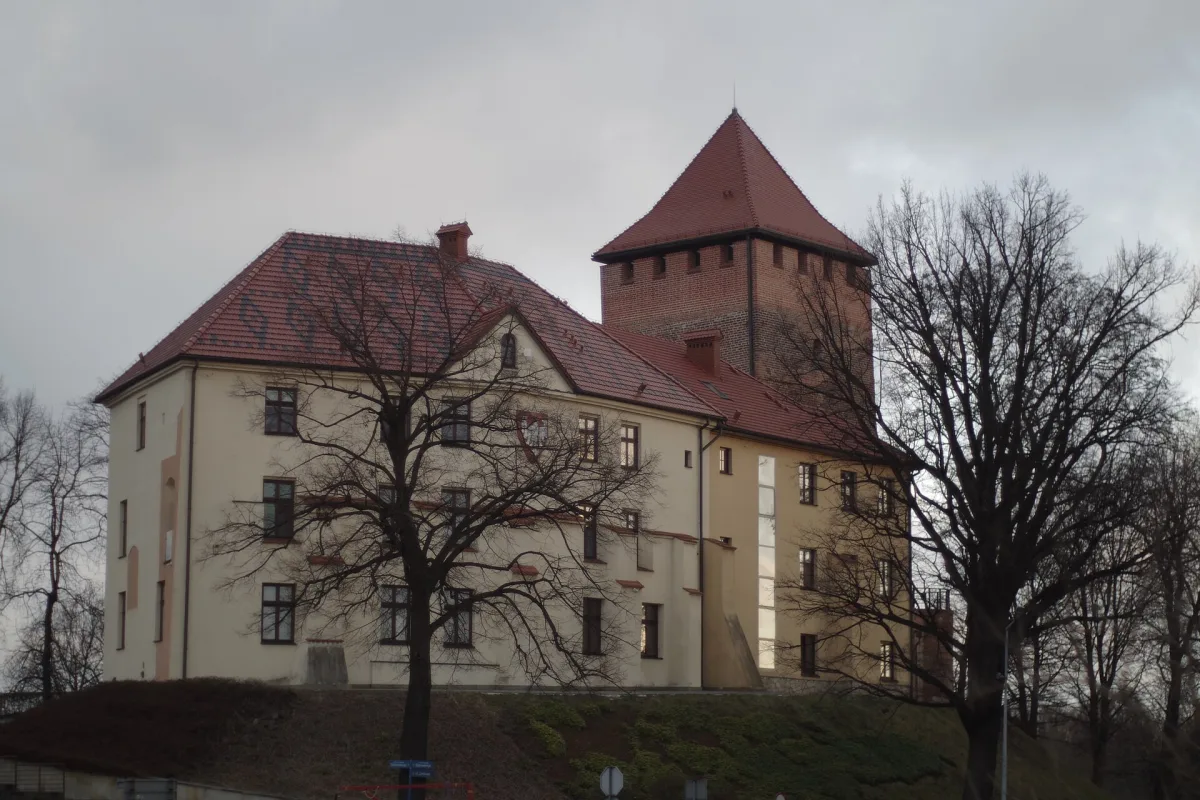
A medieval castle on a hill above the Soła River with a Gothic tower from the end of the 13th century, the former seat of the dukes of Oświęcim.
Oświęcim Castle stands on a hill on the right bank of the Soła River, near the former market square. The oldest part is a brick tower from the end of the 13th century, around which later buildings arose. For centuries it was the seat of the dukes of Oświęcim, and later of a royal starosta.
The first mentions of the Oświęcim castellany date from 1177-1179. Archaeological discoveries by the tower confirm that a masonry structure stood on the hill as early as the first half of the 13th century. After the Tatar invasion of 1241 the town was rebuilt and surrounded with walls, and a stone keep on a square plan began to be built on the hill.
In 1314 or 1315 the castle became the seat of the first ruler of the Duchy of Oświęcim, Duke Władysław I. In 1414-1433 Duke Casimir I resided here. In 1454 the duchy was paid in homage to Casimir IV Jagiellon, and three years later it was sold. Under the Treaty of Głogów of 1462 the Oświęcim-Zator land became part of the Crown.
The Gothic tower of the bergfried type stands on a square plan with a side of 10.5 metres, and its walls are about 4 metres thick at the base. The builders began with stone, interrupted the work for unknown reasons and completed it in brick, laid in Wendish bond. The original entrance with a pointed-arch portal is about 10 metres above the courtyard.
Next to the tower stands a two-storey building with a cellar from the early 16th century. It was built after the fire of 1503, which consumed the wooden buildings and spared only the keep and the foundations. The reconstruction was completed in 1534 and it was the last major rebuilding of the castle. Survey records list in it a bakery, pantries, a brewery, a malthouse and an armoury with crossbows, hackbuts and gunpowder.
The fire started by the Swedes in 1656 sealed the decline of the castle. A survey of 1765 showed the destruction of all the buildings except the tower and the southern part, and the floods of 1805 and 1813 undermined the hill and destroyed the walls. The Austrian authorities designated the castle for demolition, but it did not take place. For some time a salt store was housed in it.
The rebuildings of 1904-1906 and 1929-1931 changed its character, because a connecting wing was then added on the site of older buildings. Today the former defensive character is evidenced mainly by the tower. Remains of the defensive walls and a bastion survive on the hill, and a considerable part of the fortifications was taken by the river changing its course.
During the Second World War the castle housed the seat of the German occupation authorities. Under the hill run two tunnels: an older one, built before 1914, and a second, dug by the Germans in 1940-1944, which served as an air-raid shelter. The memorial site, that is, Auschwitz-Birkenau, the former German Nazi concentration and extermination camp, lies in another part of the town, about three kilometres from the castle, and has its own page.

Be the first! Add a comment.
You need to log in to add a comment.
Log in