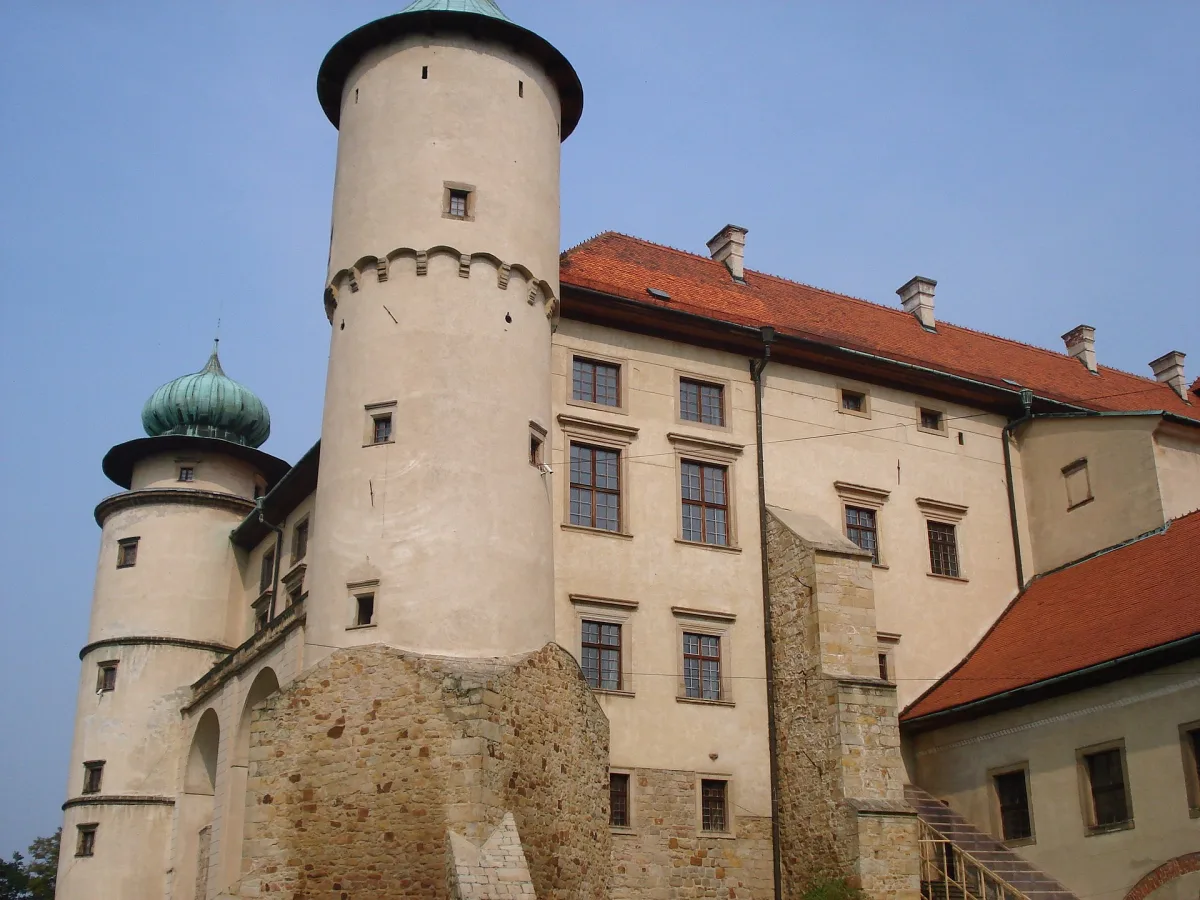
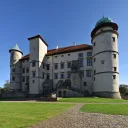
Early Baroque castle of the Lubomirski family on a quadrangular plan with four towers and bastioned fortifications, with a chapel and family crypt.
Wiśnicz Castle rises on a wooded hill above the Leksandrówka river and, according to its official website, is the largest castle in Lesser Poland after Wawel. It is an early Baroque fortified residence on a quadrangular plan with a courtyard and four towers at the corners, surrounded by bastioned fortifications.
The castle was built by Jan Kmita of the Szreniawa coat of arms in the second half of the 14th century. The castle's existence is first attested by the accounts of the Bochnia salt mines from 1396. Piotr Kmita extended the residence after 1516, and after his death in 1553 it passed to the Barzi family, and then to the Stadnickis.
In 1593 the castle was bought by Sebastian Lubomirski. His son Stanisław carried out a thorough rebuilding in 1615-1621 under the architect Maciej Trapola. The castle took on its early Baroque form and became one of the most splendid fortified residences of its age. The heritage register gives the Baroque style and the dating 1615-1621, and describes the building material as stone.
The castle is surrounded by bastioned fortifications on a pentagonal plan with sides of about 98 metres. The entrance gate takes the form of a triumphal arch from 1621. A chapel with the Lubomirski burial crypt was added to the main block on the north-east side, and the freestanding Kmitówka on the south-east. The chapel has preserved the genealogical heraldry of Stanisław Lubomirski and his wife Zofia Ostrogska, and in the crypt stand six sarcophagi. On the second floor, by the Knights' Hall, there is a viewing gallery.
The interiors comprise more than 50 rooms with marble portals, painted beams, wooden wainscoting and marble floors. Among the state spaces are a room with a coffered ceiling, a gilded salon and a chapel with good acoustics.
In the 18th century the castle belonged in turn to the Sanguszko, Potocki and Zamoyski families, and after the partitions it fell into ruin. A fire in 1831 left the building abandoned until 1901, when it was acquired by the Union of the Lubomirski Family. The rebuilding was led by Adolf Szyszko-Bohusz from 1928, interrupted by the war, and after 1945 the work was continued under Alfred Majewski.
The castle is linked to Polish culinary tradition. It was here that Stanisław Czerniecki, master of the kitchen to Prince Lubomirski, wrote down the "Compendium ferculorum", published in Kraków in 1682 and regarded as the first Polish cookbook. According to Wikipedia Czerniecki also devised the first potato dishes, after potatoes reached Poland following the relief of Vienna. The castle's stories also include the legend of the Turkish and Tatar prisoners who tried to escape using wings they had made with their own hands.
The castle's website lists, among others, the Museum of the Wiśnicz Land, the Collector's Cabinet, an exhibition of the Fowler Brotherhood (Bractwo Kurkowe), the Bastion VR experience and an evening tour with a story of the castle's intrigues. The offer is sometimes seasonal, so it is worth checking the details before your visit.
About 100 metres away stands the parish church complex of the Assumption of the Blessed Virgin Mary, and about 7 kilometres further on lies the Bochnia Salt Mine.

Be the first! Add a comment.
You need to log in to add a comment.
Log in