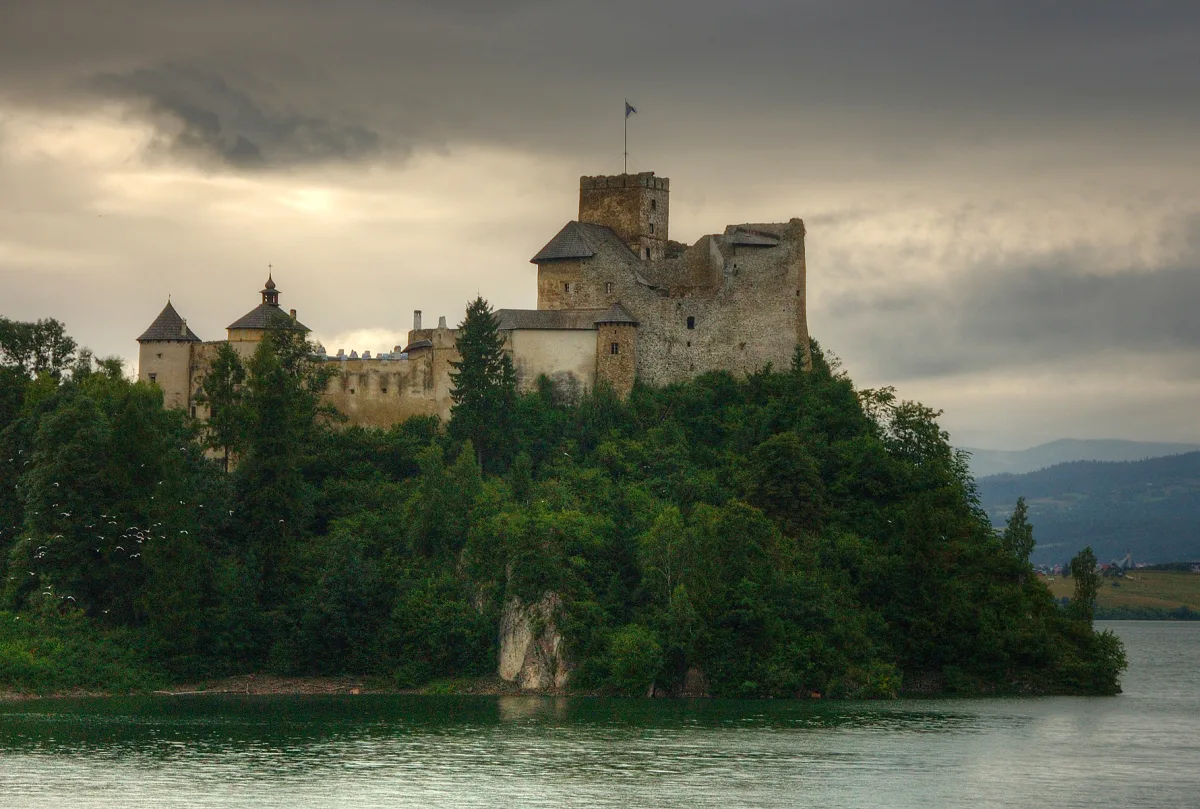
A medieval castle above Czorsztyn Lake, once called Dunajec Castle, today a museum.
Niedzica Castle, also called Dunajec Castle in historical sources and on Wikipedia, stands on a hill above Czorsztyn Lake, in the village of Niedzica-Zamek in Spisz. The castle is 566 m above sea level, about 35 m above the surface of the lake, and before the lake was created it rose roughly 75 m above the Dunajec River. Today it houses a museum, and the castle complex also has its own legend.
The stone castle began to be built in 1327-1330 on the initiative of Wilhelm Drugeth, and the first reliable mention comes from his will of 1330. The Gothic upper castle was later extended, and in the 14th and 15th centuries the middle castle was built. The lower castle was added at the end of the 15th century on the initiative of Emeric Zápolya, and at the turn of the 16th and 17th centuries it was rebuilt by Jerzy Horváth Palocsay, who gave the building mainly Renaissance features.
The fortress passed from hand to hand: it belonged to the Berzeviczy, Zápolya, Hieronim Łaski, Horváth and Palocsay families, and in the second half of the 19th century it passed to the Salamons. It was the centre of an estate that included over a dozen villages of Zamagurie. In 1817-1823 Andrzej Palocsay repaired and remodelled the castle after a fire at the family seat in Pławiec.
The castle lay in former Hungary. After the First World War, by a decision of the Conference of Ambassadors of 28 July 1920, it fell to Poland, and the former estate was cut by the border: Pławiec ended up on the Czechoslovak side. During the Second World War this part of Spisz was annexed to the Slovak Republic. In 1945 the castle was plundered and much of its furnishings destroyed, a year later it was taken over by the State Forests, and in 1947 it was entered in the heritage register.
The castle features in several legends, and the best known is the legend of the Inca treasure. It is a folk tale, not a confirmed historical fact. It is linked with the figure of Andrzej Benesz. All that is known is that in July 1946 Benesz, a plenipotentiary of the provincial culture department, was searching the castle for hidden documents and found a tube with papers from 1774 under the threshold of the gate to the upper castle. The rest of the story is built on this, and castle guides tell it in their own way.
Restoration work was carried out from 1949, and from 6 November 1950 the castle served as a Creative Work House of the Association of Art Historians, which uses it to this day. The interiors of the upper and middle castle were opened as a museum, with guided tours. Visitors can also see a coach house with historic vehicles from 1900-1939 and a wooden granary from the 18th century. A library was set up in the former castle chapel, and in 1962 medieval Gothic paintings discovered there earlier were conserved.
About 1.5 km away stands Czorsztyn Castle, and the reservoir itself is described as Czorsztyn Lake. For views of the Pieniny it is worth adding the peak of Three Crowns (Okrąglica) and the viewing tower on Luban.

Be the first! Add a comment.
You need to log in to add a comment.
Log in