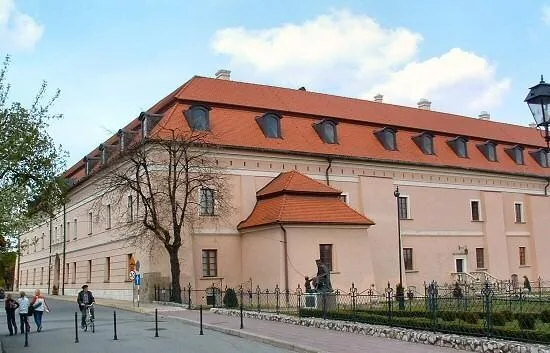
A Gothic castle from the mid-14th century, rebuilt in the Renaissance, a former residence of Polish kings and the base for hunts in the Niepołomice Forest.
The Royal Castle in Niepołomice is a Gothic residence from the mid-14th century, rebuilt in the Renaissance spirit, standing in the very centre of the town on the escarpment of the Vistula glacial valley. It is sometimes called the second Wawel, because for centuries it served the kings as a base for hunting expeditions to the nearby Niepołomice Forest.
The castle was built on the orders of Casimir the Great and was also meant to serve defensive functions. It was originally formed by three towers, buildings in the south and east wings, and curtain walls around the courtyard. At the same time the settlement of Niepołomice arose, which served the castle and the court.
The work was continued by Władysław Jagiełło, Sigismund I the Old and Sigismund Augustus. Under Jagiełło, crown assemblies were convened here and courts were held. In November 1419 the king and queen received the Silesian dukes in Niepołomice. Sigismund the Old thoroughly rebuilt the castle, giving it the form of a quadrangle with an inner courtyard. In 1527, when an epidemic raged in Kraków, the court sought refuge here.
The castle's present appearance is mainly the result of work in 1551-1568, after the great fire of 1550, which destroyed the east and north wings. The reconstruction was carried out under the direction of Tomasz Grzymała and the sculptor Santi Gucci. On the courtyard side, staircases and cloisters supported on three columns were built. The heritage register dates the castle to 1550-1571 and describes its style as Renaissance and its material as brick.
The Italian gardens by the south wing, called Queen Bona's gardens, were Queen Bona's doing. In 1635-1637 the cloisters were rebuilt in the early Baroque style.
From the end of the 16th century the castle passed into the hands of noble families, among them the Curyłos, Branickis and Lubomirskis, who mainly changed the interior decoration. The end of its splendour came with the Swedish invasion of 1655: the castle was turned into a food store, the church was destroyed, and the town was plundered. After the partitions the Austrians set up barracks here and demolished the second floor, and strengthened the walls with buttresses and supports. Later the building served as housing and warehouses, and after the wars it fell into ruin.
Since 1991 the castle has belonged to the Municipality of Niepołomice. Renovation and adaptation work lasted until 2007 and restored the residence to its former glory. The site is in the heritage register, and the first entry dates from 1934.
Since 2001 the Niepołomice Museum has operated in the chambers, with exhibitions on painting, hunting and the history of the town, and the collections of Włodzimierz Puchalski. The castle also serves as a hotel, restaurant and conference centre, and the operator also runs cultural activity there: recitals, concerts and performances. The choir of the Society of Friends of Music and Singing “Cantata” is based here.
After your visit it is worth walking to the nearby market square, about 100 metres away. The castle itself also lies near the Museum of Phonography.

Be the first! Add a comment.
You need to log in to add a comment.
Log in