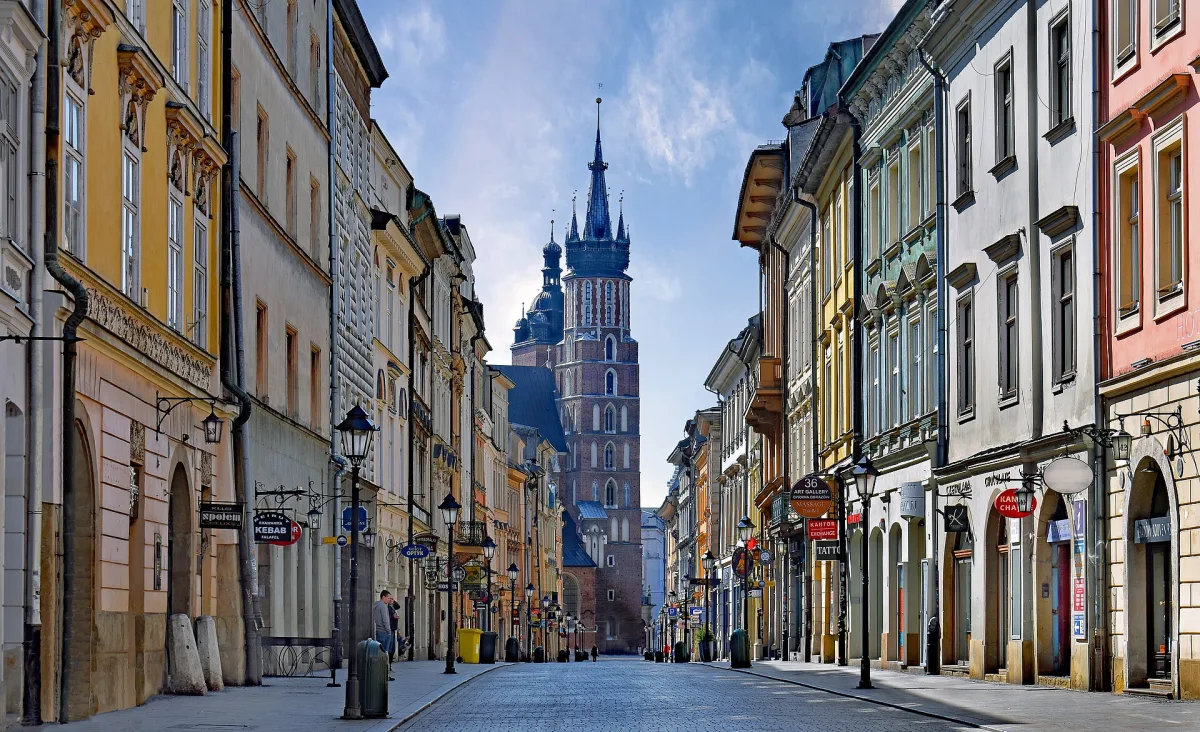
Floriańska Street in Kraków is 335 m long, links the Main Market Square with St Florian's Gate and is part of the Royal Route.
Floriańska Street is a 335-metre section of the Royal Route that runs from the north-eastern corner of the Main Market Square to St Florian's Gate. It is one of the most densely built-up streets of the Old Town: almost every townhouse here has its own name, history and a famous resident.
The street was laid out in 1257, when the city was chartered, as the first section of the old road to the north. It takes its name from St Florian's Gate, which closes the view along the street on the north side and leads towards St Florian's Church. In old sources the street also appears as "platea Sancti Floriani", that is, St Florian Street, and as Tworzyjańska Street.
Beyond the gate the road continues: the direct extension of Floriańska is Jan Matejko Square, and beyond it Warszawska Street. On the south side the street begins at the Main Market Square.
More than 20 townhouses on this street stand out for their rich architecture and interior decoration, and their styles range from Gothic through Renaissance to Baroque. At first wealthy burghers and nobles lived here, and from the 18th century inns, hotels and restaurants developed.
Among the street's residents and guests were also people of culture: at number 11, in the Pod Aniołkiem townhouse, the comedy writer Michał Bałucki was born in 1837, and at number 34 Wojciech Stattler, a painter and professor and the teacher of Jan Matejko, was born. At number 37 Henryk Frist founded the Salon of Polish Painters.
At number 41 stands a 16th-century building in which Jan Matejko was born, lived, worked and died. The façade was designed in 1872 by the painter himself and the architect Tomasz Pryliński. On 2 September 1880 Emperor Franz Joseph visited Matejko in his studio here.
After the painter's death his friends turned the house into a museum. In 1904 it became a branch of the National Museum.
At number 45, in the Bełziński townhouse, is the confectioner's shop "Jama Michalika" (Michalik's Den), founded by the Lviv confectioner Jan Michalik. In the first years of the 20th century it became the seat of the artistic cabaret "Zielony Balonik" (Green Balloon).
In 1882 a horse-drawn tram line was opened on the street, and in 1901 it was replaced by an electric line. Trams ran here until 27 June 1952.

Be the first! Add a comment.
You need to log in to add a comment.
Log in