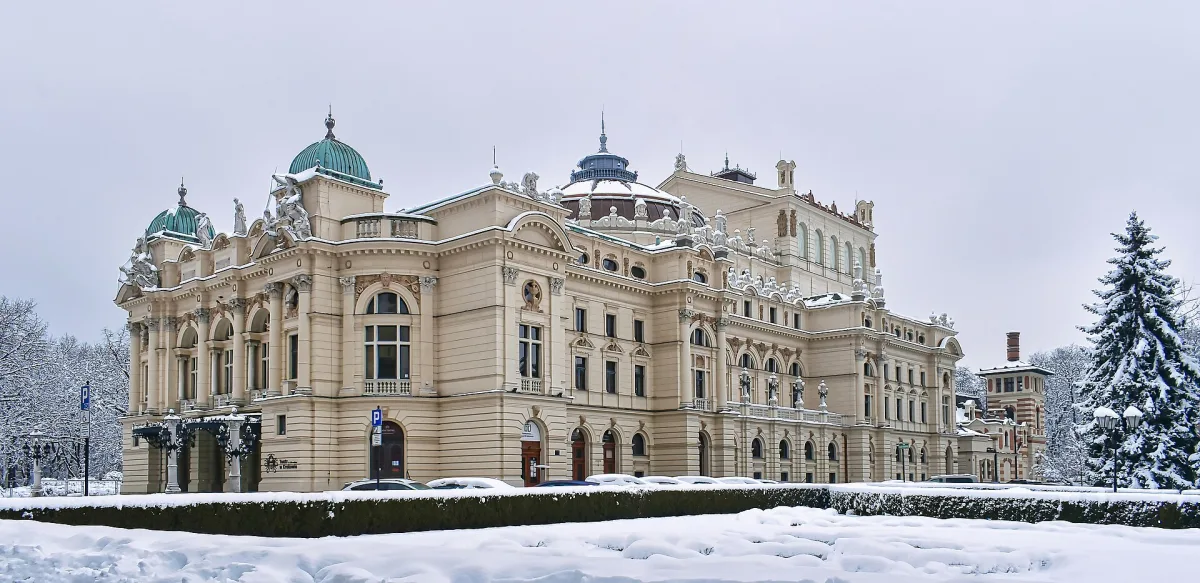
A Neo-Baroque theatre of 1893 on Plac Świętego Ducha, with a curtain by Henryk Siemiradzki, entered in the heritage register.
The Juliusz Słowacki Theatre stands on Plac Świętego Ducha in Kraków's Old Town. It opened on 21 October 1893 as the City Theatre, and today it is one of the most important theatre monuments in the city. The building was entered in the heritage register in 1961.
The building was erected in 1891-1893 on the site of the demolished Church of the Holy Spirit. The foundation stone was laid on 2 June 1891. The designer was the Kraków architect Jan Zawiejski, and the initiator of the construction was the photographer and councillor Walery Rzewuski.
The theatre has borne the name of Juliusz Słowacki since 16 October 1909. Earlier it operated as the City Theatre. At the turn of the 19th and 20th centuries, in the Young Poland period, it was one of the main centres of culture in the city. During the Second World War a German theatre operated in the building, and the stage reopened on 19 February 1945.
The building is of brick, in an eclectic style with a predominance of Neo-Baroque, and the heritage register describes it as Neo-Renaissance. It was the first building in Kraków with electric lighting.
The façade is crowned with allegorical figures: Poetry, Drama and Comedy on the left and Music, Opera and Operetta on the right. At the top stand the figures of Tadeusz and Zosia from "Pan Tadeusz", the work of Michał Korpal.
The auditorium originally had 922 seats, and today it is smaller. It is decorated with a chandelier with 120 bulbs.
The greatest curiosity of the interior is the curtain painted by Henryk Siemiradzki in 1892-1894. It measures 11.9 by 9.6 metres and shows Inspiration, Beauty, Truth, Tragedy and Comedy and a Bacchic procession around the monument of Terpsichore.
The first working rehearsal took place on 11 September 1893, and the official opening on 21 October 1893 at 12.00. The greatest event of the first decades was the world premiere of Stanisław Wyspiański's "The Wedding" on 16 March 1901. In the same year all parts of Mickiewicz's "Dziady" were staged in Kraków for the first time. On the front is the inscription "Kraków to national art".
The allegorical statues on the projecting bays were made by two artists: Poetry, Drama and Comedy by Tadeusz Błotnicki, and Music, Opera and Operetta by Alfred Daun. The chandelier in the auditorium has a diameter of 3.5 metres and 120 bulbs.
The theatre has three main stages: the Main Stage in the historic building, the Stage of the Lesser Poland Garden of Arts (Małopolski Ogród Sztuki) at ul. Rajska 12, opened in 2012, and Dom Machin. Since January 2025 the theatre has been jointly run by the Marshal's Office of the Lesser Poland Voivodeship and the Ministry of Culture and National Heritage.
In addition to these three stages there are smaller ones: the Miniatura Stage opened in 1976, the House of Theatre Crafts from 2016 and MOS Underground, which was created in 2025.
The theatre lies close to Planty Park, and from here it is a short distance to St Florian's Gate and the Barbican, both about 200 metres away. About 200 metres away is also the Czartoryski Museum, and further on, about 500 metres, the Cloth Hall (Sukiennice).

Be the first! Add a comment.
You need to log in to add a comment.
Log in