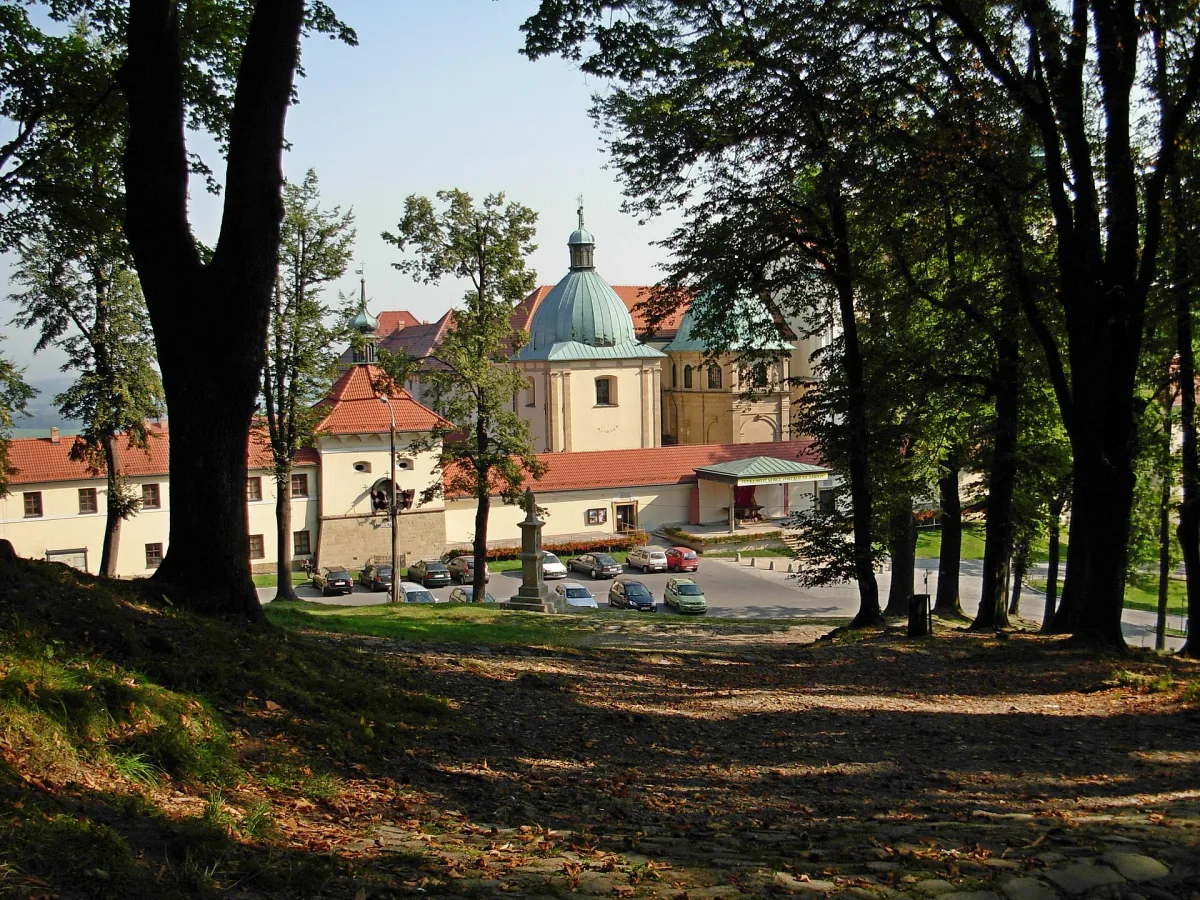
A Bernardine sanctuary with a basilica and 42 Calvary chapels, founded in 1600 and inscribed on the UNESCO list in 1999.
The Passion and Marian Sanctuary in Kalwaria Zebrzydowska is a complex of a basilica, a Bernardine monastery and Calvary paths, located south of the town, at the foot of Żar Mountain. It is often called the Polish Jerusalem. Since 1999 it has been on the UNESCO World Heritage List, and since 2000 it has been a Historic Monument of Poland.
The sanctuary was founded in 1600 by Mikołaj Zebrzydowski, Voivode of Kraków, on the Żar hill. The first small church was consecrated on 4 October 1601, and in 1602 a founding act was drawn up that gave part of the mountain to the Bernardines. The basilica and monastery were built in 1604-1609 to designs by Giovanni Maria Bernardoni and Paweł Baudarth. The building belongs to the late Baroque, with elements of Rococo.
Mikołaj Zebrzydowski's founding act is dated 1 December 1602, and in 1603 the document was confirmed by the bishop and by King Sigismund III. The church was consecrated in 1609 by Bishop Piotr Tylicki. In 1609-1617 twelve chapels of the Way of the Cross were built. After the founder's death in 1620 the work was continued by his son Jan: in 1623-1641 he funded five Passion chapels and eight Marian ones. The Chapel of Our Lady of Calvary was built in 1658-1667, and the façade with two towers was added in 1702-1720. The monastery has three storeys and five projections in the form of bastions, and is surrounded by a wall from 1624.
The image was donated to the sanctuary in 1641 by Stanisław Paszkowski, and from 1667 it was placed in a chapel by the south wall of the church. The image was crowned on 15 August 1887 by Albin Dunajewski. The title of minor basilica was granted to the church by Pope John Paul II during his first visit on 7 June 1979, and he visited the sanctuary again on 19 August 2002.
The paths comprise 42 chapels and churches in total, spread over an area of about 6 square kilometres. Their total length is about 5 km, and the individual chapels reproduce places connected with Jerusalem. The guiding idea is to recreate the last journey of Christ: the Way of the Arrest and the Way of the Cross.
The sanctuary combines two strands of devotion: the Passion, that is the suffering of Christ, and the Marian, that is the veneration of the Virgin Mary. The basilica contains the image of Our Lady of Calvary.
The Paths of the Lord Jesus have 28 stations spread over 24 buildings, and the Paths of Our Lady 24 stations in 11 buildings. Some buildings are shared by both routes. As the sanctuary's website describes it, the whole forms a complex of chapels and churches of the paths and a Mannerist landscape park. The inspiration for the layout was the work of Christian Adrichom describing Jerusalem, and the individual hills bear the names of Golgotha, Zion or the Mount of Olives.
The first Passion services were held here in 1608. In the 17th century they were limited to Maundy Thursday and Good Friday, and scripts from 1610 and 1618 by Abraham Rożniatowski have survived. After the Second World War the mystery plays were given a new form by Augustyn Chadam, and in 1947 new costumes and characters were introduced.
The sanctuary is known for the Passion mystery plays performed in Holy Week, described as very colourful. The second important date of the year is the August indulgence feast of the Dormition and Assumption of the Blessed Virgin Mary. At that time you can expect large numbers of pilgrims, which is worth taking into account in your plans.
According to Wikipedia, Kalwaria Zebrzydowska is the only Calvary inscribed on the UNESCO list in this form. The inscription took place on 1 December 1999, and the recognition as a Historic Monument on 17 November 2000.
Nearby, about 900 metres from the sanctuary, lies the Synagogue in Kalwaria Zebrzydowska. About 3.3 km away stands Lanckorona Castle, and about 1.3 km away the Barwałd Castle.

Be the first! Add a comment.
You need to log in to add a comment.
Log in