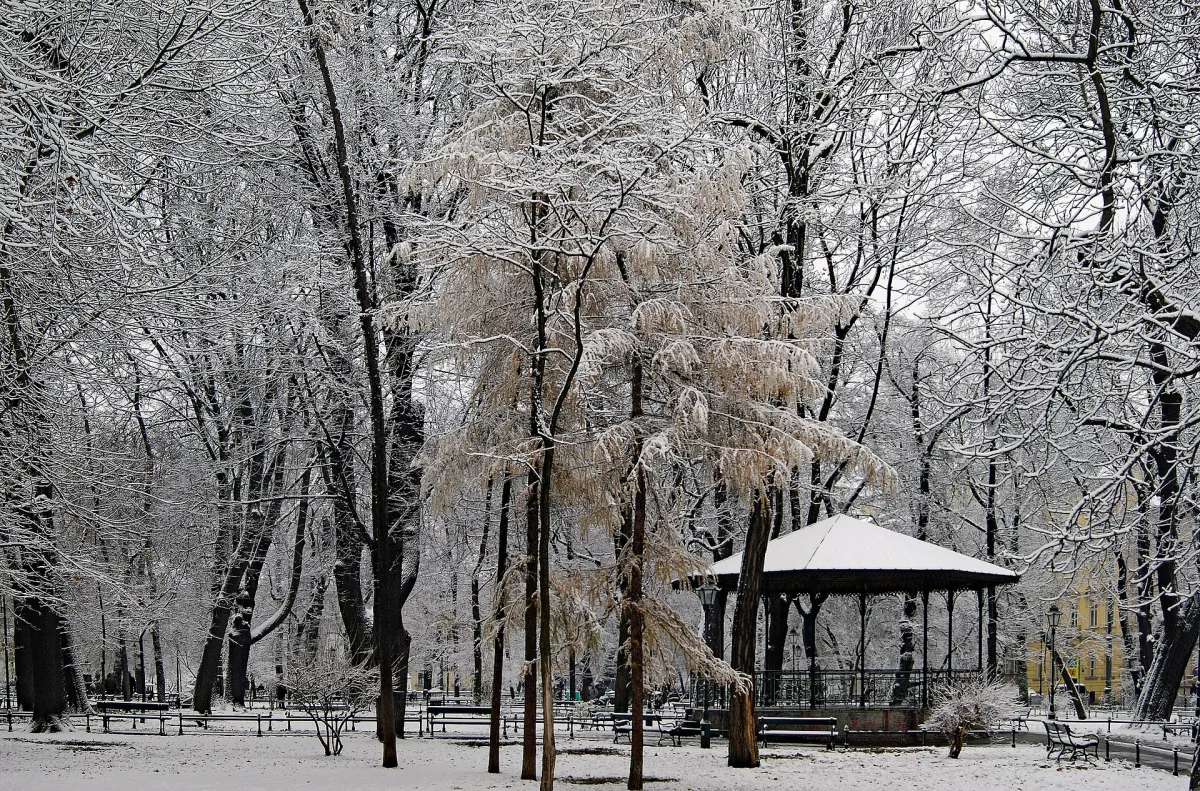
A historic park of 21 ha and about 4 km in length, laid out in 1822-1830 on the site of the defensive walls and moat around the Old Town.
Planty Park in Kraków is a historic city park that surrounds the Old Town in a ring about four kilometres long. It was created on the site of the demolished defensive walls and the filled-in moat, covers 21 hectares and lets you walk around the centre without stepping onto the roadway.
The city's defensive walls were demolished at the beginning of the 19th century. The moat and the earth ramparts in front were neglected and served as a rubbish dump. The park was laid out in 1822 to 1830. The work was initiated by Feliks Radwański, who prepared the surveys and plans. After his death in 1826 the work was taken over by Florian Straszewski, and in 1830 he established a foundation for the maintenance of the grounds.
The ground was levelled and the moat filled with imported soil. Horse chestnuts, maples, lindens, ashes, poplars and exotic trees were planted, and lawns and flower beds were laid out. Since 13 May 1976 Planty has been entered in the heritage register under number A-576.
The park is divided into eight parts called gardens: Wawel, University, Palace of Art, Florianka, Barbican, Railway Station, Gródek and Stradom. Each has its own character, and on a walk you pass the monuments of Copernicus, Chopin and other figures from Polish history. Stone walls and markings show the former course of the walls and the places of the towers.
The name comes from "splantowanie", that is, levelling the rubble of the former fortifications. The heritage register dates the urban layout to 1821-1826. The decision on revitalisation to a design by Prof. Janusz Bogdanowski was taken in 1989: the historic small architecture was restored and the course of the former walls and towers was marked. The documentation of the monument lists, among others, the sites of the coopers', ring-makers' and saddlers' towers.
In Planty stand the monuments of Chopin, Copernicus, Grottger, Rejtan, Jadwiga and Jagiełło, and Grażyna and Litawor, as well as the Owl sculptures by Bronisław Chromy. As part of the City Codes project more than a hundred benches have plaques with literary patrons and QR codes.
Within Planty the Barbican has survived, a former defensive fortress. In its neighbourhood stands St Florian's Gate. Right by the park, about 100 m from its paths, is also the Czartoryski Museum.

Be the first! Add a comment.
You need to log in to add a comment.
Log in