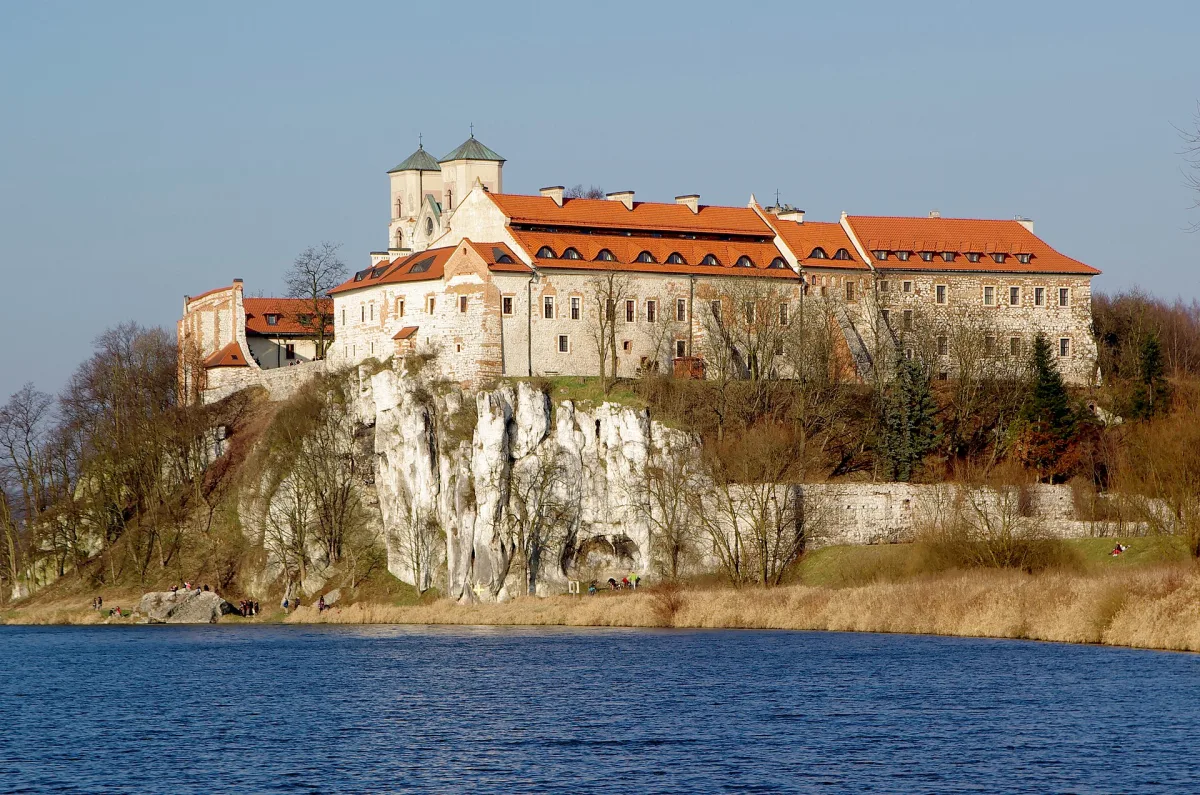
The oldest surviving monastery in Poland, a Benedictine abbey with the Church of St Peter and St Paul, a Historic Monument since 2017.
The Benedictine Abbey in Tyniec stands in the south-western part of Kraków, in the Dębniki district, and is the oldest surviving monastery in Poland. The complex consists of the Church of St Peter and St Paul and the monastery buildings, and since 2017 it has been a Historic Monument. Monks live here to this day.
The abbey was most probably founded by Casimir I the Restorer in 1044, after the stabilisation of the state. The first abbot was Aaron of Cologne. The heritage register dates the complex to the second half of the 11th century, and the monastery has been entered in the register since 1930.
The history of the abbey was not peaceful. In 1259 the complex was destroyed by a Tatar raid. In the 16th century the castle on the hill was adapted as the abbot's residence. The Austrians dissolved the monastery in 1816, and the monks returned to Tyniec after 123 years, on 30 July 1939. From 1947 they rebuilt the destroyed buildings, and in 1968 the abbey was formally restored.
In the 11th century a Romanesque three-aisled basilica stood here. In the first half of the 13th century the monastery was surrounded with stone walls, and in the second half of that century a ducal castle on a triangular plan was built on the hill. In 1306 the abbey was besieged and burned by Gerlach de Culpen. At the beginning of the 14th century a chapter house with a cross vault was built, and in 1463, under Abbot Maciej of Skawina, the Gothic buildings were consecrated. The Gothic cloisters date from the 15th century, and the defensive walls with towers and bastions from the 18th century.
In 1771-1772 the abbey was destroyed by the Bar Confederates. After the dissolution in 1816 the church became in 1821 the seat of the Tyniec bishopric with Bishop Grzegorz Tomasz Ziegler, and in 1826 the diocese was moved to Tarnów. In 1831 the church was consumed by a fire caused by a lightning strike. In 2008 the so-called Great Ruin was rebuilt and the Foundation Chronić Dobro (Protect the Good) was created, under which the museum operates. The abbey received the status of Historic Monument in March 2017.
The church has three aisles and combines two eras: a Gothic chancel with a Baroque nave. The Gothic church was rebuilt in the Baroque style in 1618-1622, and the new church was consecrated on 8 May 1622.
In the interior the Rococo high altar by Franciszek Placidi and the late Baroque pulpit stand out. The monastery complex includes Gothic cloisters, a 14th-century chapter house, the medieval Abbot's House (Opatówka) and a historic well from 1620.
The high altar is Rococo, of black marble, and came from the hand of Franciszek Placidi. The pulpit is Baroque, and its author is most probably Franciszek Józef Mangoldt. In the chancel stand choir stalls from the 17th century.
Next to the monastery operates the Benedictine Publishing House Tyniec, founded on 8 May 1991. On the grounds of the complex there is also the Benedictine Museum in Tyniec, which tells of the history of the abbey and the life of the monks. The abbey was visited on 19 August 2002 by Pope John Paul II.
In the Middle Ages the Tyniec monastery was very rich: in the 15th century it owned a hundred villages and five towns. This wealth explains why the complex was extended on such a large scale.
The abbey lies on the Vistula, on the edge of the city, so a trip can be combined with other places on the western side of Kraków. In a straight line less than five kilometres separate it from the Wolski Forest, and about 5.4 km from the Kraków Zoo.


Be the first! Add a comment.
You need to log in to add a comment.
Log in